
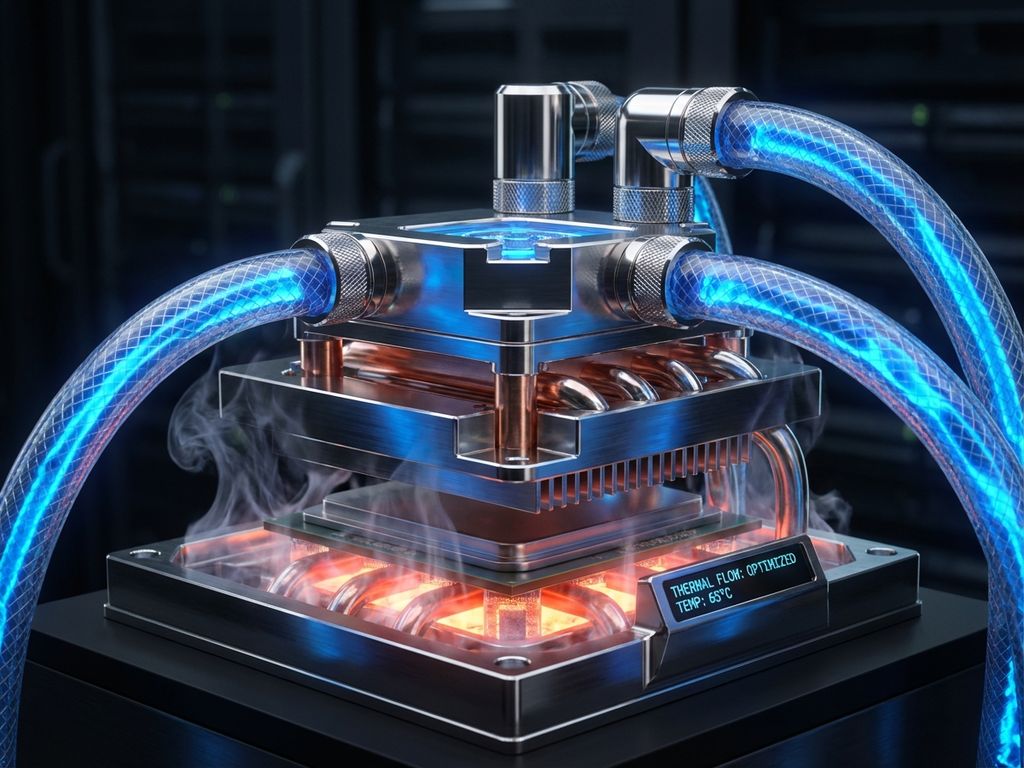
Liquid cooling becomes essential when your application generates significant heat that air cooling cannot handle efficiently. This advanced thermal management approach uses coolant fluids to transfer heat away from components, offering superior temperature control compared with traditional air-based systems. Consider liquid cooling when dealing with high power densities, space constraints, or when precise temperature management is critical for optimal performance.
What is liquid cooling and how does it differ from air cooling?
Liquid cooling systems use coolant fluids to absorb and transfer heat away from components, while air cooling relies on fans and heat sinks to dissipate thermal energy through air circulation. The fundamental difference lies in thermal conductivity: liquids can absorb and move heat much more effectively than air.
A typical liquid cooling system includes several key components: a pump to circulate coolant, radiators to release heat, reservoirs to store fluid, and connecting tubes or pipes. The coolant absorbs heat from hot surfaces and carries it to radiators, where fans help dissipate the thermal energy into the surrounding air.
Air cooling systems are simpler, using heat sinks with metal fins and fans to create airflow across heated surfaces. However, air has lower thermal conductivity than most coolant fluids, making it less efficient at removing heat from high-temperature components. This limitation becomes particularly apparent in applications requiring precise temperature management or dealing with concentrated heat sources.
When does your application actually need liquid cooling over air cooling?
Your application requires liquid cooling when heat generation exceeds what air cooling can manage effectively, typically above 100–150 watts per square inch of surface area. High power density applications, space-constrained environments, and systems requiring precise thermal control benefit most from liquid cooling solutions.
Several operational conditions make liquid cooling necessary. Electronics operating in enclosed spaces without adequate ventilation struggle with air cooling alone. Industrial equipment running continuously at high power levels generates sustained heat that overwhelms traditional cooling methods. Applications requiring temperature stability within tight tolerances also demand the superior control that liquid systems provide.
Space constraints often drive cooling method selection. When you cannot install large heat sinks or multiple fans due to size limitations, liquid cooling offers compact solutions. The ability to move heat away from the source to remote radiators makes liquid systems ideal for cramped installations where air circulation is restricted.
What are the main benefits of implementing liquid cooling systems?
Liquid cooling systems deliver superior thermal efficiency, operating at significantly lower noise levels while optimising space usage compared with air cooling alternatives. These systems provide consistent performance even under heavy thermal loads, making them ideal for demanding industrial applications and temperature-sensitive equipment.
The primary advantages include enhanced heat dissipation capabilities that keep components within optimal operating temperatures. This improved thermal control extends equipment lifespan and maintains performance consistency. Unlike air cooling systems that can become quite loud under load, liquid cooling operates much more quietly since pumps generate less noise than high-speed fans.
Energy efficiency represents another significant benefit. Liquid cooling systems often consume less power than equivalent air cooling setups because pumps typically use less energy than multiple high-performance fans. The superior heat transfer properties of coolants mean systems can maintain lower temperatures with less energy input, contributing to overall operational cost savings.
How do you determine if liquid cooling is cost-effective for your project?
Evaluate liquid cooling cost-effectiveness by comparing total ownership costs, including initial investment, installation complexity, maintenance requirements, and long-term operational benefits. While upfront costs are typically higher, liquid cooling often provides better value through improved efficiency, reduced maintenance, and extended equipment life.
Initial investment considerations include equipment costs, installation labour, and any necessary infrastructure modifications. Liquid cooling systems require pumps, radiators, coolant, and plumbing components that cost more than basic air cooling setups. However, you should also factor in the reduced need for multiple fans, large heat sinks, and frequent component replacements.
Long-term value analysis should include energy savings from improved efficiency, reduced downtime from better thermal management, and lower replacement costs due to extended component life. Calculate potential savings from quieter operation, especially in environments where noise reduction has economic value. Consider the scalability benefits: liquid cooling systems often handle increased thermal loads better than air cooling alternatives.
What challenges should you expect when switching to liquid cooling?
Switching to liquid cooling introduces complexity through additional components, potential leak risks, and more demanding maintenance requirements compared with air cooling systems. However, proper planning, quality components, and regular maintenance protocols can effectively mitigate these challenges while delivering superior thermal management performance.
System complexity increases significantly with liquid cooling implementations. You need pumps, reservoirs, radiators, and interconnecting plumbing that require careful design and installation. This complexity demands more technical expertise during setup and troubleshooting than straightforward air cooling systems.
Leak prevention becomes a critical concern with any liquid cooling system. While modern components are highly reliable, the potential for coolant leaks requires careful attention to fittings, regular inspections, and quality component selection. Implementing leak detection systems and using appropriate coolants helps minimise risks to sensitive equipment.
Maintenance requirements include regular coolant level checks, pump performance monitoring, and periodic system cleaning. Unlike air cooling systems that mainly need occasional fan cleaning, liquid cooling demands more comprehensive maintenance schedules to ensure optimal performance and prevent component failures.
How BTT solutions help with liquid cooling thermal management
We specialise in developing precision thermal management components that optimise liquid cooling system performance across automotive, industrial, and residential applications. Our expertise in thermostat technology and temperature control solutions ensures your liquid cooling systems operate at peak efficiency with reliable, long-term performance.
Our comprehensive liquid cooling support includes:
- Custom thermostat components designed for precise temperature regulation in liquid cooling circuits
- Advanced temperature sensors that provide accurate monitoring and control feedback
- Thermal management control units that optimise coolant flow based on real-time conditions
- End-to-end system design consultation to maximise cooling efficiency and reliability
- Global technical support with eight locations worldwide for local expertise and service
Our proven track record in automotive thermal management translates directly to industrial and commercial liquid cooling applications. We understand the critical importance of reliable temperature control and provide components that deliver consistent performance even in demanding environments. Our company has decades of experience in thermal management solutions across multiple industries.
Ready to optimise your liquid cooling thermal management system? Contact our technical team today to discuss your specific requirements and discover how our precision components can enhance your cooling solution’s performance and reliability.
Related Articles
- How does a thermostat housing work in an engine cooling system?
- Can switching to synthetic oil genuinely improve engine efficiency?
- Can thermostat test results vary between laboratories?
- What is the business impact of failing to meet emission targets for OEMs?
- 5 Ways Map-Controlled Thermostats Improve Fuel Efficiency and Reduce Emissions


