
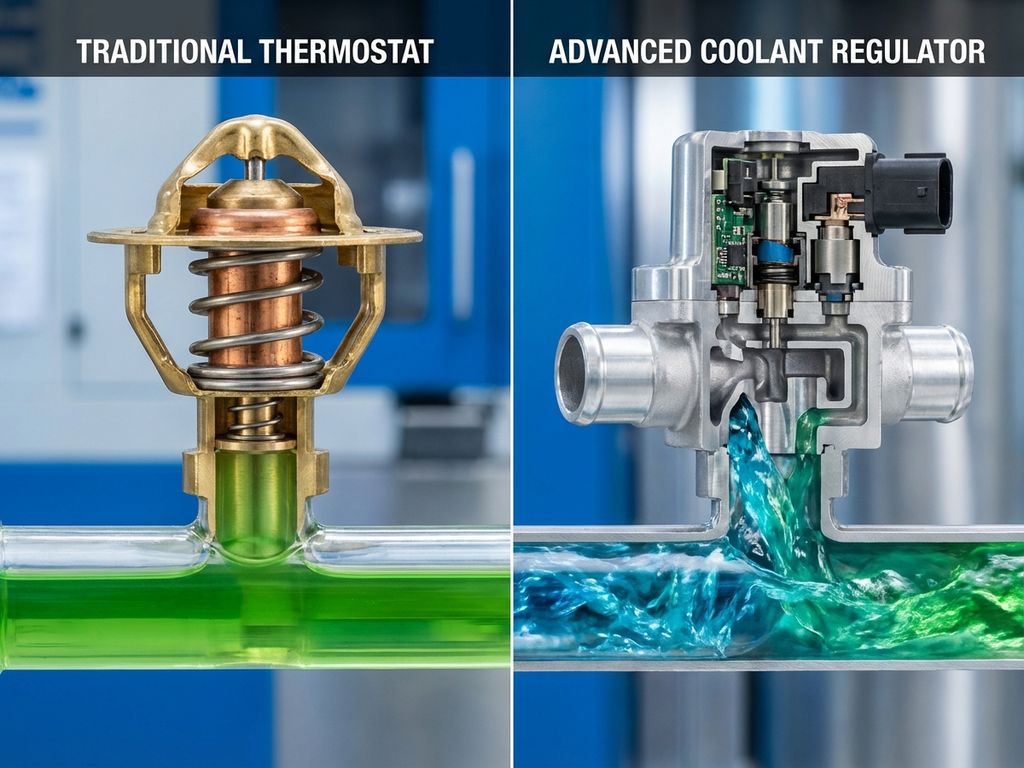
Coolant regulators and standard thermostats both manage engine temperature, but they differ significantly in precision and control mechanisms. Coolant regulators offer advanced electronic control with precise temperature management, while standard thermostats use simple wax-pellet operation. Understanding these differences helps you choose the right thermal management solution for specific automotive applications and performance requirements.
What exactly is a coolant regulator and how does it work?
A coolant regulator is an electronically controlled thermal management device that precisely manages coolant flow through multiple temperature zones in modern engines. Unlike basic thermostats, these systems use electronic sensors and actuators to provide variable coolant flow control based on real-time engine conditions.
The core functionality centers on electronic temperature sensors that continuously monitor engine conditions. These sensors send data to the engine control unit, which then adjusts the regulator’s valve position accordingly. The system can maintain different temperature zones within the engine, optimizing performance for various operating conditions.
Key components include electronic actuators, multiple temperature sensors, and sophisticated control algorithms. The electronic actuator replaces the traditional wax pellet, allowing for precise valve positioning rather than simple open-or-closed operation. This enables gradual coolant flow adjustment based on engine load, ambient temperature, and performance requirements.
Advanced coolant regulators can also integrate with other vehicle systems, such as cabin heating and emission control. This integration allows for comprehensive thermal management that optimizes fuel efficiency while maintaining optimal engine performance across all operating conditions.
How do standard thermostats control engine temperature?
Standard thermostats use a wax-pellet mechanism that expands and contracts with temperature changes to open and close a valve. When the engine reaches a predetermined temperature (typically 82–95°C), the wax pellet expands, pushing a piston that opens the valve to allow coolant circulation through the radiator.
The wax-pellet design provides reliable mechanical operation without requiring electrical power or electronic controls. As engine temperature rises, the wax material inside the sealed pellet expands, creating pressure that moves the valve mechanism. When temperatures drop, the wax contracts, allowing a spring to close the valve and restrict coolant flow.
This binary operation means the thermostat is either fully open or fully closed, with limited ability to provide graduated flow control. The opening temperature is fixed during manufacturing and cannot be adjusted for different operating conditions or performance requirements.
Traditional thermostats excel in their simplicity and reliability. They require no external power source and have proven effective for decades in basic engine cooling applications. However, their fixed opening temperature and binary operation limit their effectiveness in modern engines that require precise thermal management for optimal efficiency and emissions control.
What’s the main difference between coolant regulators and standard thermostats?
The primary difference lies in control precision and adaptability. Coolant regulators provide variable, electronically controlled coolant flow that adapts to real-time conditions, while standard thermostats offer fixed-temperature, binary operation that simply opens or closes at predetermined temperatures.
Response times differ significantly between the systems. Electronic coolant regulators can adjust valve position within seconds of receiving sensor data, while traditional thermostats rely on thermal mass changes that take longer to respond to temperature variations.
Control mechanisms represent another major distinction. Coolant regulators use electronic sensors and actuators that can maintain multiple temperature zones and integrate with engine management systems. Standard thermostats operate mechanically through wax expansion, providing no communication with other vehicle systems.
Precision levels vary considerably between the technologies. Coolant regulators can maintain temperature within 1–2 degrees of target values, while standard thermostats typically have temperature variations of 5–10 degrees due to their mechanical operation and thermal lag.
The technological advancement gap affects overall system capability. Modern coolant regulators support features like warm-up acceleration, zone-specific temperature control, and integration with hybrid powertrains—capabilities that traditional thermostats cannot provide.
Why do modern vehicles need more precise coolant regulation?
Modern vehicles require precise coolant regulation to meet stringent emission standards, achieve optimal fuel efficiency, and support advanced powertrain technologies. Today’s engines operate with tighter tolerances and more sophisticated systems that demand accurate temperature control for proper function.
Emission standards drive much of this requirement. Euro 6 and similar regulations mandate extremely low pollutant levels that require precise engine operating temperatures. Optimal combustion occurs within narrow temperature ranges, and maintaining these conditions reduces harmful emissions while ensuring compliance with environmental regulations.
Fuel efficiency demands also necessitate advanced thermal management. Modern engines use techniques like delayed warm-up and zone-specific cooling to reduce fuel consumption. These strategies require precise temperature control that traditional thermostats cannot provide effectively.
Advanced powertrain technologies, including turbocharging, direct injection, and hybrid systems, generate complex thermal management requirements. Turbocharged engines need different cooling strategies for various components, while hybrid systems must manage battery thermal conditions alongside engine cooling.
Performance expectations have evolved significantly. Drivers expect consistent performance regardless of operating conditions, rapid cabin heating, and optimal fuel economy. Meeting these expectations requires sophisticated thermal management that adapts to driving conditions, ambient temperature, and system demands in real time.
When should you choose a coolant regulator over a standard thermostat?
Choose coolant regulators for high-performance applications, modern engines with strict emission requirements, or systems requiring precise temperature control. Standard thermostats remain suitable for basic applications where simplicity, cost-effectiveness, and proven reliability take priority over advanced features.
Performance requirements often determine the choice. Applications demanding rapid warm-up, precise temperature maintenance, or integration with advanced engine management systems benefit from coolant regulator technology. Racing applications, luxury vehicles, and commercial vehicles with demanding duty cycles typically require this precision.
Cost considerations affect decision-making significantly. Standard thermostats cost considerably less initially and require minimal maintenance. However, coolant regulators may provide long-term savings through improved fuel efficiency and reduced emissions, particularly in high-mileage applications.
Specific scenarios favor each technology. Fleet vehicles benefit from coolant regulators due to fuel savings and emission compliance. Classic car restorations often use standard thermostats to maintain authenticity and simplicity. Agricultural and marine applications may prefer traditional thermostats for their mechanical reliability in harsh environments.
System complexity tolerance also influences choice. Coolant regulators require electronic diagnostics and specialized service knowledge, while standard thermostats can be serviced with basic mechanical skills. Consider your maintenance capabilities and service infrastructure when making this decision.
How BTT Solutions advances coolant regulation technology
We specialize in developing precision thermal management solutions that bridge the gap between traditional thermostats and advanced coolant regulation systems. Our engineering expertise at BTT Solutions focuses on creating reliable, high-performance components that meet the demanding requirements of modern automotive and industrial applications.
Our comprehensive approach to coolant regulation includes:
- Precision engineering of electronic and mechanical thermal management components
- Custom solutions for automotive, industrial, and marine applications
- Integration support for existing engine management systems
- Advanced testing and validation services for thermal management performance
- Technical consultation for optimizing coolant flow control in complex systems
We provide end-to-end thermal management solutions from initial design consultation through manufacturing and ongoing technical support. Our global presence ensures reliable supply and local service support for automotive manufacturers and industrial clients worldwide. Explore our comprehensive range of thermal management products designed for various applications and performance requirements.
Contact us today to discuss how our advanced thermal management technologies can improve your application’s performance, efficiency, and regulatory compliance. Our engineering team is ready to develop customized solutions that meet your specific coolant regulation requirements.
Related Articles
- How do thermal conductivity properties influence thermostat component design?
- How does thermal stress reduction extend engine lifespan?
- Which thermostat is mostly used in modern automobiles?
- What certifications should an automotive thermostat manufacturer have?
- Why do thermostats use wax instead of electronics?


