
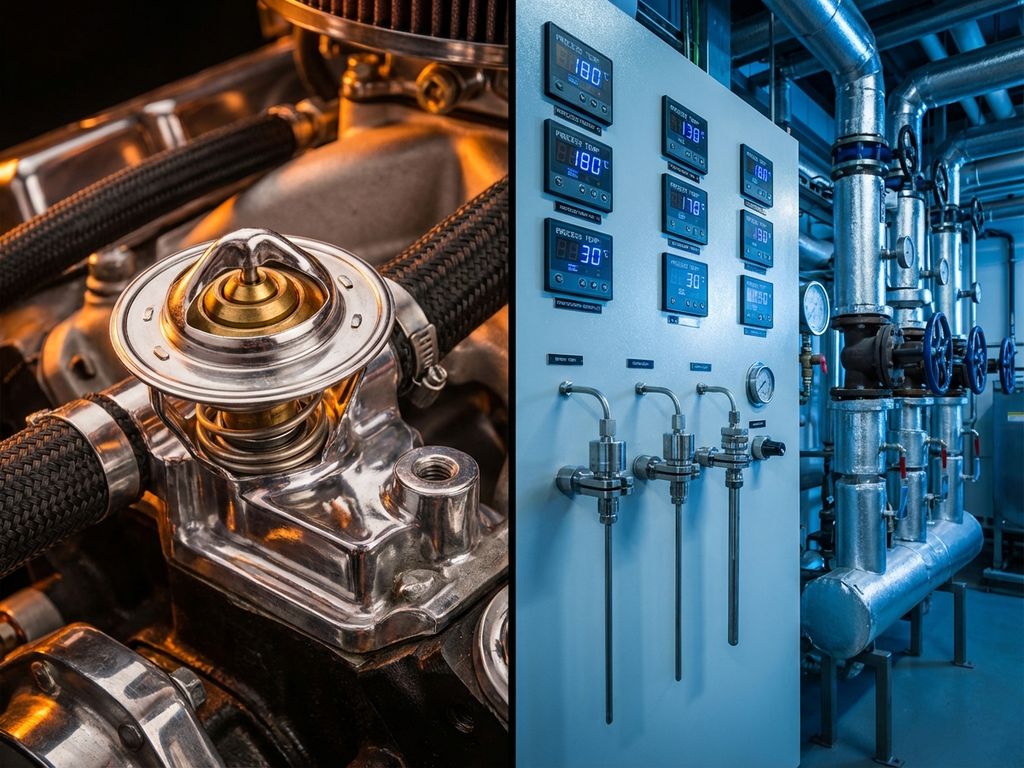
Automotive thermostats and industrial temperature control systems serve different purposes despite sharing core temperature regulation principles. Automotive thermostats prioritise compact design and rapid response for engine cooling, while industrial systems focus on precise control across broader temperature ranges. Both systems require different materials, response times, and durability standards to meet their respective operational demands and regulatory requirements.
What are the fundamental differences between automotive and industrial thermostats?
Automotive thermostats operate as compact, fast-responding devices designed specifically for vehicle engine cooling systems, while industrial temperature control systems are engineered for precise regulation across diverse manufacturing and building applications. The core difference lies in their operational scope and environmental demands.
Automotive thermostats must function within extremely limited space constraints, typically measuring just a few centimetres in diameter. They are designed to open and close rapidly, usually within seconds, to maintain optimal engine temperatures between 80–100°C. These devices face constant vibration, temperature cycling, and exposure to coolant chemicals.
Industrial temperature control systems, by contrast, can accommodate larger components and focus on maintaining precise temperatures across much broader ranges, often from -40°C to 200°C or higher. They are built for continuous operation with minimal maintenance requirements, sometimes running for years without intervention.
The response time requirements also differ significantly. Automotive systems need immediate reactions to prevent engine damage, while industrial applications often prioritise gradual, controlled temperature changes to maintain process stability and energy efficiency.
How do operating environments affect thermostat performance in cars versus industrial settings?
Operating environments create vastly different challenges for automotive versus industrial thermostats, directly influencing their design, materials, and performance characteristics. Automotive environments are harsh and dynamic, while industrial settings vary widely but often allow for more controlled conditions.
Vehicle environments subject thermostats to extreme conditions, including constant vibration from engine operation, rapid temperature fluctuations during start-up and shut-down cycles, and exposure to various coolant additives and potential contaminants. The space limitations mean every component must be precisely engineered for reliability within tight tolerances.
Industrial environments present different challenges depending on the application. Manufacturing facilities might expose components to chemical vapours, dust, or electromagnetic interference. Building systems face seasonal temperature variations but generally operate in more stable conditions than automotive applications.
Material selection reflects these environmental differences. Automotive thermostats require materials that withstand rapid thermal cycling and chemical exposure while maintaining dimensional stability. Industrial systems can utilise different materials optimised for their specific environmental conditions, whether that is corrosion resistance in chemical processing or high-temperature stability in manufacturing applications.
What are the key performance requirements for automotive versus industrial temperature control?
Performance requirements differ substantially between automotive and industrial applications, with automotive systems prioritising rapid response and fuel efficiency, while industrial systems emphasise precise control and process optimisation. Each sector has distinct regulatory standards and durability expectations.
Automotive temperature control must meet stringent emissions regulations and fuel efficiency standards. Modern vehicles require precise thermal management to optimise combustion efficiency, reduce emissions, and improve fuel economy. Response times must be measured in seconds, and failure rates must be extremely low given the consequences of engine overheating.
Industrial applications typically require higher precision levels, often maintaining temperatures within ±1°C or tighter tolerances. However, response times can be longer, measured in minutes rather than seconds, as gradual temperature changes often benefit process stability and energy consumption.
Durability expectations also vary significantly. Automotive components must withstand approximately 500,000 thermal cycles over a vehicle’s lifetime, while industrial systems might operate continuously for decades with different stress patterns. Regulatory standards for automotive applications focus on safety and emissions, while industrial standards often emphasise energy efficiency and process reliability.
Which industries benefit most from specialised temperature control systems?
Automotive and industrial sectors each benefit from temperature control systems tailored to their unique operational requirements, with automotive applications focusing on engine efficiency and industrial uses spanning manufacturing processes, HVAC systems, and building management applications.
Automotive applications include engine cooling systems, transmission temperature management, and cabin climate control. Each requires different response characteristics and temperature ranges. Engine cooling demands rapid response to prevent damage, while transmission systems need consistent temperature maintenance for optimal fluid performance.
Industrial applications span numerous sectors:
- Manufacturing processes requiring precise temperature control for quality assurance
- HVAC systems in commercial buildings demanding energy-efficient operation
- Food processing industries needing accurate temperature maintenance for safety
- Chemical processing requiring stable thermal conditions
- Building heating systems, including underfloor heating and radiator controls
Each industry’s requirements shape thermostat design differently. Manufacturing might prioritise precision and repeatability, while building systems focus on energy efficiency and user comfort. The automotive sector continues to drive innovation in compact, responsive thermal management solutions.
How BTT Solutions helps with automotive and industrial temperature control solutions
We provide comprehensive thermal management solutions for both automotive and industrial sectors through our extensive product portfolio and global manufacturing capabilities. Our expertise spans from high-precision automotive thermostats to sophisticated industrial temperature control systems.
Our automotive solutions include:
- High-precision thermostats optimised for fuel efficiency and emissions reduction
- Temperature sensors for engine and transmission applications
- Custom thermal management components for electric and hybrid vehicles
For industrial applications, we offer:
- Building heating system components, including radiator and underfloor heating controls
- Industrial process temperature control solutions
- Marine and shipping thermal management systems
- HVAC components for commercial and residential applications
With manufacturing facilities across eight global locations and 600 dedicated employees, we deliver reliable, high-quality thermal management solutions tailored to your specific requirements. Contact our technical team today to discuss how our thermal management expertise can optimise your automotive or industrial applications.
Related Articles
- What is the difference between a wax pellet thermostat and a bimetallic thermostat?
- Can a faulty thermostat mechanism increase vehicle emissions?
- What is parasitic drag and how does it steal engine power?
- Can switching to synthetic oil genuinely improve engine efficiency?
- How does engine temperature affect emission levels?


