
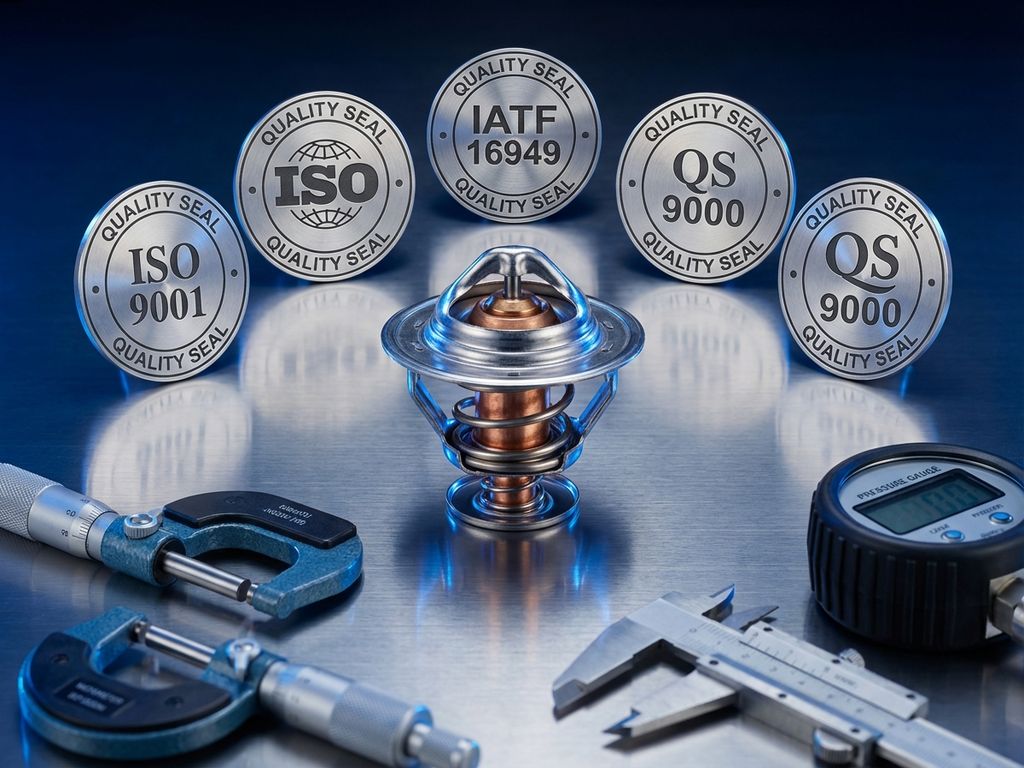
Choosing the right automotive thermostat manufacturer can make or break your vehicle’s performance and reliability. With the automotive industry’s stringent requirements for quality, safety, and environmental compliance, not all manufacturers are created equal. The key differentiator? Thermostat certifications.
When evaluating potential suppliers, the certifications they hold tell a story about their commitment to excellence, their ability to meet automotive quality standards, and their readiness to serve global markets. These credentials aren’t just paperwork—they represent rigorous testing, continuous improvement processes, and adherence to international best practices that directly impact the quality of thermostats reaching your production line.
Why certifications matter in automotive thermostat manufacturing
Certifications serve as the backbone of trust between automotive thermostat manufacturers and their clients. They provide tangible proof that a manufacturer has invested in the proper systems, processes, and quality control measures necessary for producing reliable automotive components.
For automotive suppliers, these credentials open doors to global markets and demonstrate compliance with international automotive standards. They protect both manufacturers and end consumers by ensuring products meet safety requirements and performance specifications. Without proper certifications, manufacturers risk product recalls, safety issues, and exclusion from major automotive supply chains.
The certification process involves rigorous audits, documentation reviews, and ongoing monitoring that pushes manufacturers toward continuous improvement. This results in better products, more efficient processes, and ultimately, thermostats that perform reliably in demanding automotive environments.
1: ISO/TS 16949 automotive quality management certification
ISO/TS 16949 represents the gold standard for automotive quality management systems. This certification specifically targets automotive suppliers and establishes comprehensive requirements for quality management that go beyond general manufacturing standards.
The standard emphasizes defect prevention, variation reduction, and waste minimization throughout the manufacturing process. For thermostat manufacturing, this translates to consistent product quality, reliable performance characteristics, and reduced warranty claims. Manufacturers with this certification have demonstrated their ability to implement robust quality management systems that meet the demanding requirements of automotive OEMs.
What sets this certification apart is its focus on customer satisfaction and continuous improvement. Certified manufacturers must demonstrate ongoing efforts to enhance their processes, reduce defects, and respond effectively to customer feedback. This creates a culture of excellence that benefits every thermostat that leaves their facility.
2: ISO 9001 quality management system standard
ISO 9001 serves as the foundation for quality management across all industries, including automotive thermostat manufacturing. This internationally recognized standard provides a framework for consistent quality delivery and customer satisfaction.
The certification requires manufacturers to establish documented procedures for every aspect of their operation, from incoming material inspection to final product testing. For thermostat production, this means rigorous process control, traceability throughout the manufacturing cycle, and systematic approaches to quality assurance.
Manufacturers holding ISO 9001 certification have proven their ability to deliver products that consistently meet customer requirements while continuously improving their operations. This systematic approach to quality management ensures that each thermostat meets the same high standards, regardless of production volume or timing.
3: What makes ISO 14001 environmental certification essential?
Environmental responsibility has become a critical factor in automotive supply chain decisions. ISO 14001 certification demonstrates a manufacturer’s commitment to environmental management and sustainable manufacturing practices.
This standard requires manufacturers to identify and control the environmental impact of their operations, implement waste reduction strategies, and comply with relevant environmental regulations. For thermostat manufacturing, this includes managing chemical processes, reducing energy consumption, and minimizing waste generation.
Beyond regulatory compliance, ISO 14001 certification signals to automotive OEMs that a manufacturer is prepared for the industry’s increasing focus on sustainability. This certification often becomes a prerequisite for supply chain participation as automotive companies work toward their own environmental goals.
4: OHSAS 18001 occupational health and safety standards
Worker safety in manufacturing environments directly impacts product quality and operational reliability. OHSAS 18001 certification demonstrates a manufacturer’s commitment to maintaining safe working conditions and protecting employee well-being.
The standard requires systematic identification of workplace hazards, implementation of risk control measures, and ongoing monitoring of safety performance. In thermostat manufacturing facilities, this includes proper handling of materials, safe operation of machinery, and protection from chemical exposure.
Manufacturers with OHSAS 18001 certification typically experience lower accident rates, reduced downtime, and improved employee morale. These factors contribute to more consistent production schedules and higher-quality outputs, making certified manufacturers more reliable supply chain partners.
5: IATF 16949 automotive sector-specific requirements
IATF 16949 represents the evolution of automotive quality standards, replacing the earlier ISO/TS 16949 with enhanced requirements specifically designed for today’s automotive industry challenges.
This certification incorporates additional requirements for defect prevention, supply chain management, and customer-specific needs. For thermostat manufacturers, IATF 16949 certification demonstrates readiness to meet the complex demands of modern automotive production, including just-in-time delivery, zero-defect expectations, and rapid response to design changes.
The standard places particular emphasis on risk management and contingency planning, ensuring that certified manufacturers can maintain supply continuity even during challenging circumstances. This resilience has become increasingly important as automotive supply chains face growing complexity and uncertainty.
How BTT Solutions ensures certified excellence in thermomanagement
BTT Solutions maintains a comprehensive approach to certification and quality management that encompasses all critical automotive standards. Our commitment to certified manufacturing excellence ensures reliable thermostat solutions across automotive, industrial, and household applications.
We provide certified thermomanagement solutions through:
- Multiple certification maintenance, including ISO 9001, IATF 16949, and environmental standards
- Rigorous quality control processes that exceed automotive compliance requirements
- Continuous improvement programs that enhance product reliability and performance
- Supply chain transparency and traceability for complete automotive compliance
- Customer-specific certification support and documentation
Ready to partner with a certified thermomanagement specialist? Contact BTT Solutions today to discuss how our certified manufacturing capabilities can support your automotive thermostat requirements with proven quality and reliability.


