
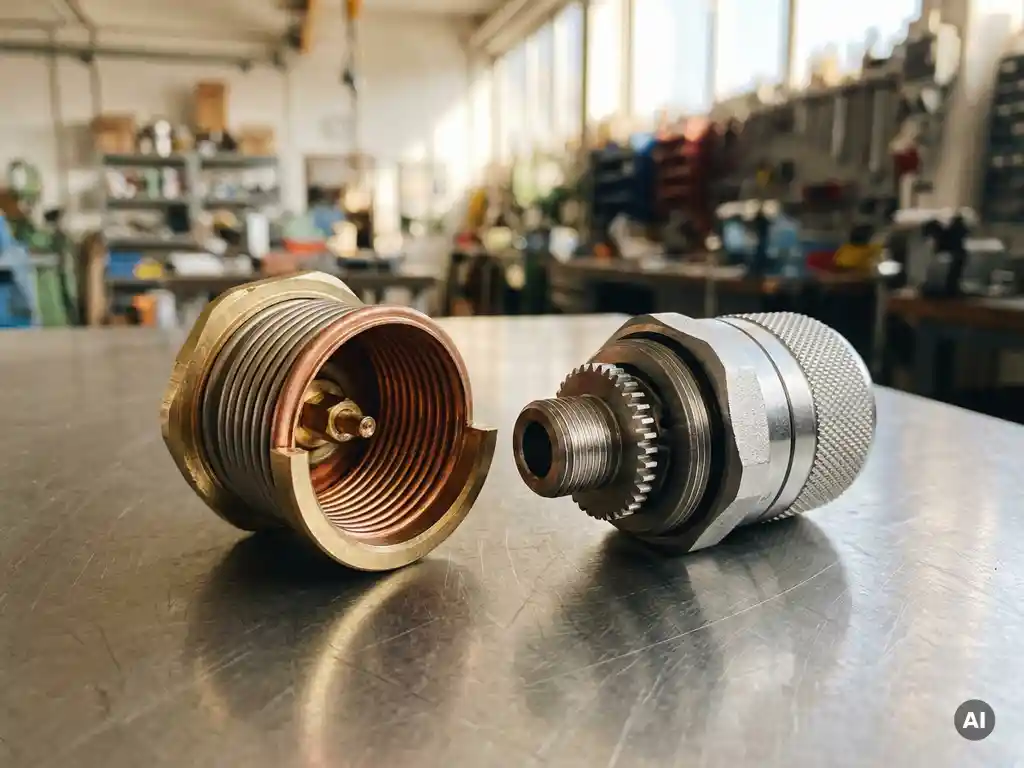
A thermostat valve and a thermostat bellows are two different mechanisms used to control fluid flow based on temperature, but they work in fundamentally different ways. A thermostat valve refers to the complete assembly that opens and closes a fluid passage, while a thermostat bellows is a specific type of actuator that uses an expandable, corrugated chamber filled with a temperature-sensitive fluid to trigger that movement. Understanding the distinction matters most when selecting the right component for a specific temperature range, fluid type, or application environment. Below, we walk through how each mechanism works, where they are used, and how to choose between them.
How does a thermostat valve actually work?
A thermostat valve is a flow-control device that opens or closes a fluid passage in direct response to temperature changes. It uses a thermally sensitive element, most commonly a wax element or bellows, to generate mechanical movement. When the fluid temperature reaches a set threshold, the actuating element expands and pushes the valve off its seat, allowing coolant or another fluid to flow through.
The valve itself consists of several core components: a valve seat, a valve disc or cone, a return spring, and the actuating element. The return spring holds the valve closed at low temperatures. As the temperature rises, the actuating element overcomes the spring force and lifts the disc, opening the flow path. When the temperature drops again, the element contracts and the spring pushes the disc back onto the seat, closing the circuit.
This kind of thermostat mechanism is widely used in engine cooling systems, industrial heat exchangers, and heating circuits because it requires no external power source. The response is entirely driven by the physics of thermal expansion, which makes it both reliable and self-regulating.
How does a thermostat bellows work?
A thermostat bellows works by using a sealed, accordion-shaped metal or elastomer chamber filled with a volatile liquid or gas. When the surrounding temperature rises, the fill medium expands, causing the bellows to extend lengthwise. This linear extension is what drives the mechanical movement needed to open or close a valve or switch.
The key characteristic of a bellows thermostat is its actuating element. Unlike wax-based thermostats, which rely on the phase change of a solid material, a bellows uses the volumetric expansion of a liquid or vapor inside a flexible, sealed container. This gives the bellows a smooth, proportional response across a temperature range rather than a sharp trigger point.
Bellows thermostats are particularly well suited to applications where precise, graduated control is more important than a hard on/off response. The corrugated structure of the bellows also provides mechanical flexibility, allowing the device to absorb small misalignments or vibrations without losing accuracy. This makes the thermostat bellows a preferred choice in laboratory instruments, HVAC systems, and certain industrial process controls.
What are the main differences between a thermostat valve and thermostat bellows?
The main difference between a thermostat valve and a thermostat bellows lies in their roles: a thermostat valve is the complete flow-control assembly, while a thermostat bellows is one type of actuating element that can be used inside that valve. In practice, however, the term “bellows thermostat” is commonly used to describe a complete thermostat unit where the bellows is the primary actuator, as opposed to a wax-element thermostat.
Here is a side-by-side comparison of the key differences:
- Actuating principle: Wax-element thermostat valves rely on the phase change of a wax compound, producing a strong, precise trigger force. Bellows thermostats use the volumetric expansion of a liquid or vapor, producing a smoother, more proportional response.
- Force output: Wax elements generate higher actuating forces, making them better suited to applications where the valve must overcome significant spring or pressure resistance. Bellows produce lower forces but with greater stroke consistency.
- Temperature range: Wax-element valves typically operate across a wider temperature range and tolerate higher peak temperatures. Bellows thermostats are often more accurate within a narrower band.
- Response character: Wax elements tend to have a sharper activation point. Bellows thermostats offer a more gradual, proportional opening that suits fine-tuned regulation.
- Durability: Wax elements are highly resistant to contamination and pressure spikes. Bellows can be vulnerable to fatigue or rupture under extreme cycling or overpressure conditions.
Where are thermostat valves and bellows thermostats used?
Thermostat valves are used wherever automatic fluid temperature control is needed without electronic intervention. The most common applications include automotive engine cooling systems, industrial oil temperature management, marine cooling circuits, and building heating systems such as radiators and underfloor heating.
Bellows thermostats, by contrast, are more commonly found in applications that require smooth, proportional control rather than a sharp switching action. These include HVAC equipment, refrigeration systems, laboratory instruments, and certain industrial process controls where temperature gradients must be managed carefully.
In the automotive world, wax-element thermostat valves dominate because they handle the high pressures, wide temperature swings, and contaminated fluids found in engine cooling circuits. In domestic heating and building technology, both types appear, though bellows thermostats have historically been common in older radiator valve designs. Modern thermostat valve designs for radiators and underfloor heating systems increasingly use wax elements for their reliability and long service life.
Which thermostat type performs better in high-temperature environments?
In high-temperature environments, wax-element thermostat valves generally outperform bellows thermostats. Wax elements are engineered to withstand the sustained heat, pressure, and thermal cycling found in automotive engines, industrial machinery, and marine propulsion systems, where operating temperatures regularly exceed 90°C and can spike well beyond that.
Bellows thermostats, while accurate and responsive, are more susceptible to fatigue at elevated temperatures. The repeated expansion and contraction of the metal or elastomer bellows under high heat can lead to material fatigue over time, potentially causing leaks or loss of calibration. For this reason, bellows designs are typically specified for moderate-temperature applications where long-term thermal stress is less of a concern.
That said, the specific fill medium inside a bellows thermostat plays a significant role. Some high-performance bellows units use specially formulated fluids that extend their effective temperature range. However, for sustained high-temperature duty cycles, the wax element remains the industry standard because of its proven robustness and high actuating force.
When should you choose a thermostat valve over a bellows thermostat?
You should choose a thermostat valve with a wax element over a bellows thermostat when your application involves high operating temperatures, significant pressure differentials, contaminated fluids, or demanding duty cycles. Wax-element thermostat valves are the right choice for most automotive, industrial, and marine applications for these reasons.
Consider a wax-element thermostat valve when:
- Operating temperatures regularly exceed 80°C
- The valve must overcome high spring or system pressure to open
- The fluid may contain contaminants, additives, or particulates
- Long service life with minimal maintenance is a priority
- The application involves frequent thermal cycling, such as engine warm-up and cool-down cycles
A bellows thermostat is the better choice when the application demands smooth, proportional flow control across a moderate temperature range and where the fluid is clean and system pressures are low. Domestic radiator controls, HVAC bypass valves, and certain laboratory instruments are good fits for the bellows approach.
If you are unsure which type suits your specific conditions, the actuating force required and the peak operating temperature are usually the two most decisive factors. High force and high temperature point toward a wax-element thermostat valve almost every time.
How BTT Solutions can support your thermostat selection
Choosing between a thermostat valve and a thermostat bellows is rarely straightforward, especially when you are engineering for demanding environments like automotive powertrains, industrial cooling circuits, or building heating systems. That is exactly where we come in.
At BTT Solutions, we design and manufacture high-precision thermostat components and thermal management systems for automotive, industrial, and building technology applications. Here is what we bring to the table:
- Precision-engineered wax elements: Our wax-element thermostat valves are built to handle high temperatures, pressure spikes, and long duty cycles, making them a reliable choice for automotive and industrial applications.
- Custom temperature calibration: We develop thermostat components to specific activation temperatures, ensuring your system responds exactly when it should.
- End-to-end solutions: From individual thermostat valves and temperature sensors to complete thermal management assemblies, we cover the full component chain.
- Flexible, responsive partnership: As a mid-sized specialist, we offer the kind of direct technical collaboration and fast response times that larger suppliers often cannot match.
- Cross-industry expertise: Whether you are working in automotive cooling, marine systems, underfloor heating, or industrial process control, our engineering team understands the specific demands of your environment.
If you are working on a project that requires precise thermal control and want to talk through which thermostat mechanism fits your application, we would love to hear from you. Get in touch with our team and let us help you find the right solution.
Related Articles
- How do miniaturized thermostat components differ from standard ones?
- Should you trust manufacturer engine efficiency ratings in real-world conditions?
- What causes industrial engines to fail prematurely
- Top 5 Certifications to Look for in an Automotive Thermostat Manufacturer
- How do oil temperature regulators work in hydraulic systems?


