
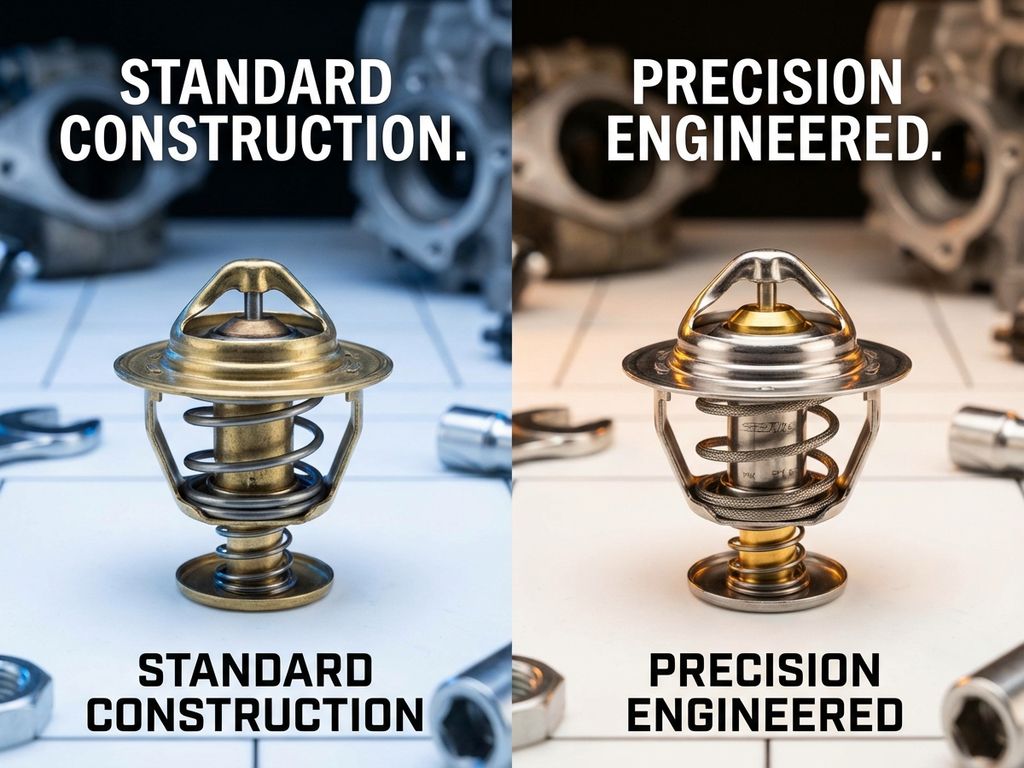
The primary difference between standard and precision thermostat inserts lies in their manufacturing tolerances and temperature control accuracy. Standard inserts typically operate within broader temperature ranges (±3–5°C), while precision inserts maintain much tighter tolerances (±1–2°C) through enhanced materials and manufacturing processes. Precision inserts also respond faster to temperature changes and provide more consistent performance over time, making them essential for applications requiring exact thermal management.
What exactly are thermostat inserts and how do they work?
Thermostat inserts are the core temperature-sensing components within thermostatic valves that control fluid flow based on temperature changes. They contain a wax element that expands and contracts as temperatures fluctuate, mechanically opening or closing valve passages to regulate coolant, water, or other fluids through thermal management systems.
The fundamental operating principle centres on thermal expansion. Inside each insert, a specially formulated wax pellet sits within a sealed chamber alongside a piston mechanism. When temperatures rise above the insert’s set point, the wax expands significantly, pushing the piston outward to open the valve. As temperatures drop, the wax contracts, allowing a spring mechanism to close the valve again.
This mechanical response happens automatically without any external power source, making thermostat inserts reliable components for automotive thermostats, industrial cooling systems, and building heating applications. The response time and accuracy depend heavily on the insert’s design quality, the materials used, and manufacturing precision.
Different applications require different opening temperatures, typically ranging from 60°C to 95°C for automotive applications, though industrial and HVAC systems may use inserts with much higher or lower activation temperatures depending on their specific thermal management needs.
What makes precision thermostat inserts different from standard ones?
Precision thermostat inserts achieve significantly tighter temperature tolerances through superior manufacturing processes, higher-grade materials, and enhanced quality control measures. While standard inserts may have opening temperature variations of ±3–5°C, precision variants typically maintain tolerances within ±1–2°C or even tighter specifications.
The key differences include:
- Manufacturing tolerances: Precision inserts undergo more stringent quality control with tighter dimensional specifications.
- Material quality: Higher-grade wax formulations and precision-machined components ensure consistent performance.
- Response time: Faster reaction to temperature changes due to optimised thermal transfer properties.
- Consistency: More predictable performance across temperature cycles and extended operational periods.
- Calibration accuracy: Individual calibration processes ensure each insert meets exact specifications.
These improvements result in more stable system temperatures, reduced energy consumption, and better overall thermal management. Precision inserts also typically feature enhanced durability, maintaining their accuracy longer than standard alternatives under demanding operating conditions.
The manufacturing process for precision inserts involves additional steps such as individual testing, calibration verification, and often hand-assembly of critical components to ensure optimal performance characteristics.
When should you choose precision over standard thermostat inserts?
Choose precision thermostat inserts when your application demands tight temperature control, consistent performance, or operation in critical systems where temperature variations could cause efficiency losses or equipment damage. Applications requiring temperature stability within 1–2°C typically justify the additional investment in precision components.
Precision inserts prove essential in several scenarios:
Automotive applications: Modern engines with strict emissions requirements benefit from precise coolant temperature control. Precision inserts help maintain optimal operating temperatures for fuel efficiency and reduced emissions, particularly important for automotive thermostats in hybrid and high-performance vehicles.
Industrial processes: Manufacturing operations requiring consistent temperatures for quality control, chemical processes with narrow operating windows, or equipment protection systems where overheating could cause expensive damage.
HVAC systems: Commercial buildings where comfort and energy efficiency are priorities, or systems with expensive heat pumps that require precise temperature management for optimal performance.
The cost–benefit analysis typically favours precision inserts when energy savings, equipment protection, or process quality improvements outweigh the higher initial investment. Calculate potential energy savings and equipment protection benefits against the additional cost to determine whether precision inserts make financial sense for your specific application.
What are the common problems with using the wrong thermostat insert type?
Using incorrect thermostat insert specifications can lead to significant operational problems, including energy inefficiency, equipment damage, temperature instability, and increased maintenance costs. The consequences often far exceed the initial cost savings from choosing inappropriate components.
Common issues include:
Energy inefficiency: Inserts with incorrect opening temperatures cause systems to run too hot or too cold, wasting energy through overcooling or insufficient heat transfer. This particularly affects fuel consumption in automotive applications and heating costs in building systems.
Equipment damage: Overheating from late-opening inserts can damage engines, pumps, or heat exchangers. Conversely, inserts that open too early may prevent systems from reaching optimal operating temperatures, causing wear and reduced efficiency.
Temperature fluctuations: Standard inserts in applications requiring precision can cause uncomfortable temperature swings in HVAC systems or process variations in industrial applications that affect product quality.
Premature failure: Inserts operating outside their designed parameters often fail sooner, leading to system breakdowns and emergency repairs. This creates higher long-term costs despite initial savings.
Maintenance issues: Incorrect inserts may cause system imbalances that increase wear on other components, leading to more frequent servicing and higher operational costs over time.
How BTT Solutions helps with precision thermostat insert selection and implementation
We provide comprehensive precision thermostat insert solutions tailored to automotive, industrial, and HVAC applications requiring exact temperature control. Our expertise in thermal management ensures you select the optimal components for your specific requirements while maximising system efficiency and reliability.
Our precision thermostat insert services include:
- Technical consultation to determine exact temperature specifications and tolerance requirements
- Custom insert development for unique applications with specific opening temperatures
- Quality assurance testing to verify performance meets your exact specifications
- Integration support for seamless implementation in existing thermal management systems
- Ongoing technical support to optimise system performance and troubleshoot issues
With eight global locations and 600 specialists, we offer local support with international expertise. Our precision manufacturing capabilities ensure consistent quality, while our technical team provides guidance on selecting between standard and precision inserts based on your application’s specific needs.
Contact our thermal management specialists today to discuss your precision thermostat insert requirements and discover how our solutions can improve your system’s efficiency and reliability.
Related Articles
- What role do thermostat materials play in floor heating systems?
- How accurate is a wax element material in controlling fluid flow?
- What is thermostat hysteresis and how does it affect test results?
- What are the main components of automotive thermostats?
- What are the three main methods of heat transfer in thermostats?


