
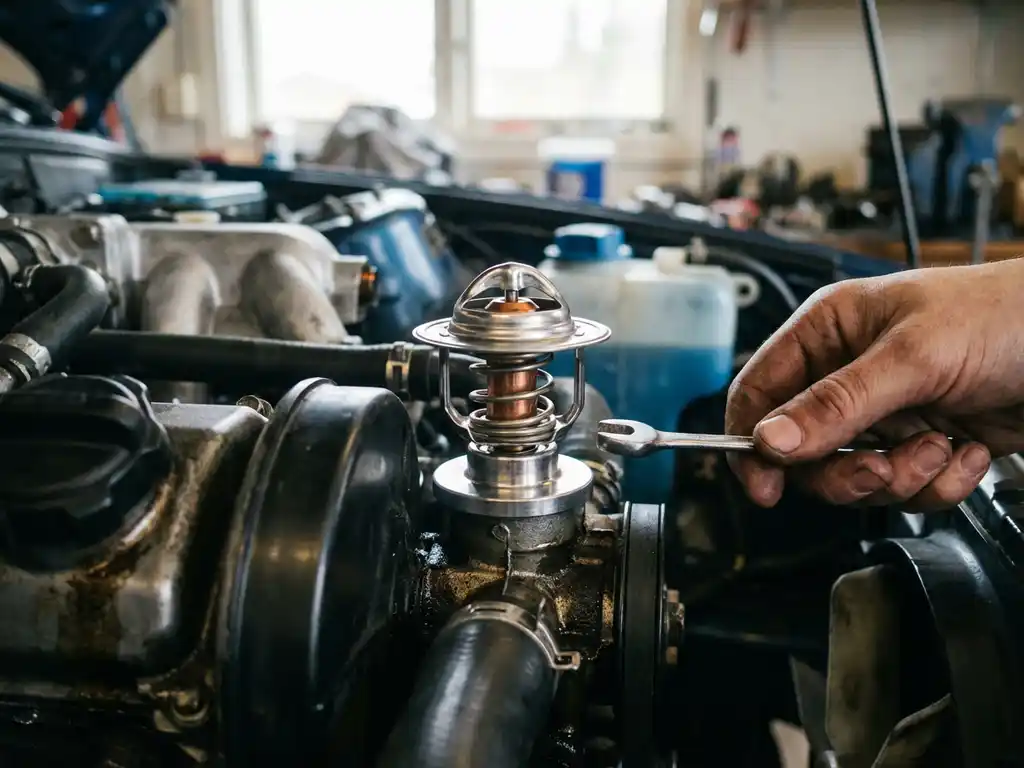
When you look under the hood of any modern car, you’ll find a small but incredibly important component working quietly to keep your engine running at the ideal temperature. The thermostat plays a vital role in automotive performance, fuel efficiency, and emissions control, yet many drivers don’t fully understand how these clever devices work or why they’ve evolved the way they have.
Today’s automotive thermostats have come a long way from the simple mechanical devices of decades past. Understanding which type dominates modern vehicles—and why—can help you appreciate the engineering that goes into every drive you take.
What type of thermostat is most commonly used in modern cars?
Wax pellet thermostats are the most commonly used type in modern automobiles. These thermostats use a temperature-sensitive wax element that expands and contracts to control coolant flow through the engine cooling system. Nearly all passenger vehicles manufactured today rely on this proven technology.
The widespread adoption of wax pellet thermostats stems from their reliability, precision, and cost-effectiveness. Unlike older mechanical designs, wax pellet thermostats provide consistent temperature control across millions of operating cycles. They open and close smoothly based on coolant temperature, ensuring your engine maintains optimal operating conditions whether you’re stuck in traffic or cruising on the highway.
Modern wax pellet thermostats also integrate seamlessly with today’s sophisticated engine management systems. They work alongside electronic sensors and control units to help optimize fuel consumption and reduce emissions, making them an ideal choice for meeting stringent environmental regulations.
How does a wax pellet thermostat work in automotive engines?
A wax pellet thermostat operates through the thermal expansion of a special wax compound sealed inside a metal capsule. When the engine coolant reaches the thermostat’s opening temperature, the wax melts and expands, pushing a piston that opens a valve to allow coolant to circulate through the radiator.
The process works in reverse as temperatures drop. When the engine cools down, the wax contracts and solidifies, allowing a spring to close the valve and restrict coolant flow. This creates a self-regulating system that maintains consistent engine temperatures without requiring any external power or electronic controls.
The wax compound used in these thermostats is carefully formulated to provide a precise temperature response. Different wax formulations allow manufacturers to create thermostats with specific opening temperatures, typically ranging from 82°C to 105°C (180°F to 221°F), depending on the engine’s requirements. This precision helps engines warm up quickly when cold while preventing overheating during normal operation.
Why did wax pellet thermostats replace older thermostat technologies?
Wax pellet thermostats replaced older technologies because they offer superior reliability, smoother operation, and more precise temperature control than previous designs, such as bellows-type and bimetallic thermostats. They also last longer and require less maintenance over a vehicle’s lifetime.
Earlier thermostat designs had significant limitations that made them less suitable for modern engines. Bellows-type thermostats, which used volatile liquids that vaporized to create expansion, were prone to leakage and could fail suddenly. Bimetallic thermostats, which relied on different metals expanding at different rates, often operated jerkily and provided less precise temperature control.
The transition to wax pellet technology also aligned with the automotive industry’s push for better fuel economy and lower emissions. These thermostats provide the consistent temperature regulation needed for modern engines to operate efficiently. They help engines reach optimal operating temperature quickly while maintaining stable temperatures under varying load conditions, which directly affects fuel consumption and exhaust emissions.
What are the different opening temperatures for automotive thermostats?
Automotive thermostats typically have opening temperatures ranging from 82°C to 105°C (180°F to 221°F), with the most common temperatures being 88°C (190°F), 92°C (198°F), and 96°C (205°F). The specific temperature depends on the engine design, intended use, and emissions requirements of each vehicle model.
Lower opening temperatures around 82°C to 88°C (180°F to 190°F) are often used in performance applications or older engine designs where quick warm-up is prioritized. These thermostats help reduce engine wear during cold starts and can improve fuel economy in certain driving conditions.
Higher opening temperatures from 92°C to 105°C (198°F to 221°F) are more common in modern engines designed for optimal efficiency and emissions control. These temperatures allow engines to operate in their most efficient thermal range, reducing fuel consumption and minimizing harmful emissions. The higher operating temperatures also help improve the effectiveness of catalytic converters and other emissions-control systems.
Some specialized applications, such as heavy-duty trucks or high-performance vehicles, may use thermostats with even more specific temperature ranges. The choice of opening temperature is carefully calibrated during engine development to balance factors such as fuel economy, emissions, performance, and component longevity.
How BTT Solutions Supports Modern Automotive Thermostats
We specialize in developing and manufacturing high-precision wax pellet thermostats that meet the demanding requirements of modern automotive applications. Our advanced thermostat technology helps vehicle manufacturers achieve optimal engine performance while meeting strict fuel-efficiency and emissions standards.
Our comprehensive automotive thermostat solutions include:
- Precision-engineered wax elements for consistent temperature control
- Custom opening temperatures tailored to specific engine requirements
- Durable construction designed for millions of operating cycles
- Integration support for modern engine management systems
As a global leader in thermal-management components, we work closely with automotive manufacturers to develop innovative solutions that enhance vehicle performance and environmental compliance. Contact us to learn how our expertise in automotive thermostats can support your next vehicle development project.
Related Articles
- What is the difference between mechanical efficiency and thermal efficiency?
- What causes thermostat corrosion in coastal driving conditions?
- What are the main components of automotive thermostats?
- What thermostats are used in wind turbines and power generation?
- What is a thermostat and how does it work?


