
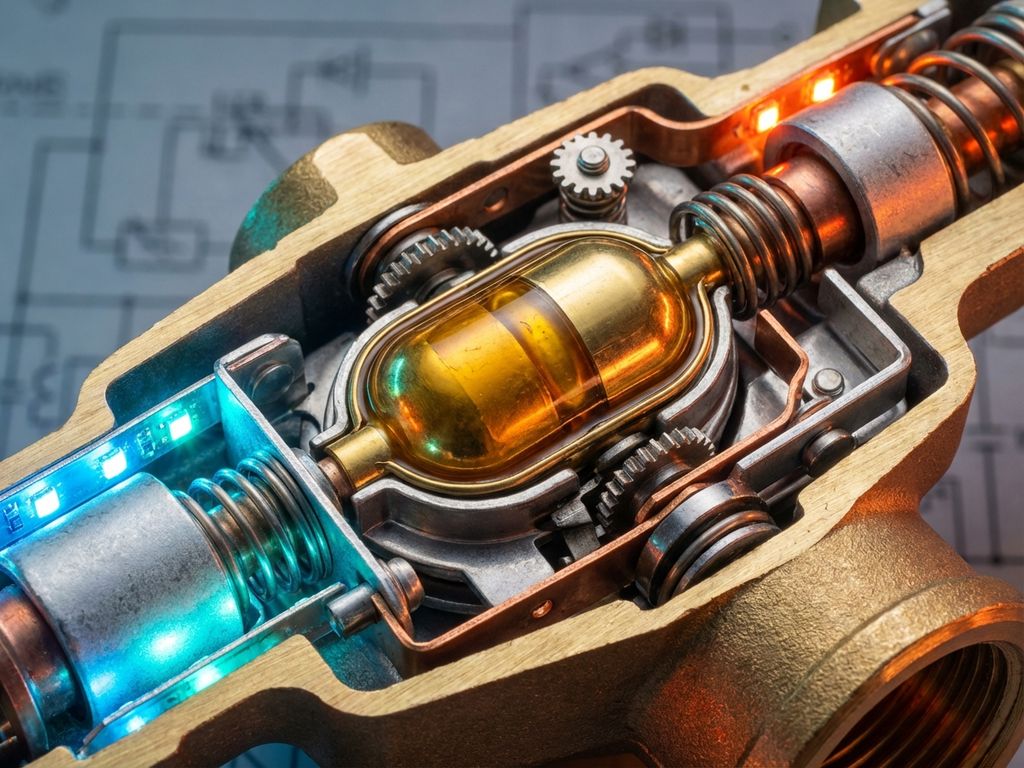
Thermostats use wax instead of electronics because wax provides reliable, mechanical temperature control through thermal expansion and contraction. This simple physics-based system operates without electrical components, making it more durable and cost-effective than electronic alternatives. Wax thermostats excel in harsh environments where electronics might fail, offering precise temperature control through a proven mechanical process that has worked reliably for decades.
What is wax actually doing inside a thermostat?
Wax inside a thermostat acts as a thermal actuator that physically expands and contracts with temperature changes. When heated, the wax pellet expands significantly, pushing against a piston or valve mechanism that opens coolant flow. As temperatures drop, the wax contracts, allowing springs to close the valve and restrict flow.
The physics behind this process involves the unique properties of specially formulated wax compounds. These materials have a high coefficient of thermal expansion, meaning they change volume dramatically with relatively small temperature variations. A typical automotive thermostat wax actuator can generate substantial force during expansion, often exceeding 100 pounds of force.
This mechanical process enables precise temperature control without requiring any electrical power, sensors, or control circuits. The wax responds directly to the temperature of the surrounding coolant or air, making the system inherently self-regulating. The response time is typically fast enough for effective thermal management in automotive and industrial applications.
Why don’t thermostats use electronic sensors instead of wax?
Electronic sensors require power sources, control circuits, and actuators that add complexity and potential failure points. Wax actuators operate purely mechanically, eliminating the need for electrical connections, batteries, or electronic components that can malfunction in extreme temperatures, under vibration, or in corrosive environments.
Cost considerations strongly favor wax thermostat technology. Electronic alternatives require temperature sensors, microprocessors, motor actuators, and power supplies, making them significantly more expensive to manufacture and maintain. Wax thermostats achieve the same temperature control function with a simple, single-component design.
Reliability factors also support wax over electronics. Electronic systems can fail due to electrical faults, software glitches, electromagnetic interference, or component degradation. Mechanical wax systems have fewer failure modes and continue operating even in conditions that would disable electronic alternatives, such as extreme temperatures or electrical system failures.
In automotive applications, wax thermostats must withstand engine vibration, temperature cycling from -40°C to 120°C, and exposure to coolant chemicals. Electronic systems struggle with these harsh conditions, while wax actuators thrive in environments where electronics become unreliable.
How reliable are wax-based thermostats compared to electronic alternatives?
Wax-based thermostats typically last 100,000 to 150,000 miles in automotive applications, often outlasting the vehicles themselves. Electronic alternatives often have shorter lifespans due to component degradation, electrical failures, and sensitivity to environmental conditions that do not affect mechanical wax systems.
Durability testing shows that wax thermostats handle millions of thermal cycles without significant performance degradation. The simple mechanical design has no wearing electrical contacts, circuit boards, or motors that commonly fail in electronic systems. Wax pellet thermostat technology proves particularly robust in industrial applications with constant temperature cycling.
Maintenance requirements differ significantly between the two technologies. Wax thermostats require no calibration, software updates, or electrical troubleshooting. When they eventually fail, replacement is straightforward and inexpensive. Electronic systems often need periodic recalibration and can require expensive diagnostic equipment for troubleshooting.
Real-world performance data from automotive and industrial applications consistently show lower failure rates for wax-based thermal management systems. Electronic thermostats may offer additional features like remote monitoring, but their increased complexity introduces reliability challenges that mechanical systems avoid entirely.
What happens when the wax in a thermostat fails?
When wax thermostat failure occurs, the system typically fails in a predictable manner. The most common failure mode is the thermostat sticking in either the open or closed position. Closed-position failure prevents coolant flow and causes overheating, while open-position failure results in poor warm-up performance and reduced efficiency.
Symptoms of wax thermostat problems include engine overheating, slow warm-up times, temperature gauge fluctuations, or coolant leaks near the thermostat housing. In heating systems, failed thermostats may cause uneven temperatures, poor heat distribution, or system cycling issues.
Diagnosing wax thermostat issues involves checking temperature response and flow characteristics. A simple test involves monitoring whether the thermostat opens at its rated temperature. Professional technicians use infrared thermometers or coolant temperature measurements to verify proper operation during warm-up cycles.
The typical lifespan of wax-based thermal management components ranges from 5–10 years in industrial applications and 8–12 years in automotive use. Failure usually occurs gradually, giving operators time to notice performance changes before complete failure. This predictable degradation pattern makes maintenance scheduling more reliable than with electronic alternatives.
How BTT Solutions advances wax thermostat technology
We specialize in developing high-precision wax actuator technology that pushes the boundaries of traditional thermostat performance. Our patented innovations focus on improving response times, temperature accuracy, and operational lifespan across automotive, industrial, and residential applications.
Our advanced thermostat technology offerings include:
- Precision-engineered wax pellet thermostats with enhanced thermal response characteristics
- Custom temperature control solutions for specific automotive and industrial requirements
- High-durability thermal management components designed for extreme operating conditions
- Integrated thermostat assemblies that optimize fluid flow and heat distribution
- Specialized components for heating systems, radiators, and underfloor heating applications
Our expertise in thermal management extends beyond traditional automotive applications into marine systems, industrial processes, and building technology. We work closely with engineers to develop custom solutions that meet specific temperature control requirements while maintaining the reliability advantages of mechanical wax actuator systems.
Contact our technical team for a consultation on your thermal management challenges and discover how our advanced wax thermostat technology can improve your system’s performance and reliability.


