
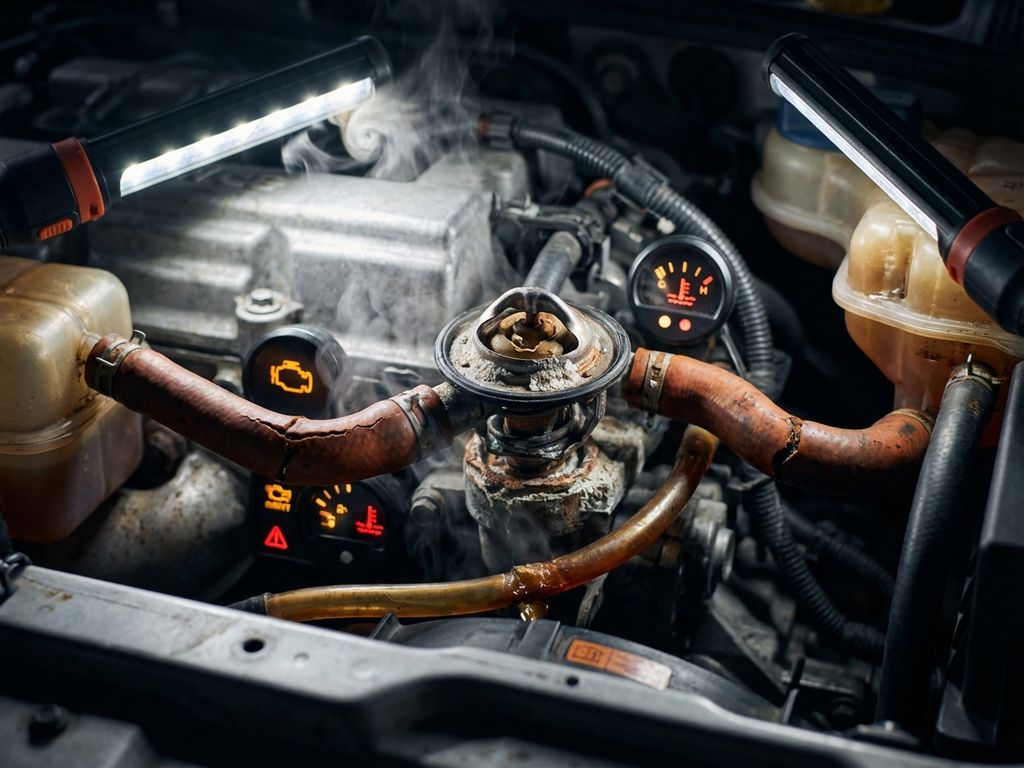
A failing thermostat in your vehicle shows several warning signs, including engine overheating, temperature gauge fluctuations, poor heater performance, and coolant leaks. Your car’s thermostat controls engine temperature by regulating coolant flow, so when it fails, you’ll notice temperature-related problems that affect engine performance and comfort systems.
What are the most common warning signs of a failing thermostat?
The most obvious signs of thermostat failure include engine overheating, erratic temperature readings, weak heater output, and visible coolant leaks. Your temperature gauge may fluctuate wildly or stay in the cold position even after the engine warms up, indicating that the thermostat isn’t opening or closing properly.
Engine overheating represents the most serious symptom of thermostat failure. When the thermostat sticks closed, coolant cannot circulate through the engine cooling system, causing temperatures to rise dangerously. You’ll notice the temperature gauge climbing into the red zone, steam coming from under the bonnet, or warning lights on your dashboard.
Temperature gauge irregularities provide another clear indication of vehicle thermostat problems. A properly functioning thermostat should allow the gauge to reach normal operating temperature and remain steady. When failing, you might see the needle jumping between hot and cold, staying permanently cold, or reading unusually high temperatures during normal driving conditions.
Poor heater performance often accompanies signs of a failing thermostat because your car’s heating system relies on hot coolant flowing through the heater core. If the thermostat remains stuck open, the engine never reaches proper operating temperature, leaving you with cold air from the vents even after extended driving periods.
Why does a car thermostat fail and what causes it to stop working?
Car thermostats fail due to age-related wear, corrosion from contaminated coolant, debris buildup, manufacturing defects, and exposure to extreme temperatures. Most automotive thermostats last 80,000 to 100,000 miles before requiring replacement as part of regular cooling system maintenance.
Corrosion represents the primary cause of thermostat failure in most vehicles. Old coolant becomes acidic over time, eating away at the thermostat’s metal components and causing the valve mechanism to stick. This process accelerates when drivers neglect coolant changes or mix different types of antifreeze, creating chemical reactions that damage the entire engine cooling system.
Debris and sediment accumulation can prevent the thermostat from opening and closing smoothly. Rust particles, scale deposits, and other contaminants circulating through the cooling system settle around the thermostat housing, interfering with proper operation. Regular cooling system flushes help prevent this type of failure.
Extreme temperature cycling also contributes to premature thermostat wear. The constant expansion and contraction of metal components eventually causes fatigue, particularly in the spring mechanism that controls valve operation. Vehicles operating in harsh climates or those subjected to frequent short trips may experience earlier failures.
How can you tell if your thermostat is stuck open or closed?
A thermostat stuck closed causes engine overheating and high temperature readings, while a stuck-open thermostat results in slow warm-up times, poor heater performance, and temperature readings that remain below normal. Observing engine temperature behaviour patterns helps identify which failure mode you’re experiencing.
When your thermostat sticks closed, you’ll notice rapid temperature increases during normal driving. The engine reaches dangerous temperatures quickly because coolant cannot flow to the radiator for cooling. Your temperature gauge climbs steadily upward, and you may see steam or coolant boiling over from the reservoir.
A stuck-open thermostat creates the opposite symptoms. The engine takes much longer to reach operating temperature, sometimes never achieving normal readings during short trips. Your heater produces lukewarm air instead of hot air, and fuel efficiency may decrease because the engine runs too cool for optimal combustion.
Engine performance indicators also differ between failure modes. Overheating engines caused by closed thermostats may experience knocking, reduced power, and eventual shutdown to prevent damage. Engines with stuck-open thermostats typically run rough when cold, take longer to smooth out, and may trigger emissions-related warning lights due to poor combustion efficiency.
What happens if you continue driving with a bad thermostat?
Driving with a failing thermostat can cause severe engine damage, including warped cylinder heads, blown head gaskets, and cracked engine blocks. You’ll also experience reduced fuel efficiency, increased emissions, and potentially costly repairs that far exceed simple thermostat replacement costs.
Engine damage from overheating represents the most expensive consequence of ignoring car thermostat symptoms. Excessive heat warps metal components, compromises gasket seals, and can crack the engine block itself. These repairs often cost thousands of pounds, while thermostat replacement typically costs under £200 including labour.
Reduced fuel efficiency occurs with both failure modes but for different reasons. Overheating engines work harder and consume more fuel trying to maintain performance, while engines running too cool never achieve optimal combustion efficiency. Either situation increases your fuel costs and reduces vehicle reliability.
Cooling system damage extends beyond the engine itself when you continue driving with thermostat problems. Water pumps work harder trying to circulate coolant, radiators may develop leaks from pressure fluctuations, and hoses can burst from excessive heat or pressure. These secondary failures compound repair costs significantly.
How BTT Solutions helps with thermostat reliability and performance
BTT Solutions provides advanced thermostat technology and precision-manufactured components that enhance automotive thermostat reliability and engine temperature control. Our solutions address common failure modes through improved materials, better engineering, and comprehensive thermal management systems.
Our thermostat solutions offer several key advantages:
- Precision-engineered valve mechanisms that resist corrosion and debris buildup
- Advanced materials that withstand extreme temperature cycling
- Integrated temperature sensors for improved engine cooling system monitoring
- End-to-end thermal management solutions for optimal vehicle performance
- Comprehensive quality testing to ensure long-term reliability
Whether you’re experiencing signs of a failing thermostat or seeking to prevent future problems, our thermal management expertise can help optimise your vehicle’s cooling system performance. Contact us to learn more about our automotive thermostat solutions and how we can support your engine temperature control needs.


