
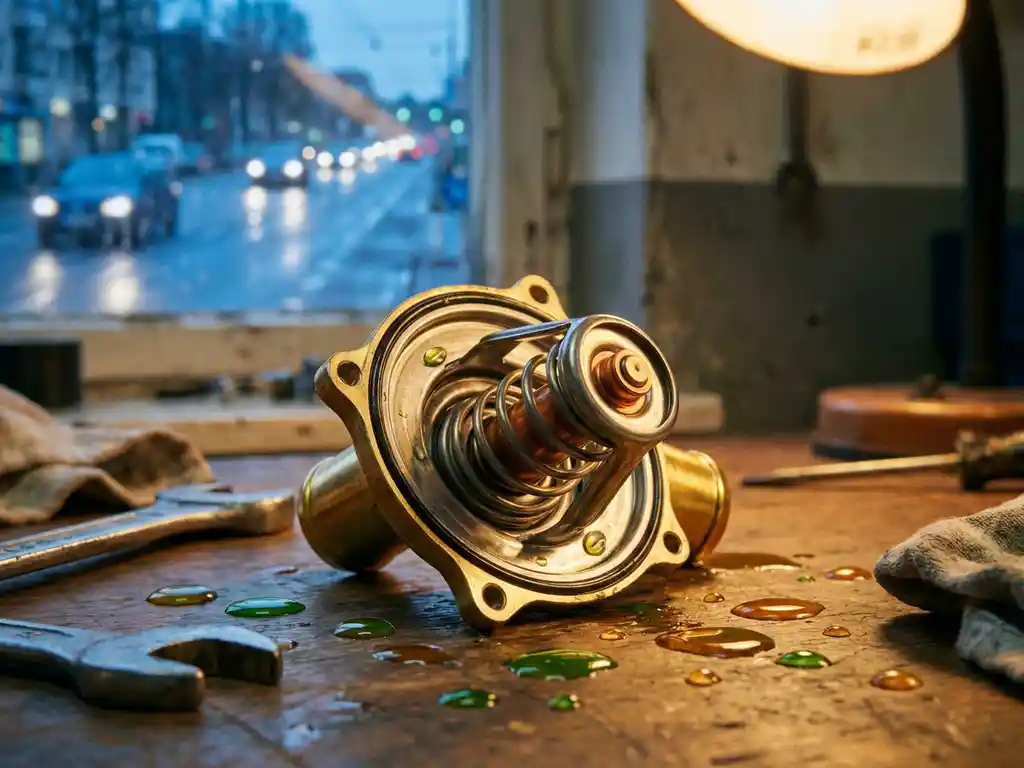
City driving puts automotive thermostats through some of the toughest conditions they’ll ever face. Between constant acceleration and braking, sitting idle in traffic jams, and navigating crowded streets where engines run hot, urban environments create a perfect storm of thermal challenges that can push even the most reliable engine-cooling systems to their limits.
Understanding how your vehicle’s thermostat handles these demanding conditions can help you make better decisions about maintenance, performance upgrades, and when to seek professional help. Let’s explore the real-world challenges that stop-and-go traffic creates for these important components.
What makes stop-and-go driving challenging for engine thermostats?
Stop-and-go driving creates extreme temperature fluctuations that force automotive thermostats to work much harder than during steady highway cruising. The constant cycle of acceleration, idling, and braking generates unpredictable heat patterns that challenge the thermostat’s ability to maintain optimal engine temperature.
During acceleration, engines generate significant heat as they work harder to move the vehicle forward. When you brake or idle at traffic lights, airflow through the radiator drops dramatically, reducing the cooling system’s efficiency. This creates a roller-coaster effect in which temperatures spike during acceleration and struggle to normalize during idle periods.
The frequent temperature swings also cause thermal expansion and contraction in the thermostat’s wax element, which is the component that opens and closes the valve. Over time, this constant cycling can lead to faster wear than steady-state driving conditions, where temperatures remain more consistent.
How do modern thermostats respond to rapid temperature changes?
Modern automotive thermostats use advanced wax elements and precision engineering to respond quickly to temperature changes, typically opening and closing within seconds of detecting temperature shifts. These components are designed with faster response times and more precise calibration than older thermostat designs.
The key innovation lies in the thermostat’s wax-pellet composition and housing design. When coolant temperature rises, the wax expands rapidly, pushing a piston that opens the valve to allow coolant to flow to the radiator. As temperatures drop, the wax contracts quickly, closing the valve to help the engine warm up faster.
High-quality thermostats also feature improved sealing and more durable materials that can handle the stress of frequent cycling. Some advanced designs include multistage opening mechanisms that provide more gradual coolant-flow control, reducing shock to the cooling system during rapid temperature changes.
What’s the difference between standard and high-performance thermostats for city driving?
High-performance thermostats open at lower temperatures and respond faster to temperature changes than standard thermostats, making them better suited to the demanding conditions of city driving. While standard thermostats typically open around 88–93°C (190–200°F), performance versions often activate at 82–87°C (180–189°F).
The lower opening temperature provides several advantages in stop-and-go traffic. It allows coolant to start flowing sooner, preventing temperature spikes during acceleration phases. This earlier intervention helps maintain more consistent engine temperatures throughout the driving cycle.
Performance thermostats also feature enhanced construction with tighter tolerances and higher-quality materials. They’re designed to handle more frequent cycling without degradation, and many include improved flow characteristics that move coolant more efficiently when open. For vehicles that spend significant time in urban environments, these upgrades can provide better temperature stability and may help extend engine life.
Why do some engines overheat in heavy traffic despite having thermostats?
Engines can overheat in traffic even with functioning thermostats because these components rely on adequate airflow and coolant circulation to work effectively. When vehicles sit stationary or move slowly, the natural airflow through the radiator decreases significantly, reducing the cooling system’s overall capacity.
Several factors can compound this problem beyond the thermostat’s control. Low coolant levels, clogged radiators, failing water pumps, or malfunctioning cooling fans can all prevent the system from dissipating heat effectively. Even with a properly functioning thermostat opening to allow coolant flow, these issues can overwhelm the cooling system’s capacity.
Additionally, some thermostats may stick partially closed due to age, contamination, or manufacturing defects. This reduces coolant flow even when the engine needs maximum cooling. Regular maintenance, including cooling-system flushes and thermostat replacement at recommended intervals, helps prevent these issues from developing into costly overheating problems.
How BTT Solutions Helps with Automotive Thermostat Challenges
We understand the unique demands that city driving places on automotive thermostats, which is why our engineering team has developed advanced thermostat solutions specifically designed to handle rapid temperature fluctuations and frequent cycling. Our products deliver the precision and reliability that modern vehicles need to perform optimally in challenging urban environments.
Our automotive thermostat solutions offer:
- Enhanced wax-element formulations for faster response times and improved durability
- Precision-engineered opening temperatures optimised for various driving conditions
- Advanced materials that resist wear from frequent temperature cycling
- Rigorous testing protocols that simulate real-world stop-and-go driving scenarios
Whether you’re an automotive manufacturer looking to improve your cooling-system performance or an industry professional seeking reliable thermostat solutions, we’re here to help. Contact our team to discuss how our expertise in thermal management can address your specific challenges and requirements.
Related Articles
- How is a wax pellet thermostat used in floor heating systems?
- How do thermostat components perform under extreme temperature cycling?
- What happens when thermostat coolant passages become blocked?
- How does thermal management impact engine performance?
- What are the three main methods of heat transfer in thermostats?


