
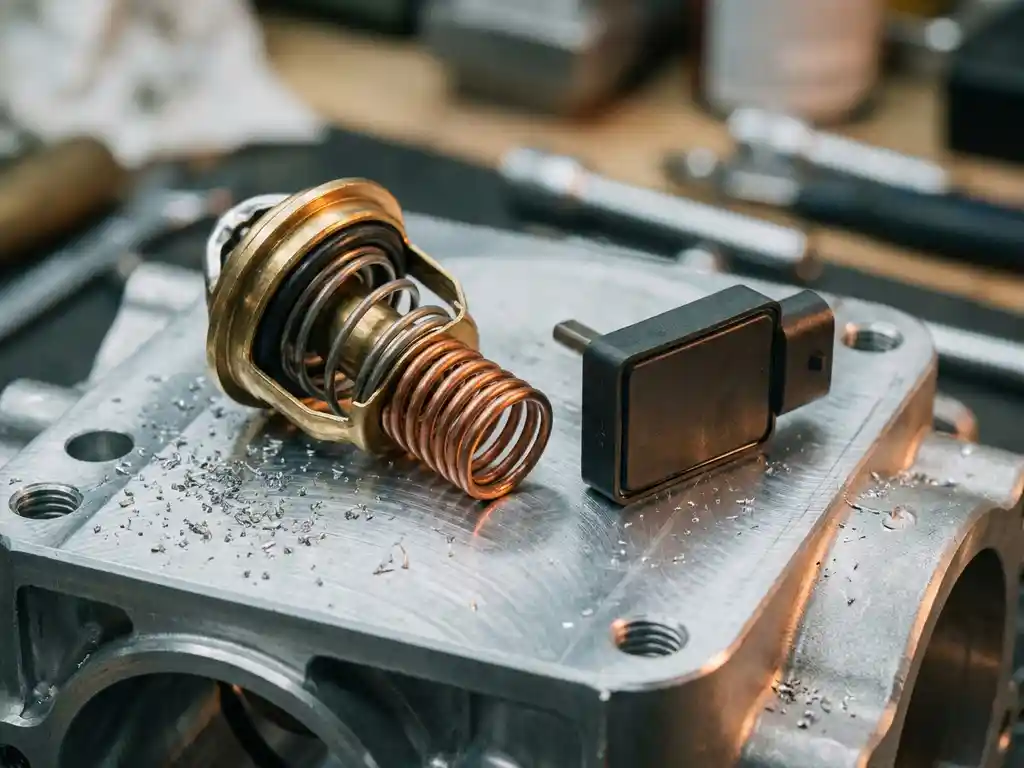
Mechanical thermostat components use a physical wax element that expands and contracts with temperature changes to control fluid flow, while solid-state thermostats rely on electronic sensors and actuators to achieve the same result. The core difference comes down to how each type detects temperature and triggers a response. Understanding that distinction helps engineers and procurement teams choose the right component for their specific application.
How does each type of thermostat component actually work?
A mechanical thermostat uses a wax element that physically changes volume as temperature rises or falls. When the wax melts, it pushes a piston that opens or closes a valve, directly controlling the flow of coolant or fluid. No electronics are involved. A solid-state thermostat, by contrast, uses electronic temperature sensors and a control unit to detect conditions and trigger an actuator or heating element to open the valve on demand.
The wax element thermostat has been the industry standard for decades precisely because it is self-contained. The wax itself is the sensor, the actuator, and the control mechanism, all in one compact unit. When the engine reaches operating temperature, the wax melts, the valve opens, and coolant flows through the radiator. As the engine cools, the wax solidifies again and the valve closes. No wiring, no software, no external power source required.
Solid-state thermostats, sometimes called electronic or map-controlled thermostats, work differently. A temperature sensor feeds data to an engine control unit, which then sends a signal to an electric actuator integrated into the thermostat housing. This allows the system to open the valve at precisely the moment the control unit decides is optimal, rather than waiting for the wax to respond passively to ambient temperature.
What are the main performance differences between the two?
The most significant performance difference between mechanical and solid-state thermostat components is response precision. A wax element thermostat opens at a fixed temperature determined by its wax formulation, while an electronic thermostat can vary its opening point dynamically based on engine load, driving conditions, and real-time data from the vehicle’s control system.
In practice, this means a solid-state thermostat can keep the engine running slightly hotter under light loads to improve fuel efficiency, then lower the operating temperature under high load to protect against overheating. A mechanical wax element thermostat always opens at the same temperature, regardless of what the engine is doing at that moment.
That said, mechanical thermostats are highly repeatable and consistent. Their response curve is predictable, which makes them easy to validate and certify for applications where simplicity and proven reliability matter more than adaptability. For many industrial and HVAC applications, that consistency is exactly what engineers need.
Which thermostat type is better suited for automotive applications?
For modern automotive applications, solid-state thermostats offer clear advantages in fuel efficiency and emissions management, making them the preferred choice in new passenger vehicle platforms. However, mechanical wax element thermostats remain widely used in commercial vehicles, older platforms, and cost-sensitive applications where the additional complexity of electronics is not justified.
Passenger car manufacturers increasingly specify electronic thermostats because even small improvements in thermal management translate into measurable reductions in CO2 emissions across a fleet. Regulatory pressure in Europe and other markets means that every fraction of a degree of optimisation matters. An electronic thermostat gives the engine control unit the flexibility to dial in the ideal operating temperature for each driving scenario.
Commercial vehicles and heavy-duty applications often still rely on mechanical thermostats. The reasoning is straightforward: these systems operate in demanding environments where simplicity, repairability, and long service intervals take priority. A wax element thermostat can be replaced in the field without specialist diagnostic equipment, which matters enormously in fleet maintenance contexts.
Explore our full range of thermostat components to see how both types are designed for different automotive and industrial requirements.
Where do solid-state thermostats outperform mechanical ones?
Solid-state thermostats outperform mechanical ones in applications that require variable temperature control, integration with digital systems, or precise response to changing operating conditions. This includes modern passenger vehicles with engine management systems, industrial processes where temperature thresholds need to shift dynamically, and any application where remote monitoring or diagnostics add value.
One area where electronic thermostats clearly win is warm-up management. By keeping the thermostat closed longer during cold starts, the engine reaches operating temperature faster, reducing fuel consumption and emissions during the critical warm-up phase. A mechanical thermostat cannot distinguish between a cold start and a normal operating cycle in the same adaptive way.
Electronic thermostats also integrate naturally with broader vehicle or system diagnostics. A fault in the thermostat can be flagged immediately by the control unit, rather than only being discovered when the engine overheats or a service technician runs a manual check. For fleet operators and industrial plant managers, that kind of real-time visibility has genuine operational value.
What are the reliability and maintenance differences over time?
Mechanical wax element thermostats generally have a strong long-term reliability record because they have fewer components that can fail. There are no electronic circuits, no sensors to degrade, and no software dependencies. The most common failure mode is the wax element losing its responsiveness over time, which is a gradual and usually detectable process rather than a sudden failure.
Solid-state thermostats introduce additional components into the system, which means more potential failure points. The electronic actuator, wiring harness, and sensor connections all need to remain functional over the vehicle or system’s service life. In harsh environments with vibration, moisture, or extreme temperature cycling, these connections can degrade faster than a purely mechanical assembly.
However, solid-state thermostats benefit from the diagnostic capabilities mentioned earlier. A mechanical thermostat can fail partially without triggering any warning until a driver notices abnormal temperature readings. An electronic thermostat, integrated with a control unit, can alert the operator to a developing problem before it causes damage. In that sense, the two types offer different reliability profiles rather than one being simply better than the other.
Maintenance intervals also differ. Mechanical thermostats are typically replaced as part of a scheduled service, often alongside the coolant. Electronic thermostats may require software updates or calibration checks in addition to physical inspection, particularly in vehicles where the engine management system has been updated.
How do you choose the right thermostat component for your application?
Choosing between a mechanical and a solid-state thermostat component comes down to four key factors: the required level of temperature control precision, integration with existing electronic systems, the operating environment, and total cost of ownership over the product’s service life.
Start with the application’s control requirements. If your system needs a fixed, reliable temperature threshold and does not benefit from dynamic adjustment, a wax element thermostat is likely the more practical and cost-effective choice. If your application involves variable loads, integration with a digital control system, or regulatory requirements around efficiency and emissions, an electronic thermostat will serve you better.
Consider the environment next. High-vibration, high-moisture, or chemically aggressive environments tend to favour mechanical components for their robustness and simplicity. Clean, controlled environments where electronic components can be adequately protected shift the balance toward solid-state solutions.
Finally, think about the full lifecycle cost rather than just the component price. An electronic thermostat may cost more upfront but deliver savings through improved efficiency or reduced downtime if its diagnostic capabilities prevent costly failures. A mechanical thermostat may cost less initially but require more frequent replacement in high-cycle applications. Learn more about who we are and how our engineering background informs these kinds of decisions.
How BTT Solutions helps you select the right thermostat components
At BTT Solutions, we work directly with engineers, procurement teams, and technical decision-makers to match the right thermostat component to each specific application. Whether you are specifying components for a new automotive platform, an industrial cooling system, or a building technology project, we bring deep expertise in both mechanical and solid-state thermostat technology to every conversation.
Our product advisory service covers:
- Wax element selection: Choosing the right wax formulation and activation temperature for your operating conditions
- Thermostat inserts and housings: Matching engineered housings to your system architecture and installation requirements
- Solid-state thermostat integration: Supporting the specification of electronic thermostats for applications requiring dynamic temperature management
- Cross-industry application support: Drawing on our experience across automotive, industrial, and HVAC sectors to recommend solutions that perform reliably over the long term
We are a focused, agile team, and that means our clients get direct access to the people who actually know the products. No lengthy escalation chains, just clear technical guidance from specialists who understand thermal management components inside and out. Get in touch with us to discuss your application and find out which thermostat solution fits your needs best.


