
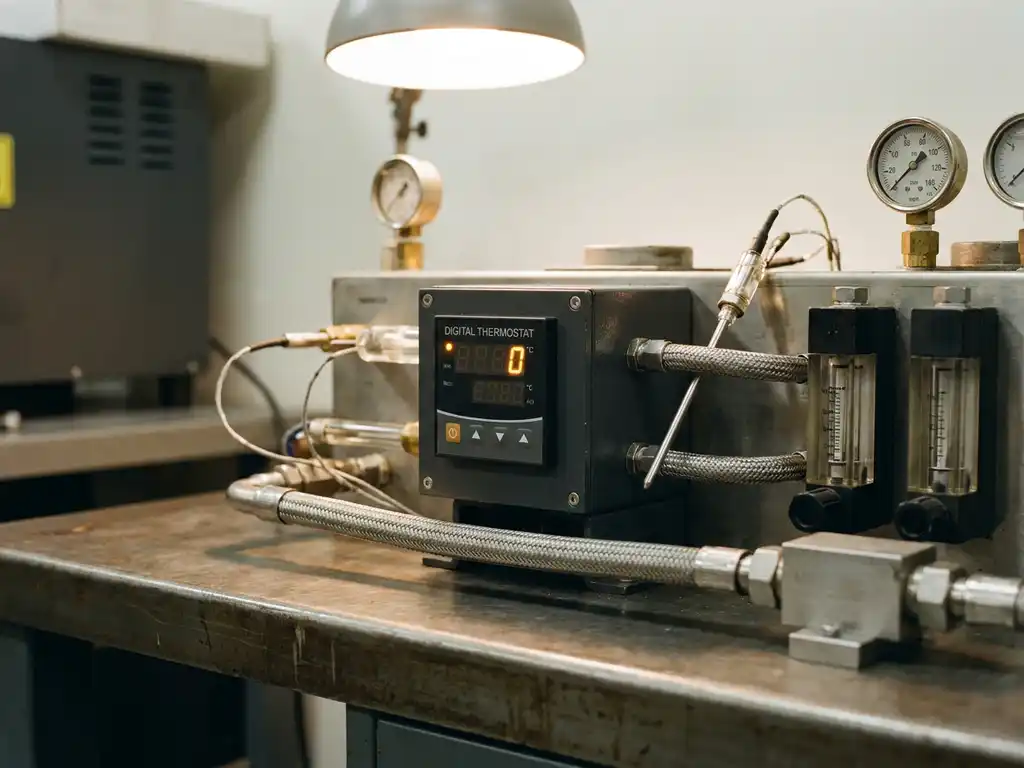
Professional thermostat performance testing relies on a combination of specialized equipment, including thermostat test benches, thermal calibration baths, data acquisition systems, and end-of-line testing rigs. The exact setup depends on whether you are testing automotive, industrial, or HVAC thermostats, but the core tools remain consistent across applications. Below, we walk through each piece of equipment, how it works, and what separates validation testing from production-line testing.
What standards govern professional thermostat performance testing?
Professional thermostat performance testing is governed by a combination of international standards and industry-specific specifications, including ISO 14771 for automotive thermostats, DIN 3421 for heating system components, and OEM-defined test protocols. These standards define acceptable opening temperatures, stroke ranges, response times, and leakage tolerances that any compliant thermostat must meet before it reaches production.
In the automotive sector, OEM requirements often go beyond baseline ISO standards. Manufacturers set their own temperature tolerances, endurance cycle requirements, and flow rate benchmarks that suppliers must validate before serial production begins. For industrial and building technology applications, EN standards and project-specific engineering specifications typically define the testing framework. Understanding which standards apply to your specific application is the essential first step before selecting any thermostat testing equipment.
What is a thermostat test bench and how does it work?
A thermostat test bench is a controlled testing platform that simulates real operating conditions to measure a thermostat’s opening behavior, stroke, and flow characteristics. It works by circulating a temperature-controlled fluid through the thermostat housing while sensors record valve movement and fluid flow at precise temperature increments, giving engineers a full picture of the component’s thermal response curve.
Most professional test benches include a heating and cooling circuit, a precision pump, flow meters, and integrated temperature probes positioned upstream and downstream of the thermostat. The bench raises fluid temperature in controlled steps, typically in increments of one degree, and logs the exact temperature at which the thermostat begins to open, reaches full stroke, and closes again on cooling. This opening and closing hysteresis data is critical for validating whether a component meets its design specification.
Modern test benches are often automated and connected to software that generates standardized test reports automatically. This reduces human error and makes it easier to compare results across production batches or across different thermostat designs during development.
What role do thermal calibration baths play in thermostat testing?
Thermal calibration baths are precision temperature-controlled fluid reservoirs used to verify the accuracy of temperature sensors and to calibrate the measurement equipment used during thermostat performance testing. They provide a stable, uniform temperature reference environment, typically accurate to within 0.01 to 0.1 degrees Celsius, ensuring that the instruments measuring thermostat behavior are themselves reliable.
In a typical testing workflow, calibration baths serve two distinct purposes. First, they are used to calibrate thermocouples, RTD probes, and other sensors before a test run begins. Second, they can be used to perform simple opening-temperature checks on thermostats directly, by immersing the component in the bath and observing at what temperature the wax element begins to actuate. This method is particularly common for incoming quality checks and for temperature sensor testing in high-volume production environments.
Calibration baths come in different temperature ranges depending on the application. Automotive coolant thermostats typically open between 80 and 105 degrees Celsius, so baths covering 60 to 130 degrees Celsius are standard. Industrial and heating system thermostats may require different ranges depending on their design.
How are data acquisition systems used in thermostat testing?
Data acquisition systems, commonly called DAQ systems, are used in thermostat testing to capture, record, and analyze the electrical and physical signals generated during a test cycle. They connect to temperature probes, pressure transducers, displacement sensors, and flow meters simultaneously, converting analog signals into digital data that can be logged, reviewed, and compared against specification limits in real time.
In thermal management testing, DAQ systems are particularly valuable because thermostat behavior involves multiple variables changing at the same time. Temperature, valve stroke, fluid flow rate, and pressure drop all interact, and understanding those interactions requires synchronized, high-frequency data capture. A good DAQ setup allows engineers to overlay multiple signal channels and identify exactly where a thermostat deviates from expected behavior.
For validation testing, DAQ systems are often paired with environmental chambers or endurance rigs to log performance over thousands of thermal cycles. For end-of-line production testing, leaner DAQ configurations focus on a smaller set of pass/fail parameters to keep cycle times short without sacrificing measurement integrity.
What’s the difference between end-of-line testing and validation testing equipment?
End-of-line testing equipment is designed for speed and repeatability in a production environment, checking each manufactured thermostat against a defined set of pass/fail criteria in seconds. Validation testing equipment, by contrast, is designed for depth and flexibility, used during product development and approval phases to characterize a thermostat’s full performance envelope under a wide range of conditions.
End-of-line testing equipment
End-of-line rigs are typically custom-built for a specific thermostat family and optimized to test one or two critical parameters quickly, most often opening temperature and leak tightness. They use automated handling, quick-connect fixtures, and integrated go/no-go logic to keep cycle times under 30 seconds per unit. The focus is on catching out-of-specification components before they leave the factory, not on generating detailed performance curves.
Validation testing equipment
Validation rigs are far more flexible and instrumented. They measure opening temperature, full stroke, closing temperature, flow characteristics, pressure drop, and long-term durability across temperature extremes. Validation testing equipment must be capable of running standardized test protocols defined by OEM customers or certification bodies, and the resulting data packages are used to formally approve a thermostat design for series production. This equipment tends to be larger, slower, and significantly more expensive than end-of-line setups.
How does testing equipment differ for automotive versus industrial thermostats?
Testing equipment for automotive thermostats is typically optimized for higher temperatures, tighter tolerances, and larger production volumes, while industrial thermostat testing equipment is often built for greater flexibility across a wider range of operating conditions, fluid types, and application-specific requirements. The core measurement principles overlap, but the fixtures, temperature ranges, and acceptance criteria differ significantly.
Automotive thermostat test benches use water-glycol mixtures that mirror actual engine coolant, and they must handle the pressurized conditions found in a running engine cooling circuit. Stroke tolerances in automotive applications are often extremely tight, sometimes within fractions of a millimeter, because even small deviations affect engine temperature regulation and fuel efficiency. Volume throughput is also a major consideration, since automotive suppliers often test hundreds or thousands of units per shift.
Industrial thermostat testing, on the other hand, may involve oils, process fluids, or water at very different temperature and pressure ranges. Testing equipment for heating system thermostats, for example, must handle lower operating temperatures but may need to verify performance across a broader range of flow rates. Marine and industrial applications can introduce additional requirements around corrosion resistance and long-term endurance in harsh environments.
How BTT Solutions supports your thermostat testing and component selection
Getting the testing right starts with having the right components to test. At BTT Solutions, we work closely with engineering and procurement teams to make sure the thermostat components we supply are already designed with testability and precision in mind. Here is what we bring to the table:
- Component advisory: We help you select the right wax elements, thermostat inserts, and engineered housings for your specific application, whether that is automotive, industrial, or building technology.
- Precision manufacturing: Our components are manufactured to tight tolerances that align with ISO, DIN, and OEM test standards, reducing the risk of failures during validation or end-of-line testing.
- Application expertise: With experience across automotive, marine, industrial, and heating system applications, we understand the testing requirements for each sector and can advise on component specifications accordingly.
- Responsive support: As a focused, mid-sized company, we offer direct access to our technical team without the delays that come with larger organizations.
If you are specifying thermostat components for a new application or working through a validation program, we are happy to discuss your requirements directly. Get in touch with our team and let us help you find the right solution.


