
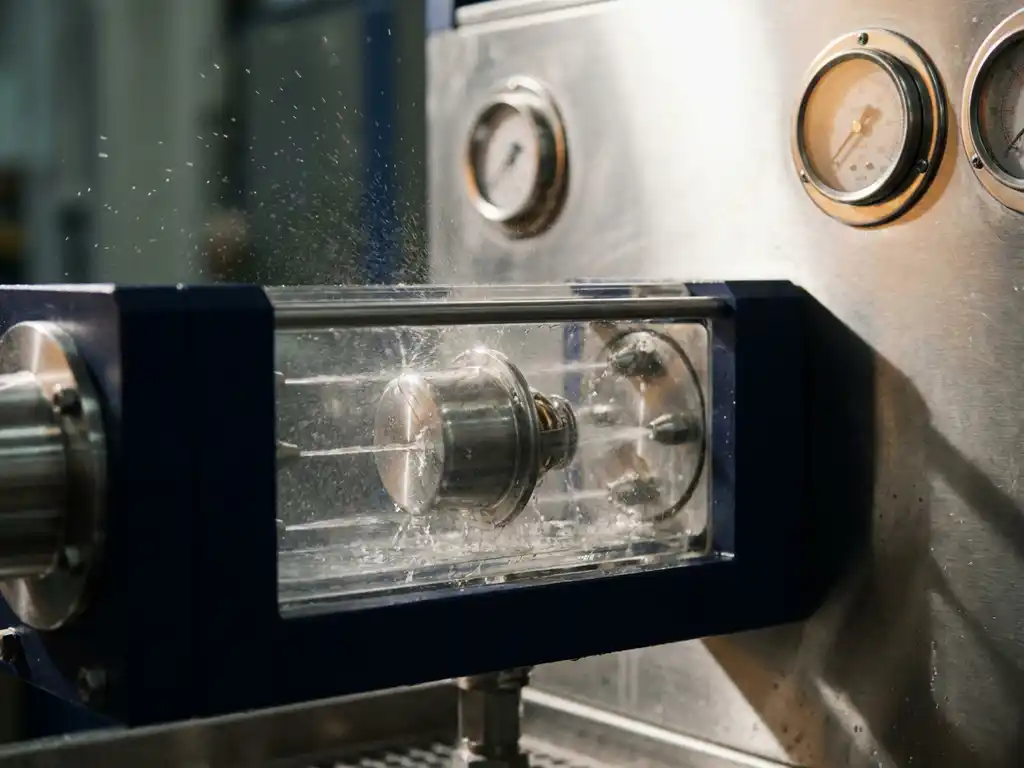
Ingress protection ratings directly affect thermostat testing requirements by defining the specific environmental stress tests a component must pass before it can be certified for use in a given application. A higher IP rating demands more rigorous dust and water exposure tests, which in turn influence material choices, sealing design, and the overall cost of validation. The sections below break down exactly how the IP code system works, which ratings matter most in automotive and industrial contexts, and what procurement teams should look for when evaluating supplier compliance.
What do the two digits in an IP rating actually mean for thermostats?
An IP rating is a two-digit code defined under international standards that communicates how well a component resists the intrusion of solid particles and liquids. The first digit runs from 0 to 6 and indicates protection against solid objects, including dust. The second digit runs from 0 to 9 and indicates protection against water, ranging from dripping water to high-pressure steam jets. For thermostat components, both digits carry real engineering weight.
The first digit matters because dust and fine particulate contamination can interfere with the mechanical movement inside a thermostat, particularly in wax element designs where small debris can prevent the actuator from seating correctly. A rating of IP5X means the component is dust-protected, while IP6X means it is completely dust-tight. In practice, most thermostats used in demanding environments are expected to meet at least IP6X on the solid particle side.
The second digit is equally important for thermostats installed near coolant circuits, under-hood environments, or outdoor heating systems. A rating of IPX4 means the component can handle water splashing from any direction. IPX6 covers powerful water jets. IPX7 and IPX8 indicate immersion resistance. For a thermostat sitting close to a coolant line or in a wet industrial enclosure, the liquid ingress digit is often the primary driver of testing scope and sealing strategy.
Which IP ratings are most commonly required for automotive thermostat components?
In automotive applications, thermostat components are most commonly required to meet IP67 or IP69K. IP67 confirms that the component can withstand temporary immersion in water up to one meter for 30 minutes. IP69K, which originates from road vehicle standards, adds resistance to high-pressure, high-temperature water jets, making it relevant for components that may be exposed during engine cleaning or pressure washing.
The specific rating required depends heavily on where the thermostat sits within the vehicle architecture. Components installed close to the engine block or within the coolant circuit are typically subject to stricter requirements than those in cabin or HVAC zones. Thermal management control units that incorporate electronics alongside mechanical thermostat elements often need to satisfy both IP67 for general immersion protection and IP69K for spray resistance, since both scenarios are realistic in service environments.
It is worth noting that automotive OEMs frequently layer their own internal specifications on top of the base IP code requirements. These specifications can demand additional testing cycles, temperature cycling during water exposure, or vibration combined with ingress testing. When sourcing thermostat components, understanding whether a supplier certifies to the base standard alone or also to OEM-specific extensions is an important distinction.
How does an IP rating change the physical testing a thermostat must undergo?
Each IP digit corresponds to a defined set of physical tests that the component must pass. Moving from a lower to a higher IP rating does not simply add one test – it changes the test parameters, the test duration, and often the conditioning sequence that precedes the test. The result is a substantially different validation burden depending on the target rating.
Solid particle ingress tests
For the first digit, testing typically involves placing the component in a chamber filled with talcum powder or fine test dust and running the chamber for several hours under defined pressure conditions. At IP5X, a limited quantity of dust may enter as long as it does not interfere with operation. At IP6X, no dust ingress is permitted at all. Inspectors examine the component after the test cycle to determine whether any particulate has reached internal surfaces.
Liquid ingress tests
For the second digit, tests range from a simple drip box at IPX1 to full submersion tanks at IPX7 and IPX8, and high-pressure spray rigs for IPX6 and IP69K. Each test specifies the water pressure, flow rate, angle, distance, and duration. IP69K testing, for example, uses water at 80 degrees Celsius delivered at 80 to 100 bar pressure from a nozzle held 100 to 150 millimeters from the component surface. A thermostat targeting IP69K must be designed with seals and housing geometries that can physically withstand that kind of thermal and mechanical stress simultaneously.
What’s the difference between IEC 60529 and ISO 20653 for thermostat certification?
IEC 60529 is the general international standard for ingress protection classifications and applies across industries. ISO 20653 is the automotive-specific adaptation of that framework, developed to address the particular environmental conditions road vehicles encounter. For thermostat certification, the distinction matters because the two standards share the same IP code notation but differ in test procedures, conditioning requirements, and the addition of IP69K in the automotive version.
IEC 60529 is the baseline that most industrial and household thermostat applications reference. It defines the standard test methods for each IP digit and is widely recognised across sectors from building automation to marine engineering. When a thermostat supplier quotes an IP rating for a heating system or industrial cooling application, they are almost always referencing IEC 60529.
ISO 20653 goes further by specifying automotive-relevant test conditions, including the IP69K category that does not exist in IEC 60529. It also introduces requirements around test sequencing, meaning a component may need to pass multiple ingress tests in a defined order rather than as standalone evaluations. For procurement teams working with automotive OEMs, confirming that a supplier certifies to ISO 20653 rather than just IEC 60529 is a meaningful quality checkpoint, particularly for thermal management components used in demanding powertrain environments.
Does a higher IP rating always mean better thermostat performance?
A higher IP rating does not automatically mean better overall thermostat performance. IP ratings measure one specific attribute: resistance to ingress of solids and liquids. They say nothing about thermal accuracy, response speed, pressure tolerance, long-term durability under thermal cycling, or compatibility with specific coolant chemistries. A thermostat can carry an IP68 rating and still underperform on the characteristics that most directly affect engine efficiency or system reliability.
Over-specifying the IP rating for an application also introduces unnecessary cost and complexity. Achieving IP69K requires robust sealing solutions, which can add weight, increase assembly complexity, and raise unit cost. For a thermostat installed in a dry cabin HVAC environment, specifying IP69K provides no functional benefit and simply increases procurement cost without improving performance where it matters.
The right approach is to match the IP rating to the actual environmental conditions the component will face. This means reviewing the installation location, the likely exposure scenarios across the service life of the product, and any OEM or regulatory requirements that define a minimum standard. IP rating compliance is a necessary threshold, but it should be evaluated alongside thermal precision, material compatibility, and validated service life data.
How should procurement teams evaluate IP rating compliance in thermostat suppliers?
Procurement teams should evaluate IP rating compliance by requesting test reports from accredited third-party laboratories, not just supplier declarations. A credible supplier will be able to provide documentation showing which standard was used, the specific test conditions applied, the date of testing, and the outcome for each digit independently. Self-certified IP ratings without supporting test data carry meaningful risk, especially for safety-relevant thermal management applications.
Beyond the test report itself, there are several additional factors worth examining:
- Standard referenced: Confirm whether the rating is certified to IEC 60529, ISO 20653, or both, and whether the testing covered the full digit combination or only individual components of it.
- Test sequencing: For automotive applications, check whether ingress tests were conducted in sequence with other environmental tests such as thermal shock or vibration, as combined testing reflects real-world conditions more accurately.
- Sample size and repeatability: A robust certification process tests multiple samples and documents pass rates, not just a single successful unit.
- Re-certification schedule: IP certifications should be renewed when materials, seals, or manufacturing processes change. Ask suppliers how frequently they re-validate and what triggers a new test cycle.
- Application-specific extensions: If your application involves OEM-specific environmental requirements beyond the base IP standard, confirm the supplier has experience with those extensions and can provide relevant documentation.
Evaluating IP compliance thoroughly at the sourcing stage is far less costly than discovering a sealing failure after components are integrated into a production system. Treating IP rating documentation as a standard part of supplier qualification, alongside dimensional tolerances and material certifications, is a practical way to reduce downstream risk.
How BTT Solutions supports your thermostat IP rating requirements
At BTT Solutions, we work closely with customers to identify the right thermostat components for their specific application environments, including the ingress protection requirements that come with them. Our product advisory process covers the full picture: not just which IP rating a component carries, but how that rating was achieved, which standard it was tested to, and whether it aligns with the real-world conditions your application will face.
Here is what we bring to the conversation when IP rating compliance is part of your sourcing criteria:
- Component selection guidance: We help you match wax elements, thermostat inserts, and engineered housings to your target IP rating, application environment, and performance requirements.
- Standards clarity: We clarify whether IEC 60529 or ISO 20653 applies to your use case and what that means for test documentation and supplier qualification.
- Documentation support: We provide transparent test data and certification records so your procurement and engineering teams have what they need for internal approval processes.
- Cross-industry expertise: Our experience spans automotive, industrial, and building technology applications, which means we understand how IP requirements differ across sectors and can advise accordingly.
If you are working through thermostat specifications and want to make sure IP compliance is handled correctly from the start, we are ready to help. Get in touch with our team to discuss your requirements directly.
Related Articles
- What is the role of housing materials in thermostat component design?
- 5 Ways Map-Controlled Thermostats Improve Fuel Efficiency and Reduce Emissions
- What are the benefits of high-quality automotive thermostats?
- What thermostats are used in wind turbines and power generation?
- Why is thermal management important for fuel efficiency?


