
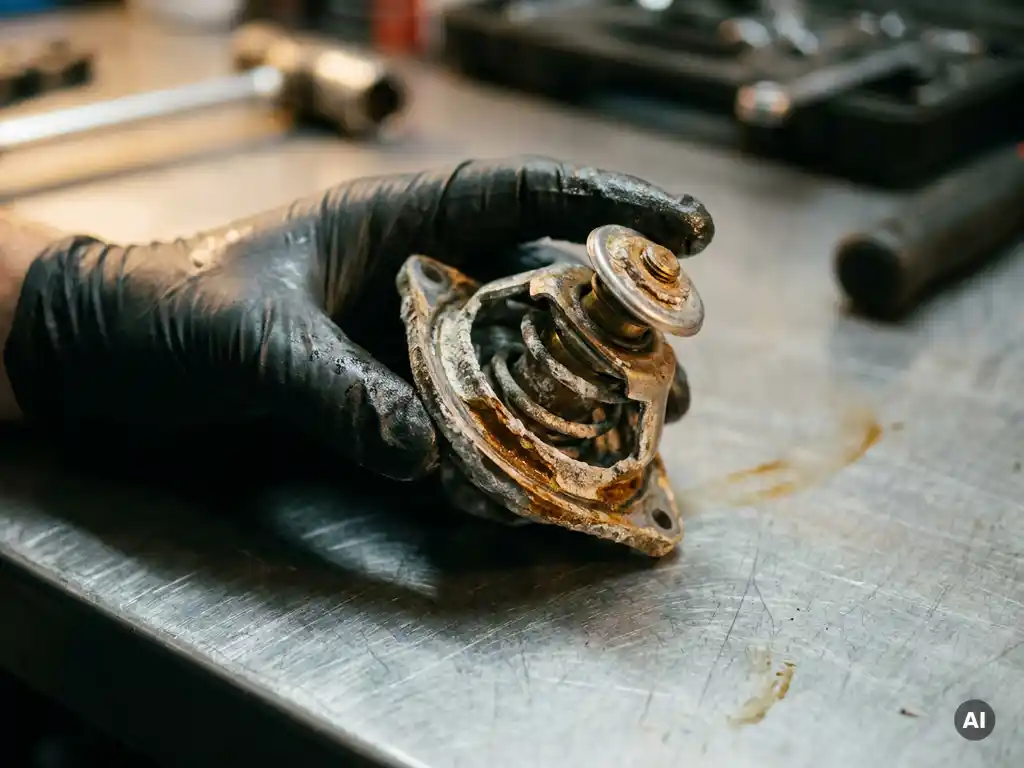
You can tell a thermostat valve needs replacing when your engine runs too hot or too cold, your heater stops working properly, or your temperature gauge behaves erratically. These are the clearest warning signs that the valve is no longer regulating coolant flow the way it should. The sections below walk through each of the key questions around thermostat valve failure so you know exactly what to look for and when to act.
What are the most common signs of a failing thermostat valve?
The most common signs of a failing thermostat valve are an engine that overheats, a temperature gauge that swings unpredictably, poor cabin heating, and reduced fuel efficiency. Any one of these symptoms on its own warrants a closer look at the thermostat mechanism, and several of them appearing together are a strong indicator that replacement is needed.
Here is what to watch for in more detail:
- Engine overheating: If the valve sticks closed, coolant cannot circulate through the radiator, and heat builds up rapidly inside the engine.
- Engine running too cold: A valve stuck open allows coolant to flow constantly, preventing the engine from reaching its optimal operating temperature.
- Fluctuating temperature gauge: The needle moving up and down erratically rather than settling at a steady point is a classic sign the thermostat mechanism is struggling to regulate flow.
- Weak or no cabin heat: Because cabin heating draws from engine coolant, a malfunctioning thermostat valve often leaves the interior feeling cold even with the heater on full.
- Increased fuel consumption: An engine that never fully warms up burns more fuel, so a noticeable drop in efficiency can trace back to a valve that is stuck open.
How does a thermostat valve actually fail over time?
A thermostat valve typically fails because the thermostat bellows or wax element inside it degrades after years of repeated expansion and contraction cycles. As the wax element loses its ability to respond accurately to temperature changes, the valve either stops opening fully, stops closing completely, or begins opening and closing at the wrong temperatures.
Inside a standard thermostat mechanism, a wax-filled chamber expands when heated and forces the valve open, then contracts as the engine cools and allows the valve to close again. This cycle happens thousands of times over the life of a vehicle or industrial system. Over time, the wax compound can break down, the thermostat bellows can develop micro-cracks, and corrosion or mineral deposits from the coolant can build up around the valve seat. Any of these changes disrupt the precise movement the thermostat relies on to do its job.
Contaminated coolant accelerates this process significantly. Coolant that has not been changed on schedule carries particulates and acidic compounds that attack the internal components of the valve, shortening its working life considerably.
Can a faulty thermostat valve fix itself or is replacement always necessary?
A faulty thermostat valve cannot fix itself. Once the thermostat bellows or wax element has degraded, or the valve seat has corroded, the component will not recover on its own. In some very rare cases, a valve that has temporarily stuck due to a debris particle may free itself, but this is not a reliable outcome and the underlying condition that allowed it to stick will remain.
Flushing the cooling system with fresh coolant can sometimes dislodge minor deposits and restore partial function temporarily, but this is not a substitute for replacement. If the thermostat mechanism has genuinely failed, the only reliable fix is fitting a new unit. Delaying that decision creates risk for the engine and for any system the thermostat is controlling.
What’s the difference between a thermostat valve stuck open and stuck closed?
A thermostat valve stuck open means coolant flows continuously through the radiator, so the engine never reaches its full operating temperature. A valve stuck closed means coolant cannot reach the radiator at all, causing the engine to overheat rapidly. Both are failures, but they produce opposite symptoms and carry different levels of urgency.
Stuck open
When the thermostat valve stays open, the engine runs chronically cold. You will notice the temperature gauge sitting lower than normal, the cabin heater underperforming, and fuel consumption creeping up. The engine is not in immediate danger of damage, but running cold for extended periods causes increased wear, incomplete combustion, and higher emissions. It is a slower problem, but still one that needs addressing.
Stuck closed
A valve stuck closed is the more urgent failure. With no coolant reaching the radiator, engine temperature rises quickly. Left unchecked, this leads to coolant boiling, cylinder head warping, and potentially catastrophic engine damage. If your temperature gauge is climbing into the red, pull over and do not continue driving until the system has been inspected. This is not a situation where waiting is an option.
How long should a thermostat valve last before needing replacement?
A thermostat valve in an automotive application typically lasts between 10 years and 150,000 kilometres under normal operating conditions, though this varies depending on coolant maintenance, operating environment, and the quality of the original component. In industrial systems, service intervals depend on duty cycles and the specific application rather than mileage.
The single biggest factor influencing longevity is coolant condition. Fresh, correctly mixed coolant protects the internal components of the thermostat mechanism from corrosion and deposit build-up. Coolant that is overdue for a change becomes acidic and begins attacking metal and rubber components, including the thermostat bellows and valve seat. Following the manufacturer’s coolant replacement schedule is one of the most effective ways to extend the life of a thermostat valve.
If a vehicle or system is operating in extreme temperatures, towing heavy loads regularly, or running in stop-start urban conditions, it is worth inspecting the thermostat mechanism earlier than the standard interval suggests.
What happens if you ignore a thermostat valve that needs replacing?
Ignoring a thermostat valve that needs replacing leads to progressively worse engine performance, higher fuel consumption, and eventually serious mechanical damage. The longer a failing valve is left in place, the more expensive the consequences become, particularly if the valve is stuck closed and overheating goes unchecked.
In the short term, a malfunctioning thermostat valve forces the engine to operate outside its designed temperature range. This affects combustion efficiency, increases wear on cylinder walls and piston rings, and can trigger warning lights or fault codes in modern engine management systems. Emissions also increase, which matters for compliance in regulated industries and commercial fleets.
In the longer term, sustained overheating from a valve stuck closed can warp the cylinder head, blow the head gasket, or cause the engine block itself to crack. These are repairs that cost many times more than a straightforward thermostat replacement. Even a valve stuck open, while less dramatic, causes long-term wear that shortens overall engine life.
The practical takeaway is straightforward: if the symptoms point to a failing thermostat mechanism, replacing the valve promptly is always the more cost-effective choice.
How BTT Solutions supports thermostat valve reliability
At BTT Solutions, we design and manufacture high-precision thermostat valves, thermostat bellows, and complete thermostat mechanisms for automotive, industrial, and building technology applications. Our components are engineered to maintain accurate temperature control across demanding duty cycles, which is exactly what prevents the failure modes described above from occurring prematurely.
Here is what we bring to the table for B2B customers:
- Patented end-to-end thermostat solutions developed for precise coolant regulation in passenger vehicles, commercial vehicles, and industrial systems
- High-quality wax elements and thermostat bellows that maintain consistent expansion and contraction characteristics over extended service lives
- Temperature sensors and control units that work alongside our thermostat valves to give engineers full visibility of thermal performance
- Application-specific engineering support for customers integrating our components into new designs or replacing legacy parts
- Direct access to our technical team without the delays that come with larger, less agile suppliers
Whether you are sourcing replacement thermostat valves for an existing platform or specifying components for a new application, we are ready to help. Get in touch with our team to discuss your requirements and find out how our thermostat technology can support your next project.
Related Articles
- What causes a thermostat bellows to fail prematurely?
- What are the most common design trade-offs in thermostat component engineering?
- How do you validate a thermostat for use in safety-critical applications?
- How do coolant regulators differ from standard thermostats?
- How is a thermostat calibrated during manufacturing?


