
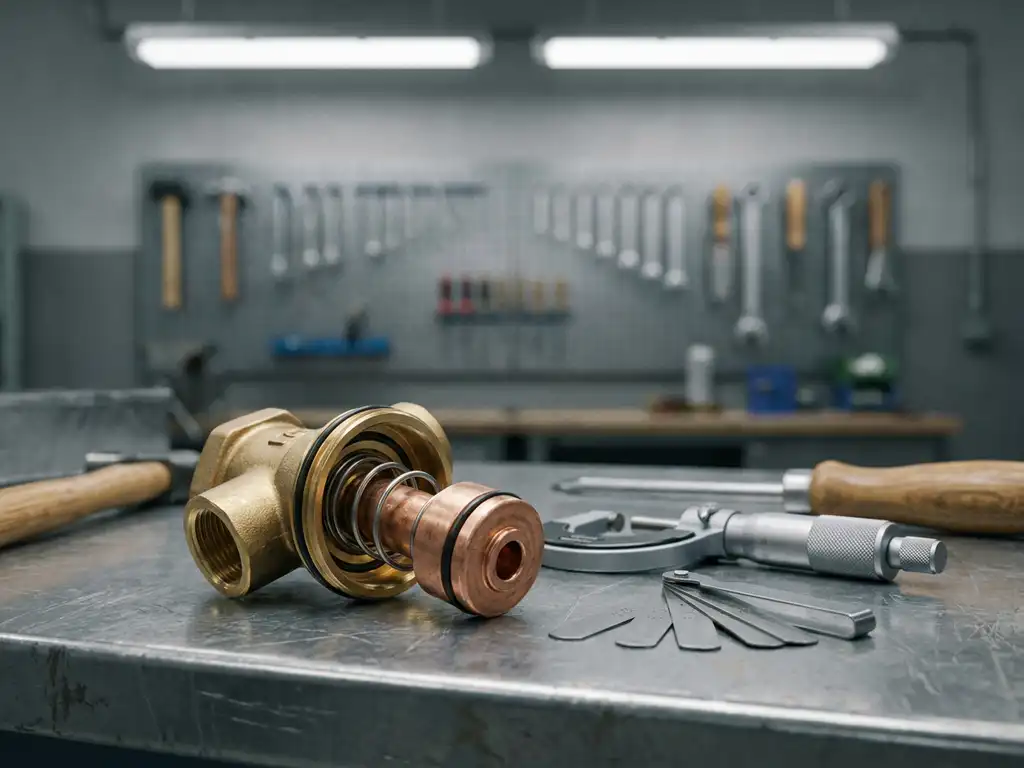
The most common design trade-offs in thermostat component engineering involve balancing response speed against thermal stability, choosing between wax-based and electronic actuation, selecting materials that hold up under stress, maintaining tight manufacturing tolerances, and adapting a single component design to work reliably across very different operating environments. These trade-offs are not abstract engineering puzzles. They have real consequences for fuel efficiency, emissions, durability, and cost. The sections below walk through each of the core challenges engineers face when developing precision thermomanagement components.
How do engineers balance response speed and thermal stability in thermostat design?
Engineers balance response speed and thermal stability in thermostat design by accepting that optimizing for one inherently constrains the other. A thermostat that reacts very quickly to temperature changes will be more sensitive to short-term fluctuations, which can cause instability. A design tuned for stable, consistent regulation tends to respond more slowly to sudden thermal shifts.
In practice, this trade-off is managed through the selection and calibration of the actuating element. Wax elements, for example, can be engineered to begin opening at a very precise temperature, but the speed of that opening depends on how quickly heat transfers into the wax pellet. Increasing thermal conductivity in the housing speeds up response but can also make the element more reactive to transient temperature spikes that do not reflect the true steady-state condition of the fluid.
For automotive applications, where coolant temperatures can shift rapidly during acceleration or load changes, engineers often accept a slightly slower response in exchange for smoother, more predictable regulation. In industrial settings, where thermal loads are more consistent, faster response can be prioritized without the same risk of hunting or oscillation. Getting this balance right requires detailed knowledge of the specific operating cycle, not just the target temperature range.
What are the trade-offs between wax element and electronic thermostat designs?
Wax element thermostats are passive, mechanically simple, and highly reliable, while electronic thermostats offer programmable control and faster adaptation but introduce complexity, cost, and potential failure points. The choice between them is one of the most fundamental decisions in thermal management design, and neither option is universally superior.
Wax element thermostats
Wax elements have been the backbone of thermostat engineering for decades, and for good reason. They require no external power, have no electronic components that can fail, and deliver consistent performance across a wide temperature range. Their self-contained actuation mechanism makes them ideal for applications where simplicity and long service life matter most. The limitation is that their response profile is fixed at the point of manufacture. Once the wax formulation and housing geometry are set, the opening temperature and stroke are essentially locked in.
Electronic thermostats
Electronic or map-controlled thermostats allow the engine management system to adjust the coolant temperature target dynamically based on load, speed, and ambient conditions. This can meaningfully improve fuel efficiency under certain driving cycles because the engine can run at a higher temperature during light-load cruising and a lower temperature under heavy load. The trade-off is that the system now depends on sensors, actuators, and control logic working together correctly. Each additional component adds potential failure modes and maintenance complexity, which is why wax elements remain the preferred choice in many cost-sensitive or reliability-critical applications.
How does material selection affect thermostat component performance?
Material selection directly affects a thermostat component’s thermal conductivity, chemical resistance, dimensional stability, and service life. Choosing the wrong material for a given application can lead to premature failure, inaccurate temperature regulation, or degraded performance over time, even if the underlying design is sound.
The housing material needs to withstand continuous exposure to coolant, oil, or other process fluids without corroding or swelling. Plastics offer weight and cost advantages but must be carefully selected for thermal stability, since some polymers soften or creep at elevated temperatures. Metal housings, typically aluminum or brass, provide better dimensional stability and thermal conductivity but add weight and cost.
For the wax element itself, the formulation of the wax blend determines the activation temperature and the force generated during expansion. Small changes in wax composition can shift the opening point by several degrees, which is why material consistency from batch to batch is so important in precision thermostat engineering. Seal materials face their own set of demands, needing to remain flexible and leak-free across a wide temperature range while resisting chemical attack from the fluids they contact.
Why is manufacturing tolerance such a critical trade-off in precision thermostat components?
Manufacturing tolerance is a critical trade-off in precision thermostat components because tighter tolerances improve performance accuracy and reliability but significantly increase production cost and complexity. Every dimension that must be held within a narrow band requires more precise tooling, more careful process control, and more thorough inspection.
In thermostat engineering, the activation temperature of a wax element depends on how precisely the element is assembled, how consistently the wax is filled, and how accurately the housing dimensions are maintained. A small variation in any of these factors can shift the opening temperature outside the acceptable range, which affects engine operating temperature, emissions, and, in some cases, warranty compliance.
The practical challenge is that not every dimension in a thermostat housing needs the same level of precision. Engineers must identify which tolerances are truly performance-critical and which can be relaxed without consequence. Tightening every dimension across the board adds cost without adding value. Relaxing the wrong tolerance can cause field failures. This prioritization process is where deep application knowledge makes a real difference, because the critical dimensions vary depending on whether the component is going into a passenger car, a commercial vehicle, or an industrial system.
What trade-offs arise when designing thermostats for multiple application environments?
Designing thermostats for multiple application environments requires balancing the desire for a common platform against the reality that different industries impose very different demands on temperature range, fluid compatibility, pressure rating, and service life. A design that works well in one context will often need meaningful adaptation to perform reliably in another.
Automotive thermostats typically operate within a relatively well-defined temperature band and are designed for long service intervals in coolant or oil circuits. Industrial thermostats used in process cooling or hydraulic systems may need to handle higher pressures, more aggressive fluids, or wider temperature swings. Heating system components for buildings, including those used in underfloor heating or radiator circuits, face different demands again, with lower operating temperatures but a need for very consistent regulation over many years of continuous use.
The trade-off engineers face is between standardization and optimization. A single component platform that covers multiple markets reduces tooling costs, simplifies inventory management, and concentrates engineering knowledge. But it also means accepting some performance compromise in each application rather than delivering the ideal solution for any one of them. In markets where precision and reliability are paramount, such as emissions-critical automotive applications or safety-sensitive industrial processes, that compromise may not be acceptable. In less demanding contexts, a well-designed common platform can deliver excellent value without sacrificing meaningful performance.
Fluid compatibility is another area where multi-environment design creates tension. A seal material that performs well in ethylene glycol coolant may not hold up in a synthetic hydraulic fluid. A housing alloy chosen for corrosion resistance in water-based systems may behave differently in oil circuits. Designing for versatility means either selecting materials that are acceptable across all target environments or building in application-specific variants, which reintroduces the complexity that standardization was meant to reduce.
How BTT Solutions supports thermostat component engineering decisions
Navigating these trade-offs is exactly where working with an experienced component specialist makes a practical difference. At BTT Solutions, we work directly with engineering and procurement teams to help identify the right thermostat components for their specific application requirements, whether that means selecting between wax element and electronic designs, advising on material compatibility, or defining the tolerance specifications that genuinely matter for performance.
Our product advisory service covers the full range of thermostat components we develop and manufacture, including:
- Wax elements engineered to precise activation temperatures for automotive, industrial, and building technology applications
- Thermostat inserts and complete assemblies designed for reliability across diverse operating conditions
- Engineered housings built to application-specific dimensional and material requirements
- Temperature sensors for accurate thermal feedback in vehicle and industrial systems
Because we operate as an independent, focused specialist rather than a large generalist supplier, we can give your project the direct attention it needs. Our teams across eight global locations combine deep manufacturing expertise with application knowledge built over decades in the field. If you are working through a thermostat design challenge or evaluating component options for a new application, we would be glad to help. Get in touch with our team to start the conversation.
Related Articles
- How do you validate a thermostat for use in safety-critical applications?
- 4 Key Metrics Fleet Operators Use to Measure Thermal Efficiency
- What are the most common automotive thermostat component failures?
- What happens when an engine thermostat opens and closes?
- How do coolant regulators differ from standard thermostats?


