
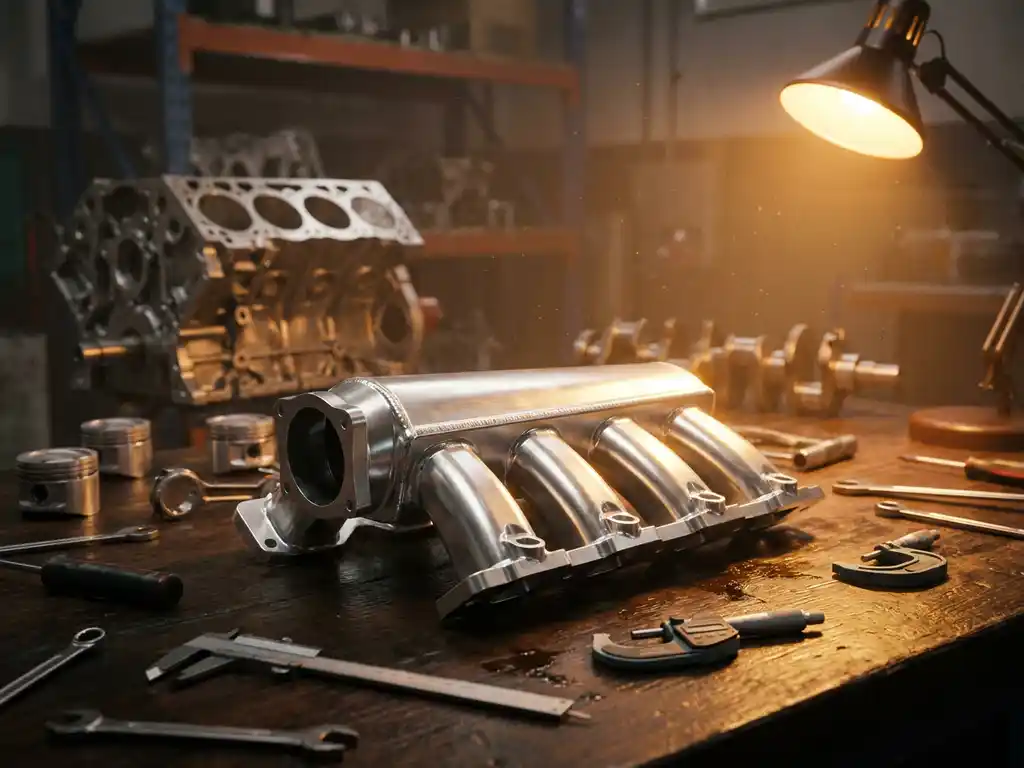
Yes, upgrading the intake manifold can improve engine efficiency, though the extent depends on your engine type, current setup, and how well the upgrade is matched to your specific application. A better-designed manifold improves airflow distribution across cylinders, which translates into more complete combustion, stronger power output, and in many cases, measurable gains in fuel economy. The sections below walk through the key questions engineers and procurement teams ask when evaluating this kind of modification.
How does the intake manifold affect engine performance?
The intake manifold distributes air, or an air-fuel mixture in older designs, from the throttle body to each cylinder. Its geometry directly determines how evenly and efficiently that charge reaches each combustion chamber. Poor distribution means some cylinders run lean while others run rich, which creates uneven power output, increased emissions, and wasted fuel.
Beyond distribution, the manifold’s internal volume and runner length influence the velocity and pressure of incoming air. Longer runners tend to favor low-end torque by creating a tuned resonance effect at lower RPMs, while shorter, wider runners support higher-RPM power. The shape of the plenum, the transitions between sections, and the smoothness of internal surfaces all play a role in how much turbulence the airflow encounters before reaching the valves.
In modern engines, the intake manifold also houses sensors, vacuum ports, and in some designs, variable runner systems that adjust geometry based on engine load. This makes the manifold a genuinely active component in engine air intake management, not just a passive passage.
What types of intake manifold upgrades are available?
Intake manifold upgrades generally fall into three categories: replacement manifolds, ported and polished stock manifolds, and variable intake systems. Each addresses a different aspect of airflow performance and suits different use cases.
- Replacement performance manifolds: Cast or fabricated units designed with optimized runner geometry for a specific RPM range or application. These are common in motorsport and high-output industrial engines.
- Ported and polished manifolds: The stock unit is machined to remove casting imperfections, smooth transitions, and match port dimensions to the cylinder head. This is a cost-effective route when the base design is already sound.
- Variable intake manifolds: These use actuators to change runner length or plenum volume dynamically. Many OEM engines already include this technology, but aftermarket upgrades can extend the range or improve the response of existing systems.
- Thermal barrier coatings: Applied to the interior of the manifold to reduce heat soak from the engine bay, keeping incoming air denser and more oxygen-rich.
The right choice depends on the engine’s intended operating range. A manifold optimized for peak power at high RPM will often sacrifice low-end responsiveness, which matters considerably in commercial vehicle or industrial engine contexts.
How much can an intake manifold upgrade improve fuel efficiency?
A well-matched intake manifold upgrade can contribute to fuel efficiency improvements, though it rarely acts alone. The gains come from more complete combustion driven by better air distribution, reduced pumping losses from smoother airflow, and in variable systems, better matching of air supply to actual engine demand at any given load point.
In practice, manifold improvements are most effective when combined with complementary upgrades, such as a properly calibrated fuel management system, a matched throttle body, and optimized thermal management across the engine. An upgrade that delivers better airflow but is not supported by accurate temperature and mixture control will not reach its potential.
It is also worth noting that on modern engines with tight factory tolerances, the marginal gains from a manifold upgrade alone are smaller than on older or higher-displacement engines. The clearest efficiency benefits tend to appear in applications where the stock manifold was a compromise, such as an engine family used across multiple vehicle lines, with a single manifold design serving very different displacement and power targets.
What’s the difference between a performance manifold and a stock manifold?
A stock manifold is designed for broad compatibility, cost-effective manufacturing, and compliance across a range of operating conditions. A performance manifold is engineered for a specific power and efficiency target, often at the expense of that versatility.
Design priorities
Stock manifolds are cast in large volumes and must accommodate packaging constraints, emissions equipment, sensor locations, and serviceability requirements. Runner lengths and plenum volumes are often a compromise between low-end driveability and peak output. Performance manifolds, by contrast, are designed around a target RPM range and airflow volume, with runner geometry, port matching, and plenum sizing all optimized for that specific goal.
Materials and construction
Stock manifolds are commonly made from cast aluminum or plastic composites, which are lightweight and inexpensive to produce. Performance units may use higher-grade aluminum alloys, fabricated steel, or composite materials with thermal barrier properties. The internal surfaces of performance manifolds are typically smoother, with tighter tolerances at port entries and exits to minimize turbulence and pressure drop.
Does intake manifold temperature affect engine efficiency?
Yes, intake manifold temperature has a direct effect on engine efficiency. Warmer air entering the combustion chamber is less dense, meaning it carries less oxygen per unit volume. Less oxygen means less fuel can be burned effectively, which reduces power output and can force the engine management system to compensate in ways that hurt economy.
Heat soak is a common issue in performance and high-load applications. The manifold sits close to hot engine components, and over time, especially during stop-start driving or idling, it absorbs that heat and transfers it to incoming air. This is one reason thermal management across the entire engine bay matters, not just at the cooling circuit level.
Strategies to address manifold temperature include thermal barrier coatings on the manifold interior, heat shields between the manifold and exhaust components, and in some designs, water-cooled intake manifolds that actively regulate charge temperature. Keeping intake air as cool as possible is one of the more straightforward ways to maintain consistent engine air intake density across varying operating conditions.
When is an intake manifold upgrade worth it?
An intake manifold upgrade is worth considering when the current manifold is a demonstrable bottleneck, when the engine is being rebuilt or substantially modified, or when specific efficiency or emissions targets cannot be met with the existing hardware. It is rarely the right first step on its own.
The strongest cases for a manifold upgrade include:
- Engines that have been retuned or modified beyond their original specification, where the stock manifold can no longer supply air at the required volume or velocity
- Applications where the engine operates consistently at loads or RPM ranges outside the stock manifold’s optimized range
- Industrial or commercial engines where fuel costs over a long service life make even incremental efficiency gains economically significant
- Situations where intake air temperature management is a known issue and a manifold with better thermal properties would address it directly
For most standard applications running within their designed parameters, a manifold upgrade will deliver modest results unless the rest of the engine system is also optimized. The upgrade works best as part of a coordinated approach to manifold improvement and engine thermal management rather than as a standalone fix.
How BTT Solutions supports engine thermal management
Intake manifold performance is only one part of the efficiency picture. Charge air temperature, coolant flow, and thermal regulation across the engine all interact, and that is where precise thermostat components make a measurable difference. At BTT Solutions, we help engineers and procurement teams select the right thermostat components to keep engine temperatures within the optimal range, which directly supports the fuel efficiency and emissions targets that drive decisions like intake manifold upgrades.
Our product advisory service covers:
- Wax elements for precise temperature-triggered actuation in engine cooling circuits
- Thermostat inserts engineered for reliable performance across demanding duty cycles
- Engineered housings designed to integrate cleanly into automotive, industrial, and commercial vehicle applications
We work directly with technical decision-makers and engineers to match components to specific thermal management requirements, whether that is for a new platform design or an upgrade to an existing system. As a focused specialist with a lean structure, we provide the kind of responsive, individual attention that larger suppliers often cannot. If you are evaluating how thermal management components can support your engine efficiency goals, get in touch with our team and we will find the right solution together. You can also learn more about us and the expertise we bring to every application.
Related Articles
- What is the difference between engine efficiency and fuel economy?
- How do miniaturized thermostat components differ from standard ones?
- Can thermostat test results vary between laboratories?
- How do you choose the right thermal management solution?
- How do thermal management systems control coolant temperature?


