
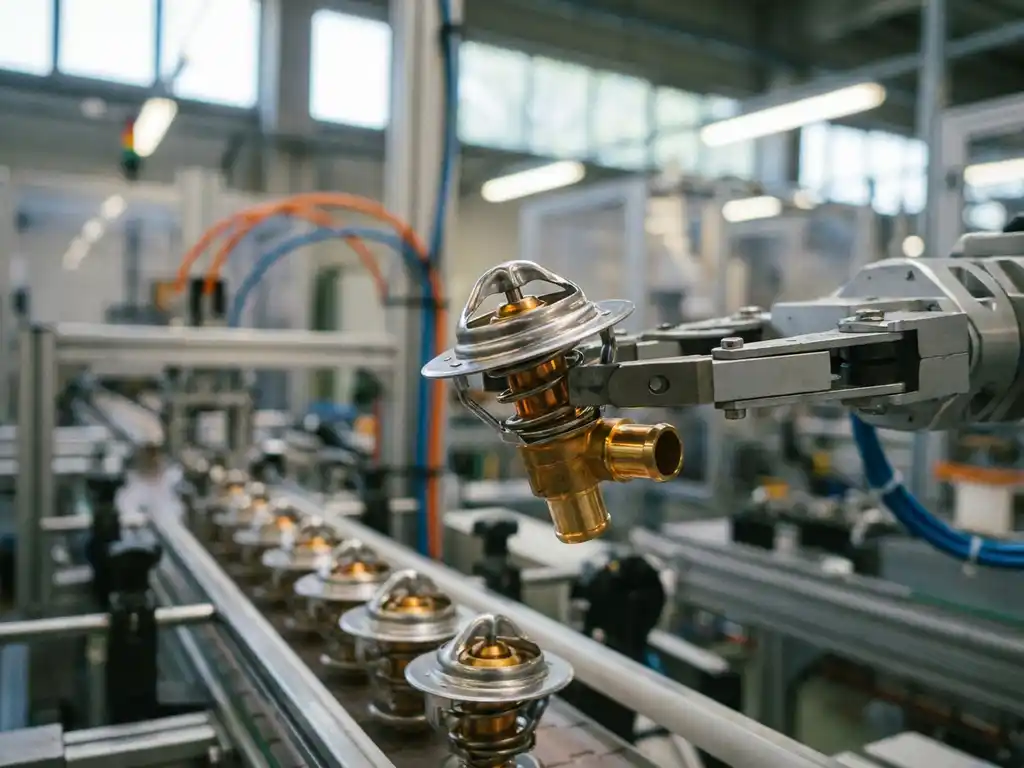
Thermostat components are manufactured at scale through a combination of precision material processing, automated assembly lines, and rigorous quality control systems. The process begins with carefully selected raw materials and moves through several controlled production stages to deliver components that meet exact thermal performance specifications. Each section below unpacks a key part of that process, from materials and machining to customization and the challenges manufacturers face when scaling up.
What materials are used to make thermostat components?
Thermostat components are primarily made from wax elements, brass, aluminum, engineered plastics, and rubber seals. The specific material mix depends on the application, but wax-based actuators sit at the heart of most thermostatic devices because of their reliable and repeatable thermal expansion behavior across a defined temperature range.
Wax elements are particularly important because they expand and contract predictably as temperature changes, which is what physically opens and closes the thermostat valve. The composition of the wax blend is carefully engineered to activate at a precise temperature, and even small variations in formulation can shift the opening point by several degrees.
Brass and aluminum are commonly used for housings and valve bodies because they offer excellent thermal conductivity, corrosion resistance, and dimensional stability under heat cycling. Engineered plastics have become increasingly common in secondary structural components where weight reduction matters, particularly in automotive thermostat production. Rubber and elastomer seals complete the assembly by maintaining fluid-tight performance across the full operating temperature range.
How does the precision manufacturing process for thermostats work?
Precision thermostat manufacturing follows a structured sequence: material preparation, wax element production, component machining, sub-assembly, final assembly, and calibration. Each stage is tightly controlled to ensure the finished component opens and closes within a tolerance that is often as narrow as plus or minus one degree Celsius.
Wax element production is one of the most technically demanding steps. The wax blend is mixed to a precise formulation, filled into metal capsules under controlled conditions, and sealed with a rubber plug that transmits the expansion force to the valve pin. Any inconsistency in fill volume or seal integrity affects the thermal response of the finished unit.
Machined components, such as valve bodies and housings, are produced on CNC equipment to tight dimensional tolerances. After machining, parts go through cleaning and surface treatment processes before moving into assembly. Final assembly brings together the wax element, valve, spring, and housing in a controlled environment, followed by calibration testing where each unit is verified against its target opening temperature.
What quality control methods are used in thermostat production?
Quality control in thermostat production relies on a combination of in-process inspection, functional testing, and statistical process control. Every thermostat component passes through temperature-based functional testing to confirm it opens and closes at the specified set point before it leaves the production line.
In-process inspection catches dimensional issues early by checking machined parts at key stages rather than waiting until final assembly. Statistical process control monitors production trends over time, flagging drift before it leads to out-of-specification parts. This approach reduces waste and keeps the process stable across high-volume runs.
Functional testing typically involves exposing finished components to a controlled temperature bath and measuring the exact point at which the valve begins to open and reaches full stroke. Components that fall outside the defined tolerance window are rejected or reworked. For demanding applications such as automotive engine cooling, additional durability and leak tests are standard.
How do manufacturers scale thermostat production without losing precision?
Scaling thermostat manufacturing without sacrificing precision requires investing in automated assembly equipment, standardized tooling, and robust process documentation. Automation reduces the variability introduced by manual handling, while standardized tooling ensures that the same dimensional outcomes are achieved consistently across shifts and production cells.
Process documentation plays a larger role than it might seem. When every step is clearly defined, including torque values, fill weights, and calibration procedures, it becomes possible to replicate the same quality outcome whether a facility is producing hundreds or hundreds of thousands of units per year. Training and operator qualification programs reinforce this consistency at the human level.
Manufacturers also use end-of-line testing as a final gate. Rather than sampling, many high-volume thermostat production lines test every single unit, which means scaling up output does not mean accepting a higher defect rate. The test data generated at scale also feeds back into process improvement, making the production system smarter over time.
What are the biggest challenges in manufacturing thermostat components at scale?
The biggest challenges in scaling thermostat component manufacturing are maintaining wax element consistency, managing thermal calibration across high volumes, and sourcing materials that meet tight specifications reliably. Each of these becomes harder to control as production volumes increase.
Wax element consistency is particularly sensitive because the wax blend must behave identically from batch to batch. Variations in raw material quality or mixing conditions can shift the activation temperature, which means incoming material quality control is as important as the manufacturing process itself.
Thermal calibration at scale also presents a challenge. Testing every unit individually is time-consuming, and the test equipment itself must be maintained and calibrated regularly to remain accurate. As production volumes grow, the testing infrastructure must scale alongside the assembly lines.
Supply chain reliability is another pressure point. Precision thermal management components depend on materials and sub-components that are often sourced from specialized suppliers. Disruptions at any point in that chain can affect production schedules and output quality, which is why strong supplier relationships and dual-sourcing strategies are important for high-volume manufacturers.
How are thermostat components customized for different industries?
Thermostat components are customized primarily by adjusting the wax element formulation, housing geometry, valve configuration, and material selection to match the thermal and mechanical requirements of a specific application. The same underlying technology serves automotive engines, industrial cooling systems, building heating circuits, and marine applications, but each requires a tailored specification.
In automotive applications, the focus is on precise opening temperatures, fast response times, and durability under high-pressure coolant conditions. For building heating systems, thermostatic components often operate at lower pressures and temperatures but need to be compatible with a wider range of fluid types, including water-glycol mixtures used in radiant floor heating.
Industrial applications introduce their own demands, such as resistance to aggressive media, wider operating temperature ranges, or integration into larger valve assemblies. In each case, the customization process starts with a detailed specification review, followed by prototype development and validation testing before series production begins. This upfront investment in getting the specification right is what makes high-volume production reliable.
How BTT Solutions supports your thermostat component requirements
We work with customers across the automotive, industrial, and building technology sectors to develop and supply thermostat components that are built to precise specifications and ready for high-volume production. Our team brings deep expertise in the full manufacturing process, from wax element formulation through to final calibration and testing.
Here is what we offer as part of our component advisory and supply service:
- Component selection guidance: We help you identify the right wax elements, thermostat inserts, and engineered housings for your specific thermal management application.
- Custom specification development: We work with your engineering team to define opening temperatures, materials, and form factors that match your system requirements.
- Scalable production: Our manufacturing infrastructure supports both development quantities and full-series production without compromising on precision or quality.
- Cross-industry experience: Whether you are working on an automotive cooling circuit, an industrial process system, or a building heating application, we have relevant experience to draw on.
- Responsive support: As a focused, mid-sized organization, we offer direct access to technical expertise and faster decision-making than larger suppliers typically allow.
If you are developing a new application or looking to improve the performance of an existing thermal management system, we would be glad to talk through your requirements. Get in touch with our team to start the conversation.


