
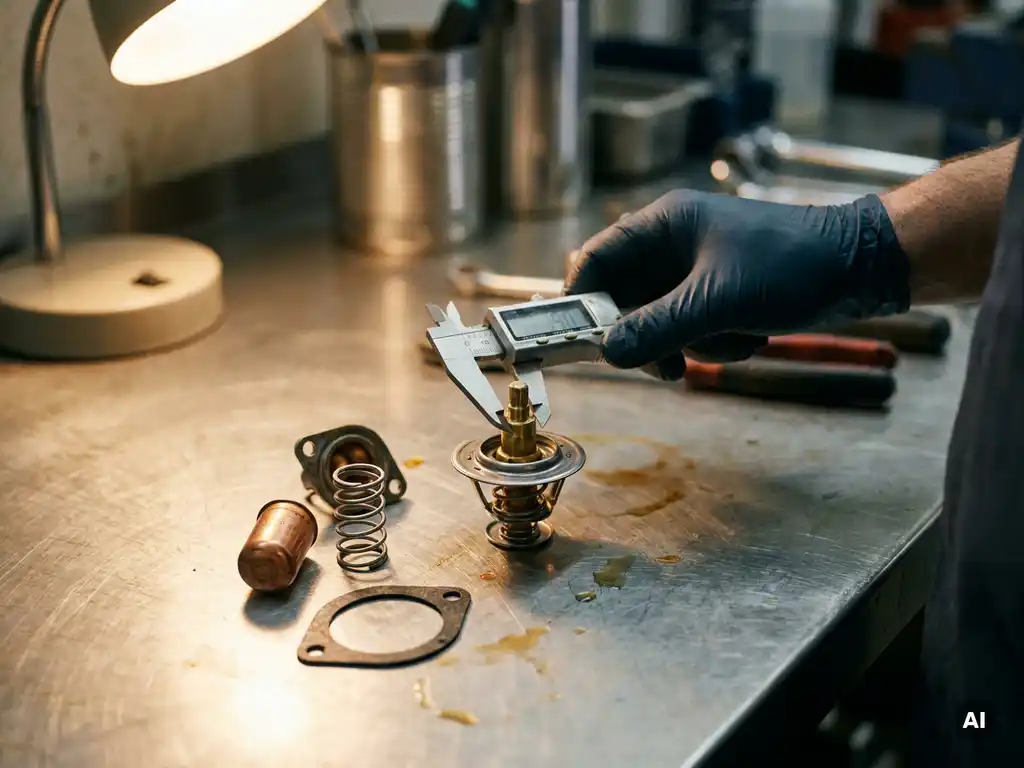
To test whether a wax pellet thermostat is working correctly, submerge it in a pot of hot water and observe whether it opens at the temperature marked on its body. If it stays shut or fails to open fully, the thermostat is faulty. This simple hot water test is reliable, low-cost, and requires no specialist equipment.
The test works because of how the thermostat is designed: a small chamber of wax expands as it heats up, physically pushing a valve open. When that wax element material degrades or the mechanism seizes, the valve stops responding as it should. The sections below walk through the warning signs, the testing method, and when replacement is the right call.
What signs indicate a wax pellet thermostat has failed?
The most common signs of a failed wax pellet thermostat are an engine or system that overheats, one that runs permanently cold, or temperature readings that fluctuate unpredictably. In heating systems, you might notice uneven heat distribution or a circuit that never reaches its set temperature. Any of these symptoms point to a valve that is stuck open, stuck closed, or opening at the wrong point.
A thermostat stuck in the closed position is the more dangerous failure. The coolant or fluid cannot circulate to the radiator, so heat builds up rapidly. A thermostat stuck open is less urgent but still problematic: the system never reaches its optimal operating temperature, which wastes energy and, in automotive applications, increases fuel consumption and emissions. Erratic temperature swings often mean the wax element is partially degraded and responding inconsistently to heat.
How does a wax pellet thermostat actually open and close?
A wax pellet thermostat opens and closes through the physical expansion and contraction of a specially formulated wax element material sealed inside a metal capsule. As the surrounding fluid temperature rises toward the thermostat’s rated opening point, the wax melts and expands, pushing a piston outward. That piston movement opens the valve. When the temperature drops, the wax solidifies and contracts, and a return spring closes the valve again.
The precision of this mechanism depends entirely on the consistency of the wax thermal expansion curve. High-quality wax compounds are engineered to expand predictably within a very narrow temperature band, which is what allows a thermostat to open at, say, 80°C rather than anywhere between 75°C and 90°C. This is why the quality of the wax element material matters so much: inconsistent wax leads to inconsistent valve behavior, and inconsistent valve behavior undermines the entire temperature control system.
The simplicity of the design is also its strength. There are no electronic components, no sensors, and no software. The thermostat components respond directly to the physical environment, which makes them robust and long-lasting when manufactured to a high standard.
How do you test a wax pellet thermostat with hot water?
To test a wax pellet thermostat with hot water, remove it from the system, place it in a pot of water, and slowly heat the water while monitoring the temperature with a thermometer. Watch for the valve to begin opening. It should start to open within a few degrees of the temperature stamped on the thermostat body, and it should open fully as the water continues to heat.
Here is how to carry out the test step by step:
- Remove the thermostat from the engine, heating circuit, or industrial system following the manufacturer’s procedure.
- Inspect it visually for corrosion, cracking, or obvious physical damage before testing.
- Suspend the thermostat in a pot of cold water using a piece of wire or string so it does not rest against the hot metal base.
- Place a calibrated thermometer in the water alongside it.
- Heat the water slowly and watch the valve carefully as the temperature approaches the rated opening point.
- Note the exact temperature at which the valve begins to move and the temperature at which it reaches full open.
- Remove the heat source and allow the water to cool. The valve should close smoothly as the temperature drops.
A healthy thermostat will open within roughly two to three degrees of its rated temperature and close cleanly as the water cools. If the valve does not move, moves too early, or fails to close again, the thermostat should be replaced.
Can you test a wax pellet thermostat without removing it?
You can perform some basic checks without removing a wax pellet thermostat, but a definitive test always requires removal. In an automotive context, you can use an infrared thermometer or a scan tool to monitor coolant temperature at different points in the circuit. If the upper radiator hose stays cold while the engine is at operating temperature, the thermostat is likely stuck closed. If the engine never reaches normal operating temperature, it may be stuck open.
For heating systems, monitoring flow temperatures on either side of the thermostat can reveal whether it is regulating correctly. However, these in-situ checks only tell you that something is wrong, not whether the thermostat itself is the cause. A pipe blockage, a failing pump, or a sensor fault can produce similar symptoms. The hot water bench test is the only way to isolate the thermostat and confirm its behavior with confidence.
What causes a wax pellet thermostat to fail prematurely?
Wax pellet thermostats fail prematurely most often due to contaminated fluid, thermal shock, or the use of incompatible coolant additives that degrade the wax element material over time. Corrosion inside the valve housing and mechanical damage from debris in the fluid are also common culprits.
The specific causes worth knowing about include:
- Contaminated coolant or heating fluid: Particles, scale, and chemical contaminants can clog the valve seat or attack the wax capsule seal, causing leakage or erratic behavior.
- Incompatible additives: Some antifreeze formulations or industrial fluid additives are chemically aggressive toward the materials used in the thermostat capsule.
- Thermal shock: Rapid, repeated swings between extreme temperatures can fatigue the metal components and cause the wax thermal expansion mechanism to lose its calibrated response.
- Overheating events: A single severe overheating episode can permanently alter the wax compound, shifting its expansion curve and changing the thermostat’s opening temperature.
- Age and cycle fatigue: Even in normal service, the open-close cycle, repeated thousands of times, eventually wears the valve seat and spring.
Regular fluid maintenance, using the correct fluid specification, and avoiding overheating events are the most effective ways to extend thermostat service life.
When should a faulty wax pellet thermostat be replaced rather than retested?
A wax pellet thermostat should be replaced immediately if it fails the hot water test, shows visible corrosion or physical damage, or if the system has experienced a severe overheating event. Retesting is only useful as a diagnostic step to confirm a suspected failure. Once a thermostat has been confirmed faulty, there is no repair option: the wax element material cannot be recalibrated or restored.
In practice, replacement is also the right choice when a thermostat is old and has already been removed. Reinstalling a high-mileage thermostat to save the cost of a new part is a false economy. The labor involved in accessing the thermostat is often the larger part of the job, and a new component provides a known, reliable starting point. For industrial and commercial heating systems, planned replacement intervals based on operating hours are often more cost-effective than waiting for a failure to occur.
If the system has suffered repeated thermostat failures in a short period, the root cause is almost certainly elsewhere. Contaminated fluid, an undersized cooling circuit, or a pump fault can destroy a new thermostat just as quickly as it did the old one. Replacing the thermostat without investigating why it failed will not solve the underlying problem.
How BTT Solutions supports wax pellet thermostat applications
We design and manufacture high-precision wax pellet thermostats and thermostat components for automotive, industrial, and building technology applications. Our products are engineered around tightly controlled wax element material formulations that deliver consistent wax thermal expansion behavior across the full service life of the component.
Here is what working with us looks like in practice:
- Precision-engineered wax elements: Our wax compounds are developed in-house and validated to open within a narrow, repeatable temperature band, reducing variability across production batches.
- Application-specific solutions: Whether you need thermostats for engine coolant circuits, industrial fluid systems, radiant floor heating, or marine applications, we develop components matched to your exact operating conditions.
- End-to-end supply: From wax element capsules to complete thermostat assemblies and temperature sensors, we supply the full component range through a single, responsive partner.
- Flexible, direct collaboration: As a focused mid-size manufacturer, we give our B2B customers direct access to our engineering team, fast response times, and the flexibility to develop custom solutions without the delays of a large corporate structure.
If you are specifying thermostat components for a new application or looking to improve the reliability of an existing system, we would be glad to discuss your requirements. Get in touch with our team to start the conversation.


