
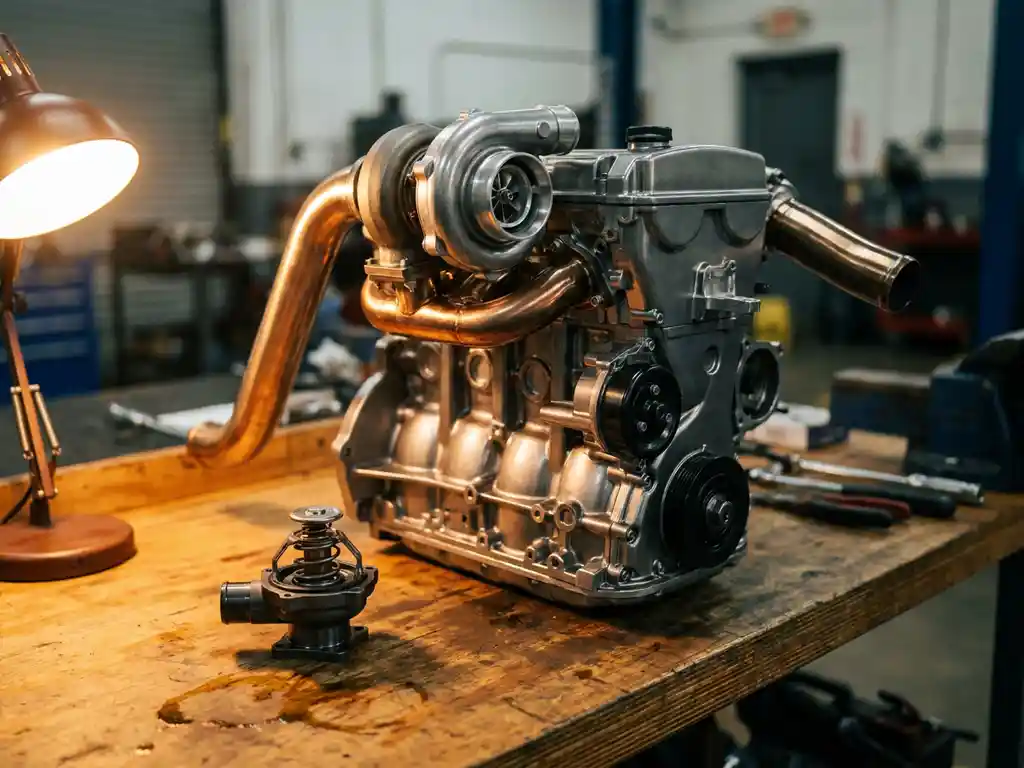
Turbocharged engines generally deliver greater efficiency per liter of displacement than naturally aspirated engines, especially under steady-state highway conditions. By forcing more air into the combustion chamber, a smaller turbocharged engine can match or exceed the output of a larger naturally aspirated unit while consuming less fuel at moderate loads. The sections below explore how these two engine types compare across power density, fuel economy, thermal behavior, reliability, urban driving, and emissions compliance.
Which engine type produces more power per liter of displacement?
Turbocharged engines produce significantly more power per liter of displacement than naturally aspirated engines. A modern turbocharged 1.5-liter four-cylinder can comfortably match the output of a naturally aspirated 2.0-liter or even 2.5-liter unit, making turbocharging the dominant strategy for achieving high specific output without increasing engine size or weight.
This advantage comes from the turbocharger’s core function: it compresses intake air before it enters the combustion chamber, allowing more oxygen to mix with fuel in each cycle. More oxygen means more fuel can be burned per stroke, which translates directly into greater torque and power from the same swept volume.
Naturally aspirated engines, by contrast, rely entirely on atmospheric pressure to fill the cylinders. Their specific output is limited by physics unless engineers raise compression ratios, optimize valve timing, or increase engine speed. High-revving naturally aspirated engines in sports cars can achieve impressive specific outputs, but they typically require the driver to work the engine hard to access that performance. A turbocharged engine delivers its power advantage across a much broader rev range, particularly in the mid-range where everyday driving happens.
How does a turbocharger affect fuel consumption in real-world driving?
In real-world driving, a turbocharged engine’s fuel consumption advantage over a naturally aspirated engine is real but conditional. At steady highway speeds and light loads, a smaller turbocharged engine typically consumes less fuel than a larger naturally aspirated engine producing similar power. However, aggressive driving that keeps the turbocharger spooled up can narrow or eliminate that gap.
The efficiency benefit works because a downsized turbocharged engine spends more of its operating time at relatively high load, which is where internal combustion engines are thermodynamically most efficient. A large naturally aspirated engine cruising at light throttle operates far from its efficiency peak, wasting fuel on pumping losses and friction from its greater displacement.
Where turbocharged engines can underperform their official economy figures is in stop-start urban traffic. Frequent acceleration events demand boost pressure, and the turbocharger introduces a brief lag before full torque arrives, which can prompt drivers to apply more throttle than necessary. The result is fuel consumption that sometimes exceeds what a well-matched naturally aspirated engine would use in the same conditions.
Why does engine temperature management differ between the two engine types?
Engine temperature management is more complex and more critical in turbocharged engines than in naturally aspirated ones. The turbocharger itself operates at extremely high temperatures, the compressed intake air must be cooled before entering the engine, and the engine’s coolant and oil systems must handle heat loads that naturally aspirated engines simply do not generate at the same intensity.
A turbocharger’s turbine wheel spins in the exhaust stream, where gas temperatures can exceed 900 degrees Celsius under load. The bearing housing that supports the shaft must be continuously cooled and lubricated. After the engine is switched off, residual heat can cook the oil in the bearing housing if coolant circulation stops immediately, which is why many turbocharged vehicles run a post-shutdown coolant pump.
The intercooler adds another layer of thermal management. Compressed air heats up as it is pressurized, and feeding hot, dense air into the engine reduces efficiency and increases knock risk. The intercooler strips that heat away before the charge air reaches the intake manifold. Naturally aspirated engines have no equivalent component to manage.
For the engine block itself, a turbocharged engine’s thermostat and coolant routing must respond quickly and precisely to changing heat loads. The transition from a cold start to full boost at operating temperature places rapid, large demands on the cooling system. Precise thermostat components that open and close at exactly the right temperatures are essential to keeping a turbocharged engine in its optimal thermal window, protecting both performance and longevity.
What are the long-term reliability differences between NA and turbocharged engines?
Naturally aspirated engines have a long-established reputation for long-term reliability because they have fewer components that can wear or fail. Without a turbocharger, intercooler, boost pressure management system, or post-shutdown cooling circuit, there are simply fewer potential failure points. Well-maintained naturally aspirated engines routinely cover very high mileages with minimal intervention.
Turbocharged engines have closed this reliability gap considerably over the past two decades. Modern turbochargers are far more durable than earlier generations, and engine management systems have become sophisticated enough to protect the turbocharger from the conditions most likely to cause damage. That said, turbocharged engines remain more sensitive to maintenance quality than their naturally aspirated counterparts.
Oil quality and change intervals matter more in a turbocharged engine because the turbocharger’s bearings depend on clean, properly viscous oil to survive the heat and speed they operate under. Skipping oil changes or using the wrong specification can shorten turbocharger life significantly. Naturally aspirated engines are more forgiving of occasional maintenance lapses, though they certainly benefit from regular servicing too.
The cooling system is another reliability-critical area in turbocharged engines. A thermostat that sticks open or closed can expose a turbocharged engine to thermal stress that a naturally aspirated engine would tolerate more easily, because the heat loads and the consequences of poor temperature regulation are more severe.
Which engine type is more efficient for low-speed urban driving?
For low-speed urban driving, naturally aspirated engines often match or outperform turbocharged engines in real-world fuel efficiency. In stop-start city traffic, the turbocharger’s efficiency advantage largely disappears because the engine rarely reaches the sustained moderate loads where downsizing pays off, and the additional complexity of the forced induction system adds weight and mechanical losses without delivering its intended benefit.
A small, naturally aspirated engine with a well-calibrated fuel injection system can be genuinely efficient in urban conditions. It has no turbo lag to manage, no intercooler to add thermal mass, and no boost-related demands on the cooling system. Drivers tend to drive it more smoothly because the throttle response is linear and predictable.
That said, many modern turbocharged engines are specifically tuned for urban efficiency. Variable geometry turbochargers, electric turbocharger assistance, and advanced engine management systems have reduced lag and improved low-load efficiency considerably. In 2026, the gap between the two technologies in urban conditions is narrower than it was a decade ago, and the choice often comes down to the specific engine calibration rather than the technology category.
How do emissions regulations influence the choice between NA and turbocharged engines?
Emissions regulations have been one of the primary forces pushing automakers toward turbocharged engines over the past fifteen years. Stricter CO2 targets in Europe, North America, and Asia have made engine downsizing through turbocharging an attractive compliance strategy, because a smaller turbocharged engine can deliver the performance customers expect while producing lower average CO2 emissions on official test cycles.
Naturally aspirated engines struggle to meet the most demanding CO2 standards at higher power outputs because achieving strong performance requires larger displacement, which inherently burns more fuel. Turbocharging allows engineers to extract that performance from a smaller package, reducing the CO2 penalty per unit of output.
Particulate emissions tell a more nuanced story. Turbocharged gasoline direct injection engines, which are now the dominant powertrain configuration in passenger cars, produce more particulate matter than port-injected naturally aspirated engines under certain conditions. This has led regulators to tighten particulate standards specifically targeting direct injection engines, requiring gasoline particulate filters on many new vehicles.
Thermal management plays a role here too. Engines that reach operating temperature quickly produce fewer cold-start emissions, and a well-designed coolant circuit with a precisely calibrated thermostat shortens the warm-up phase. This is an area where our engineering expertise at BTT Solutions directly supports emissions compliance, because the thermostat’s response characteristics during warm-up have a measurable effect on cold-start emissions output.
How BTT Solutions supports engine thermal management across both engine types
Whether you are working with naturally aspirated or turbocharged powertrains, precise temperature control is fundamental to efficiency, emissions compliance, and long-term durability. We at BTT Solutions design and manufacture thermostat components built specifically for the demanding thermal environments that modern engines create.
Our product advisory service helps engineering and procurement teams select the right components for their specific application. Here is what we bring to the table:
- Wax elements and thermostat inserts engineered for fast, accurate response across a wide temperature range, reducing warm-up time and cold-start emissions
- Engineered housings designed to integrate cleanly into complex coolant routing systems, including the multi-circuit architectures common in turbocharged engines
- Application-specific calibration so that each component opens and closes at precisely the temperature your engine management system expects
- Cross-industry expertise spanning automotive, industrial, and building technology, giving us a broad view of thermal management challenges and solutions
We work directly with technical decision-makers, procurement leads, and engineers to match components to real application requirements, not just catalogue specifications. If you are evaluating thermostat solutions for a new powertrain program or looking to improve the thermal performance of an existing design, we would be glad to help. Get in touch with our team to start the conversation.
Related Articles
- What is parasitic drag and how does it steal engine power?
- How do thermostat components behave differently in wet or humid environments?
- Can thermostat component design affect response time?
- What role does temperature stability play in engine protection?
- Why do thermostats use wax instead of electronics?


