
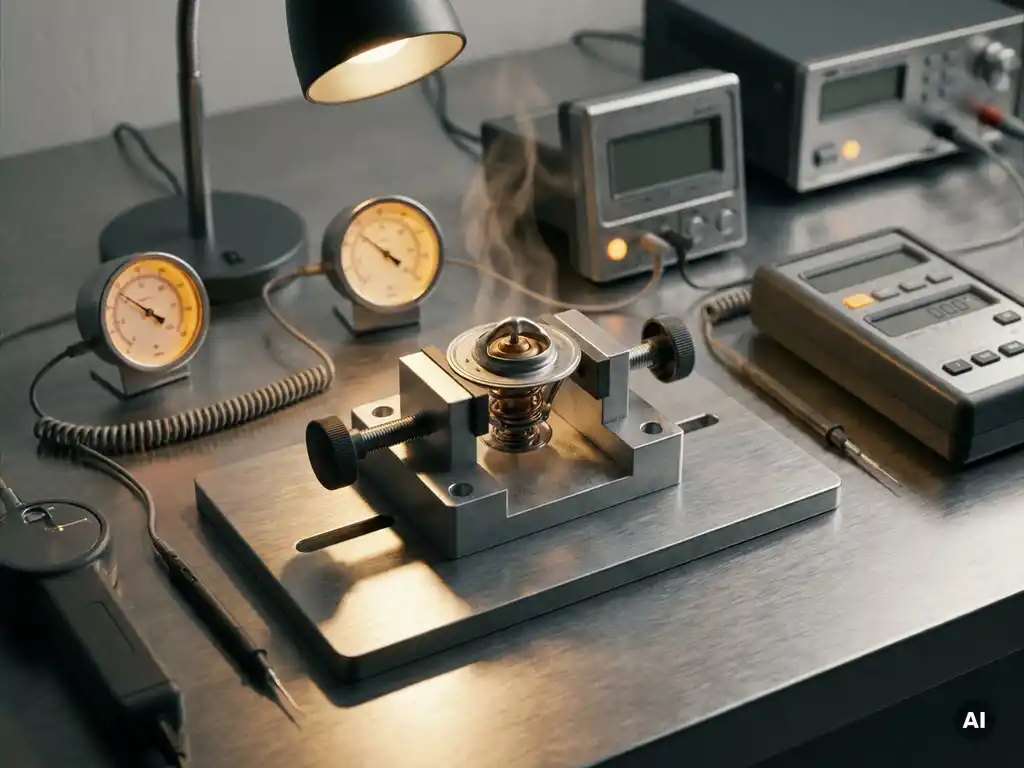
Yes, engineers should absolutely prioritize thermostat calibration during component validation. Skipping or deprioritizing this step risks deploying components that fail to regulate temperature accurately under real operating conditions, which can compromise system efficiency, safety, and longevity. The sections below walk through the most common questions engineers raise around thermostat calibration, from what goes wrong when it is skipped to how precision requirements differ across thermostat types.
What happens when thermostat calibration is skipped during validation?
When thermostat calibration is skipped during validation, components enter service without confirmed accuracy against their specified opening temperature and flow characteristics. This means a thermostat may open too early, too late, or inconsistently, causing the system it controls to operate outside its intended thermal window. The consequences range from reduced efficiency to accelerated component wear.
In automotive applications, an uncalibrated thermostat can allow the engine to run too cool, increasing fuel consumption and emissions, or too hot, raising the risk of thermal damage. In industrial and HVAC settings, the same principle applies: if the thermostat does not respond at the correct temperature point, the entire system compensates in ways that were never designed into it.
Beyond the immediate performance impact, skipping calibration during validation also creates a traceability gap. If a field failure occurs later, there is no baseline measurement to compare against, making root cause analysis significantly harder. Building calibration into validation is not just a quality step; it is a form of insurance for the entire product lifecycle.
How does thermostat calibration affect overall system performance?
Thermostat calibration directly determines how accurately a component triggers the temperature transitions that keep a system in its optimal operating range. A well-calibrated thermostat ensures that coolant, oil, or fluid is directed precisely when and where it is needed, minimizing energy waste and protecting downstream components from thermal stress.
In a cooling circuit, for example, even a few degrees of deviation from the specified opening temperature can shift the engine’s steady-state operating temperature noticeably. That shift affects combustion efficiency, lubricant viscosity, and emissions output. In heating systems for buildings or industrial processes, the same principle holds: a thermostat that opens or closes at the wrong point forces the system to work harder to compensate, increasing energy consumption over time.
Calibration also affects system stability. A thermostat with a narrow, well-defined hysteresis band produces smoother temperature regulation. One that is out of specification tends to cause hunting, where the system cycles above and below the target temperature repeatedly rather than settling into a stable range. This kind of instability adds mechanical stress to pumps, valves, and heat exchangers, shortening their service life.
What are the key calibration parameters engineers should validate?
The key thermostat calibration parameters engineers should validate are the initial opening temperature, the full-open temperature, the stroke or lift at full open, and the closing temperature on cool-down. Together, these four measurements confirm that the thermostat responds correctly across its full operating cycle, not just at a single point.
- Initial opening temperature: The point at which the thermostat first begins to open. This must fall within the tolerance band defined in the thermostat specifications to ensure the system does not stay in a closed-loop state longer than intended.
- Full-open temperature: The temperature at which the thermostat reaches its maximum stroke. Validating this confirms the component can deliver full flow when the system demands it.
- Stroke or lift: The physical travel distance of the thermostat element at full open. Insufficient stroke restricts flow even if the opening temperature is correct.
- Closing temperature (hysteresis): The temperature at which the thermostat returns to closed on cool-down. A large or unpredictable hysteresis gap can cause instability in regulated systems.
Depending on the application, engineers may also need to validate response time under defined heating rates and leak rate in the closed position. These additional checks are especially relevant in high-precision automotive or industrial environments where thermostat performance is tied directly to emissions compliance or process control accuracy.
When in the validation process should thermostat calibration occur?
Thermostat calibration should occur at two distinct points in the validation process: immediately after manufacturing, as part of incoming or outgoing quality control, and again during system-level validation once the thermostat is integrated into its intended assembly. Calibrating only at one stage leaves gaps that neither step alone can catch.
At the component level, calibration confirms that the thermostat meets its standalone specifications before it is ever installed. This is where dimensional checks, opening temperature verification, and stroke measurement are most efficiently performed, because the thermostat can be tested in a controlled bath environment without the added variables of the surrounding system.
At the system level, calibration validation shifts focus to how the thermostat performs within the actual thermal circuit. Factors like installation torque, seal compression, and the thermal mass of surrounding components can all influence real-world behavior in ways that bench testing alone does not capture. Running a calibration check at this stage, comparing the system’s thermal response against expected behavior, confirms that the component and the assembly work together as intended.
For high-volume production, statistical sampling plans aligned with recognized thermostat testing standards are a practical way to maintain calibration quality without testing every single unit at both stages.
How does calibration precision differ across thermostat types?
Calibration precision requirements differ significantly across thermostat types because each technology responds to temperature through a different physical mechanism, and each mechanism has its own tolerance characteristics. Wax element thermostats, bimetallic thermostats, and electronic thermostats each demand a distinct approach to calibration validation.
Wax element thermostats
Wax element thermostats are the most common type in automotive and industrial cooling applications. Their calibration precision is determined largely by the composition of the wax charge and the mechanical tolerances of the piston and housing. Opening temperature tolerances for wax elements typically fall within a few degrees of the nominal specification, but the exact band depends on the application’s sensitivity. Calibration testing for these units focuses heavily on the opening temperature and full-stroke measurements, since the wax’s expansion curve is the core performance variable.
Electronic and electrically heated thermostats
Electronic thermostats, including map-controlled and electrically heated variants, offer tighter calibration control because their opening point can be adjusted by the engine control unit rather than fixed by material properties alone. However, this flexibility introduces a different calibration challenge: validating not just the mechanical response but also the signal accuracy and the control logic that triggers heating. Engineers validating these units need to confirm both the electrical input thresholds and the resulting mechanical output, effectively doubling the number of parameters that require verification against thermostat testing standards.
How BTT Solutions supports thermostat calibration and validation
We understand that calibration is not a checkbox; it is a core part of delivering components that perform reliably in the field. At BTT Solutions, we build calibration precision into every stage of our manufacturing and quality process, so our customers receive thermostats that are already validated against their specifications before they arrive on the production line.
- Our components are manufactured and tested to tight thermostat specifications, with full traceability across opening temperature, stroke, and hysteresis parameters.
- We offer technical support for system-level validation, helping engineers understand how our components will behave within their specific thermal circuits.
- Our product range covers wax element thermostats, temperature sensors, and electronically controlled variants for automotive, industrial, and building applications, each calibrated to the demands of its intended environment.
- As a focused, mid-sized organization, we can respond quickly to specification questions, custom tolerance requirements, and validation data requests, without the delays that come with larger supply chains.
If you are working through a validation program and want to discuss thermostat calibration requirements, our engineering team is ready to help. Get in touch with us to talk through your application and find out how we can support your component validation from the start.
Related Articles
- How do thermostat components perform under extreme temperature cycling?
- Why is thermal management considered part of emission control strategy?
- How does engine temperature affect emission levels?
- 7 Key Factors When Selecting an Automotive Thermostat Supplier
- How accurate are mechanical thermostats compared to electronic?


