
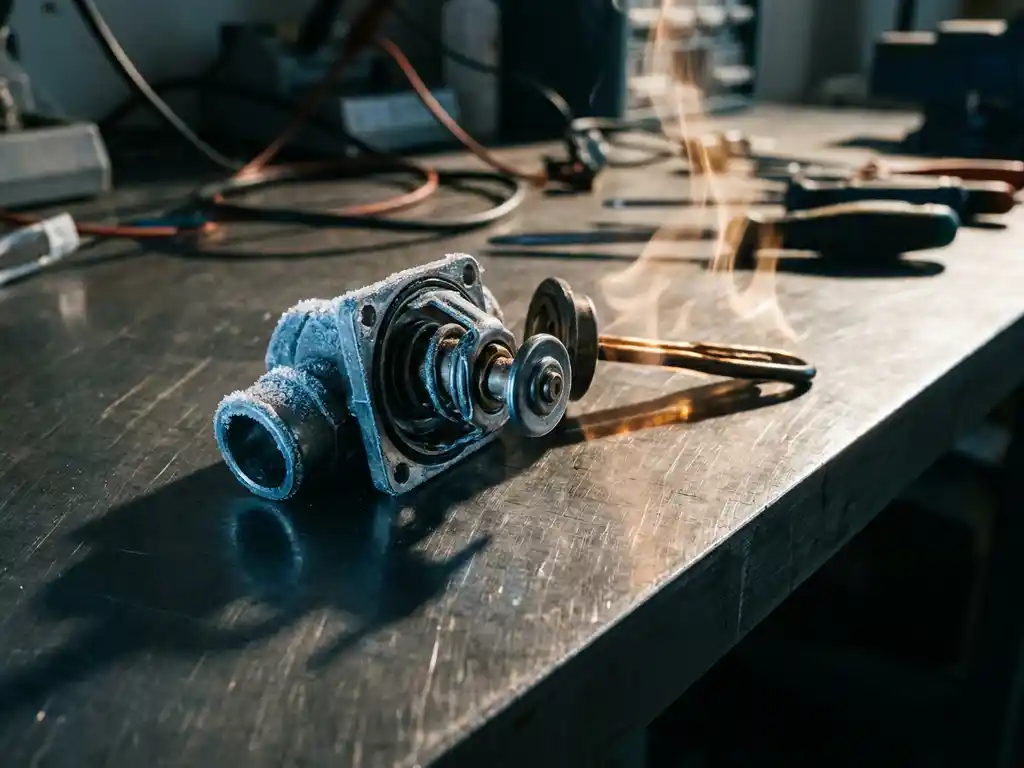
Thermostat components can perform reliably through thousands of temperature cycles when they are properly engineered for the application. The key factors are material selection, seal integrity, and the precision of the wax element at the core of most thermostat designs. Performance degrades when any of these elements are mismatched to the thermal demands of the environment. The sections below walk through what actually happens inside a thermostat under repeated thermal stress, where failures typically originate, and how to extend component life in demanding applications.
What happens to thermostat materials during repeated temperature cycling?
During repeated temperature cycling, thermostat materials experience cumulative mechanical stress caused by continuous expansion and contraction. Over time, this fatigue weakens seals, alters the response characteristics of the wax element, and can cause micro-cracking in housings or valve seats. The rate of degradation depends heavily on the amplitude of each cycle and how quickly temperatures shift.
The wax element is the functional heart of most thermostats. It works by expanding as it absorbs heat, pushing a piston that opens the valve. Every cycle puts that wax through a phase change, and while high-quality formulations are designed to handle this repeatedly, the surrounding components bear the mechanical load. Elastomeric seals are particularly vulnerable because rubber loses flexibility at low temperatures and can swell or harden at high temperatures. After enough cycles, seals that were once tight begin to allow small leaks.
Metal housings and valve components face a different challenge. Differential thermal expansion between dissimilar metals creates stress at joints and fastener points. In applications where cycling happens rapidly, such as engines moving between idle and load, these stresses accumulate faster than in systems that change temperature slowly. Choosing materials with compatible expansion coefficients is one of the most effective ways to reduce this risk at the design stage.
What are the most common failure modes in thermostats under thermal stress?
The most common thermostat failure modes under thermal stress are wax element degradation, seal leakage, valve sticking, and housing cracking. Each of these can cause the thermostat to open or close at the wrong temperature, which disrupts fluid flow and leads to either overheating or inefficient operation. Seal leakage and valve sticking are the most frequently reported issues in high-cycling environments.
Valve sticking deserves particular attention. It occurs when debris, oxidation, or material deformation prevents the valve from moving freely. In automotive applications, this often results in an engine running too cold because the thermostat stays open, or dangerously overheating because it stays closed. In industrial cooling systems, a stuck valve can cause temperature swings that damage downstream equipment.
Wax element contamination is a less visible but equally serious failure mode. If coolant additives or industrial fluids degrade the wax formulation, the element loses its ability to expand and contract predictably. This changes the temperature at which the valve opens, which means the system operates outside its designed parameters even though the thermostat appears intact. Regular fluid maintenance in the broader system plays a real role in protecting the thermostat itself.
How do manufacturers test thermostat components for temperature cycling resistance?
Manufacturers test thermostat components for temperature cycling resistance by subjecting them to accelerated life testing protocols that simulate thousands of open-close cycles in a compressed timeframe. These tests measure valve opening temperature, full stroke travel, leak rate, and response time before and after cycling to detect any drift in performance. Testing is typically conducted across the full operating temperature range, including extreme cold and peak heat conditions.
Standard test rigs cycle thermostats between controlled low and high temperatures, recording how many cycles pass before any parameter falls outside tolerance. Leak testing uses pressurized fluid to detect seal degradation. Dimensional inspection after cycling checks for deformation in the housing and valve components. Some manufacturers also combine thermal cycling with vibration testing to simulate real-world conditions more accurately, since engines and industrial machinery expose components to both simultaneously.
For automotive thermostat components, testing protocols align with industry standards that specify minimum cycle counts and acceptable performance drift. Industrial applications often require custom test profiles because the thermal environment, fluid chemistry, and cycle frequency can vary significantly between installations. A thermostat component validated for one industrial process may not be appropriate for another without additional testing.
What’s the difference between automotive and industrial thermostat performance requirements?
Automotive thermostats are optimized for fast response, precise opening temperatures, and compatibility with engine coolant chemistry, while industrial thermostats prioritize durability across a wider range of fluid types, larger flow volumes, and often longer service intervals. The two application types share core principles but diverge significantly in their design specifications and validation standards.
Automotive thermostat requirements
In an automotive engine, the thermostat must respond quickly to temperature changes because the engine moves between thermal states rapidly, especially during cold starts and acceleration. Opening temperature precision is critical because modern engine management systems are calibrated around specific coolant temperatures to optimize combustion efficiency and reduce emissions. Automotive thermostats are also compact by necessity and must function reliably within the tight packaging constraints of an engine bay.
Industrial thermostat requirements
Industrial applications often involve larger flow rates, higher pressures, and exposure to fluids other than standard coolant, including oils, glycol mixtures, and process fluids with varying pH levels. Cycle frequency in industrial systems can be lower than in automotive engines, but the consequences of failure are often more severe because a single thermostat may regulate temperature for an entire production process. Industrial thermostats are also expected to operate for longer service intervals without replacement, which places greater demands on seal and housing durability.
The crossover between these two worlds is growing. As industrial automation and electrification advance, many industrial thermal management systems are adopting components originally developed for automotive use, bringing tighter tolerances and better response characteristics into factory environments.
How can thermostat component lifespan be extended in high-cycling applications?
Thermostat component lifespan in high-cycling applications can be extended through correct component selection for the specific temperature range, regular fluid maintenance, installation practices that avoid mechanical stress on the housing, and periodic performance checks to catch drift before it causes system damage. Getting the specification right at the outset is the single most impactful step.
Over-specifying or under-specifying a thermostat both cause problems. A component rated for a much higher temperature than the application requires may respond sluggishly within the actual operating range. One rated too close to the system’s peak temperature may spend most of its service life near its upper limit, accelerating wax and seal degradation. Matching the thermostat’s rated range closely to the actual operating window reduces the mechanical stress each cycle imposes.
Fluid quality matters more than many operators realize. Coolant and process fluids degrade over time, becoming acidic or depositing scale that can affect valve movement and attack seals. Following the fluid manufacturer’s replacement schedule protects the thermostat as much as it protects other system components. In industrial settings, installing filtration upstream of the thermostat reduces particle contamination that contributes to valve sticking.
Installation quality also has a measurable effect on lifespan. Thermostats installed with misaligned fittings or over-torqued connections experience additional mechanical stress every time the housing expands and contracts. Using the correct torque values and ensuring proper alignment during installation is straightforward but often overlooked during maintenance cycles.
How BTT Solutions supports thermostat performance in demanding applications
We work directly with engineering and procurement teams to identify the right thermostat components for applications where thermal cycling performance is a genuine concern. Whether you are managing coolant flow in a commercial vehicle powertrain, regulating temperature in an industrial process, or specifying components for a heating system, we bring both the technical depth and the flexibility to match the right solution to your actual operating conditions.
Our product advisory service covers:
- Component selection guidance for wax elements, thermostat inserts, and engineered housings matched to your temperature range and fluid environment
- Application-specific recommendations for automotive, industrial, and building technology use cases
- Support for high-cycling environments where standard off-the-shelf components may not meet the durability requirements
- End-to-end thermal management solutions developed with precision and reliability as the starting point, not an afterthought
We are a focused team with deep expertise in thermostat technology, and we give every client the direct attention that larger suppliers rarely can. If you are evaluating thermostat components for a demanding application, we would be glad to discuss your requirements. Get in touch with us to start the conversation.
Related Articles
- What is the difference between mechanical efficiency and thermal efficiency?
- Does changing the car thermostat make a difference?
- What is the cost impact of poor thermal management on fleet fuel bills?
- What factors should OEMs consider when selecting a thermostat supplier?
- What are the main components of automotive thermostats?


