
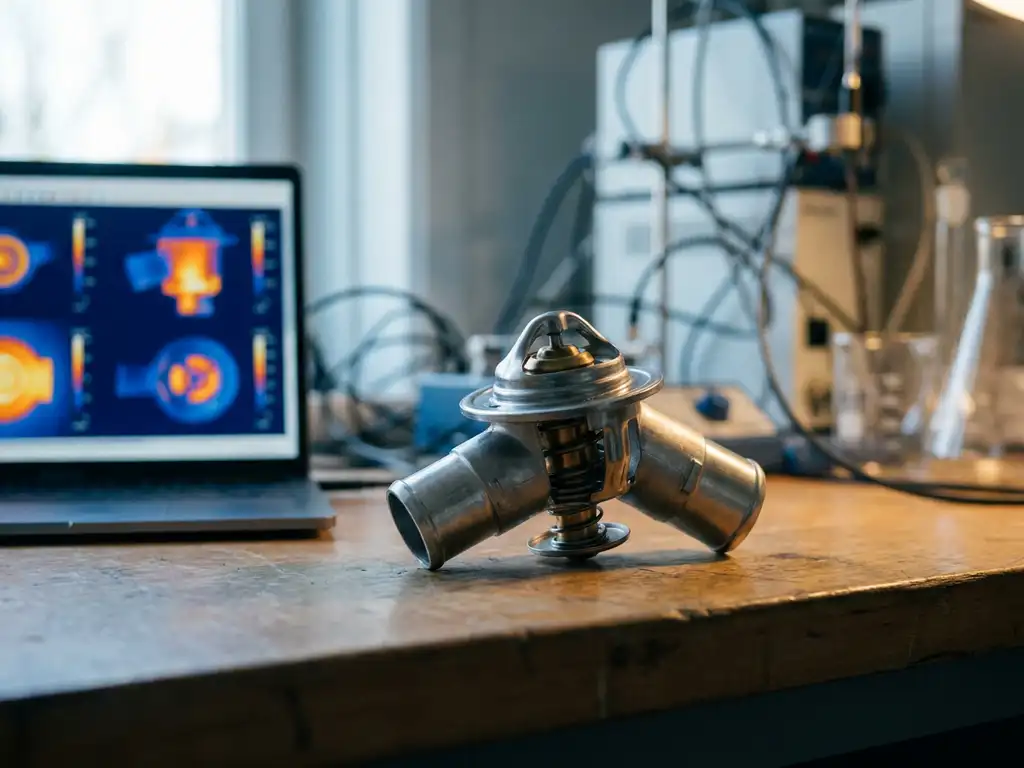
Software simulation cannot fully replace physical thermostat testing in 2026, but it has become precise enough to handle a significant portion of the validation workload. For most thermal performance scenarios, simulation tools now deliver results that closely match real-world behavior. Physical testing remains essential for final validation, edge-case verification, and regulatory sign-off, but the two approaches increasingly work as a team rather than as alternatives.
The balance between virtual and physical testing is shifting fast, and understanding where the line sits matters enormously for engineering teams managing cost, speed, and compliance. Below, we work through the most important questions surrounding thermostat validation in 2026.
How accurate is software simulation for thermostat validation today?
Modern thermostat simulation software is highly accurate for predicting steady-state thermal behavior, fluid flow dynamics, and temperature response curves under defined conditions. For well-characterized materials and standard operating ranges, simulation results typically align closely with physical test outcomes, making virtual thermostat testing a reliable first-pass validation tool in most engineering workflows today.
The accuracy depends heavily on the quality of the input data. Simulation models built on precise material property data, accurate boundary conditions, and validated mesh configurations produce results engineers can trust. Where models struggle is in capturing subtle real-world variables: manufacturing tolerances, wax element aging, or the interaction between a thermostat and a specific engine’s thermal mass under transient load cycles.
For automotive thermostat validation specifically, simulation tools have matured to the point where they can model coolant flow behavior, valve opening characteristics, and temperature regulation under standard drive cycles with strong fidelity. That said, “highly accurate” is not the same as “sufficient for certification.” Most OEM validation protocols still require physical test data to close the loop.
What physical thermostat tests can’t yet be replaced by simulation?
Physical thermostat testing remains irreplaceable for durability assessment, regulatory compliance testing, and any scenario involving material degradation over time. Simulation tools can predict thermal behavior but cannot replicate the cumulative mechanical stress, corrosion exposure, or wax element fatigue that occurs across thousands of real operating cycles in a physical test rig.
Several test categories consistently require physical hardware:
- Thermal cycling endurance tests, where components are subjected to repeated heating and cooling to assess long-term valve response consistency
- Vibration and mechanical load testing, which evaluates how thermostat housings and seals perform under engine-induced stress
- Corrosion resistance validation, particularly relevant for coolant-facing components exposed to varying fluid chemistries
- Opening and closing hysteresis measurement, which requires precise physical instrumentation to capture real valve behavior
- Regulatory and OEM approval testing, where homologation standards explicitly require physical test certificates
The common thread is that these tests involve material behavior over time or under mechanical stress, neither of which simulation can fully replicate with current technology. Thermal management testing in 2026 still depends on physical rigs for these scenarios, even when simulation handles the front-end design validation.
How does a digital twin differ from a standard simulation model?
A digital twin is a live, continuously updated virtual replica of a physical thermostat or thermal management system, synchronized with real-world sensor data throughout the product’s operational life. A standard simulation model, by contrast, is a static representation built from design parameters and used at specific points in the development process, typically during design or pre-production validation.
The distinction matters practically. A standard thermostat simulation software model helps engineers predict how a component will behave before it is built. A digital twin tracks how a specific physical component is actually behaving in the field, comparing live data against the model to detect drift, degradation, or anomalies in real time.
For industrial and automotive thermostat applications, digital twin technology is gaining traction in high-value or high-consequence systems where predictive maintenance has clear economic benefits. In a manufacturing context, a digital twin can flag when a thermostat’s real-world performance is beginning to diverge from its design specification, triggering inspection or replacement before failure occurs.
The practical barrier to digital twin adoption is cost and infrastructure. Building a meaningful digital twin requires sensor integration, data pipelines, and ongoing model calibration. For high-volume automotive components, this investment is increasingly justified. For lower-volume industrial applications, many companies still rely on periodic physical testing rather than continuous digital monitoring.
What’s the difference between simulation-led and test-led validation strategies?
A simulation-led validation strategy uses virtual thermostat testing as the primary design verification tool, with physical testing reserved for final confirmation and compliance. A test-led strategy builds physical prototypes early and uses simulation primarily to interpret results or guide iteration. The key difference is where the majority of engineering decisions are made and which data source is treated as authoritative.
Simulation-led approaches compress development timelines and reduce prototype costs significantly. Engineers can iterate through dozens of design variants in software before committing to tooling, which is particularly valuable when exploring new thermostat geometries or evaluating performance across a wide operating range. This approach suits organizations with strong simulation competency and mature material databases.
Test-led approaches carry higher upfront costs but generate physical evidence earlier in the process. For applications where regulatory approval depends on physical test certificates, or where novel materials or operating conditions make simulation accuracy uncertain, starting with hardware provides a more reliable foundation.
In practice, most serious automotive thermostat validation programs in 2026 use a hybrid model: simulation leads the design phase, physical testing confirms key milestones, and both data sets inform the final validation report. The question is not which approach is better, but how to allocate each appropriately across the development timeline.
Should B2B buyers require physical test data alongside simulation reports?
Yes, B2B buyers should require physical test data for any thermostat component entering a safety-relevant or regulated application. Simulation reports are valuable for understanding design intent and thermal performance predictions, but they do not carry the same legal or technical weight as certified physical test results. Requiring both gives buyers a complete picture of component performance and protects them during supplier audits or product liability reviews.
The practical question is which physical tests to require. Buyers working with reputable suppliers should ask for:
- Opening temperature and hysteresis data from calibrated test benches
- Durability test results showing valve performance after defined thermal cycles
- Dimensional inspection reports confirming manufacturing tolerances
- Any OEM or industry standard certifications relevant to the application
Simulation reports become most valuable when they accompany physical test data, providing context for why the component behaves as it does and supporting root-cause analysis if performance issues emerge in the field. Treating simulation as a replacement for physical evidence introduces risk that most procurement teams in the automotive and industrial sectors are not positioned to accept.
For buyers evaluating suppliers, the ability to provide both rigorous simulation documentation and comprehensive physical test data is a strong signal of engineering maturity and process discipline.
What will thermostat testing look like by 2026?
By 2026, thermostat testing is characterized by tighter integration between simulation and physical validation, with digital tools handling more of the routine verification work and physical testing concentrated on high-stakes confirmation points. The industry has moved away from treating the two as competing approaches and toward structured workflows where each method is deployed where it adds the most value.
Several shifts are visible in how leading thermal management programs operate this year:
- Front-loaded simulation: Design teams run extensive virtual thermostat testing before any physical prototypes are produced, reducing iteration cycles and cutting time to first hardware build
- Model-based validation packages: OEMs increasingly accept simulation-supported validation documentation for non-safety-critical parameters, reducing the total number of physical test cycles required
- Automated test bench integration: Physical test rigs feed data directly into simulation environments, allowing real-time model calibration and faster convergence between predicted and measured behavior
- Digital twin adoption in industrial applications: Beyond automotive, industrial thermal management customers are beginning to deploy digital twin monitoring for critical process control components
The direction is clear: simulation tools are taking on more of the validation burden, but physical testing is not disappearing. If anything, the physical tests that remain are becoming more targeted and more rigorous, focused specifically on the scenarios where simulation cannot yet provide sufficient confidence.
How BTT Solutions supports your thermostat validation process
Navigating the right balance between simulation and physical testing is not just a technical question. It is a supplier selection question. Working with a component partner who understands both sides of the validation equation makes a real difference when development timelines are tight and compliance requirements are non-negotiable.
At BTT Solutions, we support B2B customers across the full validation journey for thermostat components, including wax elements, thermostat inserts, and engineered housings. Here is what that looks like in practice:
- Component advisory: We help customers select the right thermostat components for their specific thermal management requirements, whether for automotive, industrial, or building technology applications
- Technical documentation: We provide comprehensive physical test data alongside design documentation, so procurement and engineering teams have everything they need for supplier qualification and regulatory review
- Application-specific guidance: Our engineering team advises on how simulation results should be interpreted for specific use cases, and which physical validation steps are essential for your application
- Flexible response: As a focused, mid-sized organization, we respond quickly to technical questions and can adapt documentation packages to meet specific OEM or industrial customer requirements
If you are evaluating thermostat components for a new application or reviewing your current validation strategy, we would be glad to help. Get in touch with our team to discuss your requirements and find out how we can support your project from component selection through to validation sign-off.
Related Articles
- How do miniaturized thermostat components differ from standard ones?
- What equipment is used in professional thermostat performance testing?
- How do thermostat components behave differently in wet or humid environments?
- What is the difference between single-pole and double-pole thermostat components?
- How do you budget for engine maintenance in commercial operations


