
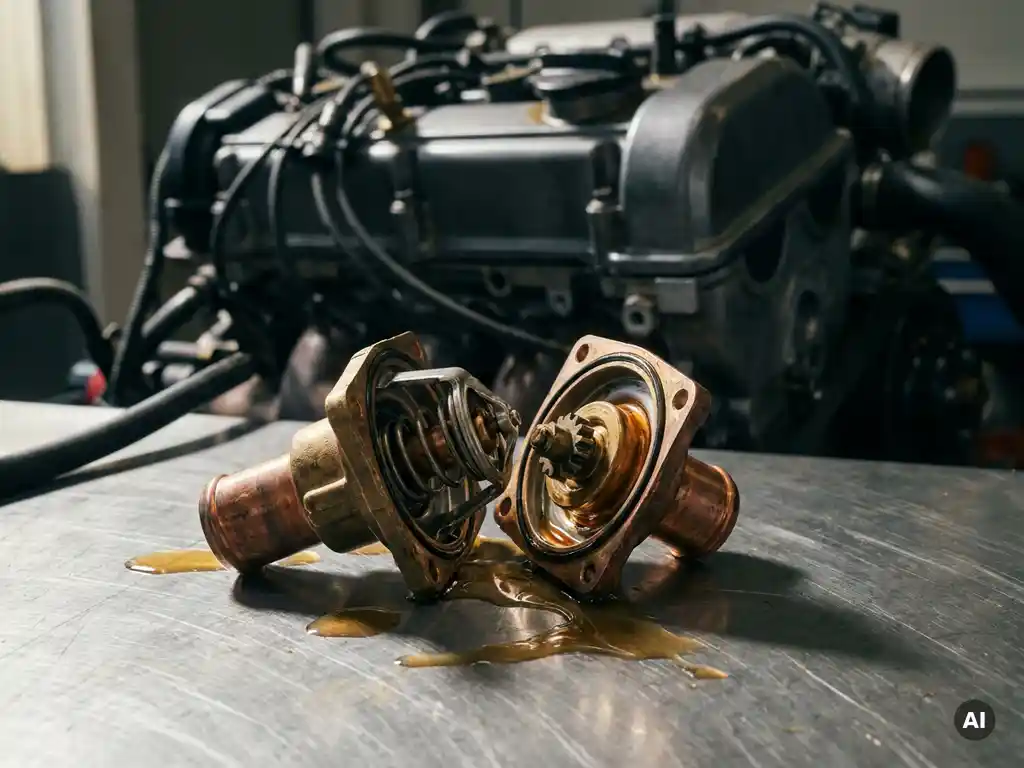
A precise thermostat mechanism is critical for fuel efficiency because it controls exactly when and how much coolant flows through the engine, keeping the engine operating at its optimal temperature. When that temperature window is maintained accurately, the engine burns fuel cleanly and completely. Even small deviations from the correct operating temperature can push fuel consumption noticeably higher and increase harmful emissions.
Below, we walk through the key questions around thermostat precision, from how the mechanism works to why it matters far beyond the automotive world.
How does a thermostat mechanism control engine temperature?
A thermostat mechanism regulates engine temperature by acting as a temperature-sensitive valve in the cooling circuit. When the engine is cold, the thermostat valve stays closed, keeping coolant inside the engine block so heat builds up quickly. Once the engine reaches its target temperature, the valve opens progressively, allowing coolant to circulate through the radiator and release excess heat.
At the heart of this process is the thermostat bellows or wax element. As engine temperature rises, the wax inside the element expands, physically pushing the valve open. When the engine cools, the wax contracts and the valve closes again. This expansion and contraction cycle repeats continuously while the engine runs, making the thermostat one of the most consistently active components in any vehicle.
The precision of this cycle matters enormously. A thermostat that opens too early lets the engine run cool; one that opens too late risks overheating. Either scenario creates problems that ripple through fuel consumption, emissions, and engine wear.
Why does thermostat accuracy directly affect fuel consumption?
Thermostat accuracy directly affects fuel consumption because engines are calibrated to run efficiently within a specific temperature range. When the thermostat valve holds the engine at precisely the right operating temperature, the fuel-air mixture ignites cleanly and the engine management system can apply its most efficient settings. If the engine runs even slightly too cool, the system compensates by injecting more fuel, which wastes energy and raises running costs.
Modern engine management systems are sophisticated, but they depend on the engine reaching and staying at its target temperature. A thermostat that opens just a few degrees too early can keep the engine in a semi-warm state for extended periods, particularly during short urban trips. Over time, this translates into measurably higher fuel bills and more frequent refuelling stops for fleets and individual drivers alike.
For automotive engineers and procurement teams sourcing thermostat components, this is why manufacturing tolerance is not a minor specification detail. It is a direct lever on the real-world efficiency of every vehicle that carries the component.
What happens when a thermostat fails or loses precision?
When a thermostat fails or loses precision, the engine either runs too cold, too hot, or cycles unpredictably between the two. A thermostat stuck in the open position keeps the engine chronically cool, forcing it into a fuel-rich operating mode. A thermostat stuck closed causes overheating, which can damage cylinder heads, gaskets, and bearings. Both failure modes are costly, but the slow degradation of precision is often more insidious than a complete failure because it goes unnoticed for longer.
Precision loss typically happens gradually. The thermostat bellows or wax element may begin to respond more slowly to temperature changes, or the thermostat valve may not fully close or open at the correct thresholds. The engine still runs, but not at its best. Drivers may notice slightly higher fuel consumption, a heater that takes longer to warm up, or a temperature gauge that sits lower than usual. These are early warning signs that the thermostat mechanism is no longer performing to specification.
For fleet operators and vehicle manufacturers, catching precision loss early through quality components and proper maintenance intervals is far cheaper than dealing with the downstream consequences of engine damage or excessive fuel waste.
How does thermostat precision affect vehicle emissions?
Thermostat precision directly affects vehicle emissions because combustion efficiency and exhaust composition are both tied to engine temperature. At the correct operating temperature, catalytic converters reach their activation threshold faster and work more effectively, breaking down harmful exhaust gases before they leave the tailpipe. An engine running too cool produces higher levels of hydrocarbons and carbon monoxide because incomplete combustion leaves unburned fuel in the exhaust stream.
In 2026, emissions standards in major markets continue to tighten, and regulators are increasingly scrutinising real-world driving performance rather than just laboratory test results. This makes thermostat precision a compliance issue as much as an efficiency one. A vehicle that performs well in a controlled test but runs with a slightly imprecise thermostat in daily use may breach real-world emissions limits, creating regulatory and reputational risk for manufacturers.
Precise thermal management is therefore not just about saving fuel. It is a foundational requirement for meeting the emissions targets that automotive OEMs and their supply chains are held to.
What’s the difference between a standard and a map-controlled thermostat?
A standard thermostat operates purely mechanically, relying on the thermostat bellows or wax element to open and close the thermostat valve at a fixed temperature. A map-controlled thermostat, by contrast, is electronically managed and can vary its opening temperature based on engine load, driving conditions, and data from the vehicle’s engine control unit. This allows the engine to run at a higher temperature during light loads for better efficiency and at a lower temperature under heavy loads to protect components.
Standard thermostat
Standard thermostats are reliable, cost-effective, and well-suited to applications where the operating conditions are relatively consistent. The wax element responds to actual coolant temperature, providing a self-contained and robust mechanism that requires no electrical input. For many industrial and heating applications, this simplicity is an advantage rather than a limitation.
Map-controlled thermostat
Map-controlled thermostats give engineers much finer control over the thermal behaviour of an engine across different operating scenarios. By adjusting the target temperature dynamically, they can squeeze additional efficiency out of modern combustion engines and support the complex thermal management demands of hybrid powertrains. The trade-off is greater system complexity and a dependency on accurate sensor data and engine management software.
Choosing between the two comes down to the application’s requirements. For high-performance or efficiency-critical automotive applications, map-controlled systems offer clear advantages. For straightforward industrial or building technology uses, a well-engineered standard thermostat mechanism delivers everything needed at lower cost and complexity.
Which industries beyond automotive rely on precise thermostat mechanisms?
Precise thermostat mechanisms are essential in any application where temperature control directly affects performance, safety, or energy use. Beyond automotive, the most significant industries include building technology, industrial manufacturing, and marine systems, all of which depend on accurate thermostat valves and wax elements to manage fluid temperatures reliably.
- Building technology: Radiators, underfloor heating systems, and wall-mounted heating units use thermostat mechanisms to regulate water temperature and flow. Precise control here reduces energy waste and improves occupant comfort in commercial and residential buildings.
- Industrial manufacturing: Machinery that generates heat during operation, from hydraulic systems to large compressors, relies on thermostat-controlled cooling circuits to maintain safe operating temperatures and protect equipment from thermal stress.
- Marine systems: Ship engines and onboard hydraulic systems face demanding thermal environments. Precise thermostat mechanisms keep coolant and oil temperatures within safe ranges, supporting both fuel efficiency and equipment longevity at sea.
- HVAC systems: Large-scale heating, ventilation, and air conditioning installations use thermostat components to balance thermal loads across complex building networks, contributing to both energy efficiency and regulatory compliance.
The underlying physics is the same across all these sectors. Accurate temperature sensing, a responsive thermostat bellows, and a well-engineered thermostat valve are what separate efficient, long-lasting systems from ones that waste energy and require frequent maintenance.
How BTT Solutions supports precise thermal management across industries
We at BTT Solutions design and manufacture high-precision thermostat mechanisms for exactly the challenges described throughout this article. Whether the application is an automotive powertrain, an industrial cooling circuit, or a building heating system, our components are built to maintain accurate temperature control across the full operating range.
Here is what working with us looks like in practice:
- End-to-end thermostat solutions: From thermostat valves and wax elements to complete thermostat assemblies and temperature sensors, we supply the full component range needed for precise thermal management.
- Automotive and beyond: Our technology supports fuel efficiency and emissions compliance in passenger vehicles, commercial vehicles, and hybrid powertrains, as well as industrial machinery, marine engines, and building heating systems.
- Flexible, responsive partnership: As a focused mid-sized company, we offer the individual attention and fast turnaround that larger suppliers often cannot. Our engineering teams work closely with customers to match components to specific performance requirements.
- Global reach, local expertise: With eight locations worldwide, we support customers across regions without sacrificing the precision and quality that our components are known for.
If precise thermostat performance matters to your application, we would be glad to discuss how we can help. Get in touch with our team to start the conversation, or learn more about who we are and the expertise we bring to every project.
Related Articles
- Can wax element material be used in industrial thermostat applications?
- What is a thermostat housing and what does it do?
- Why does engine temperature affect component wear?
- What engineering approaches help reduce engine emissions during cold start?
- What are the three main methods of heat transfer in thermostats?


