
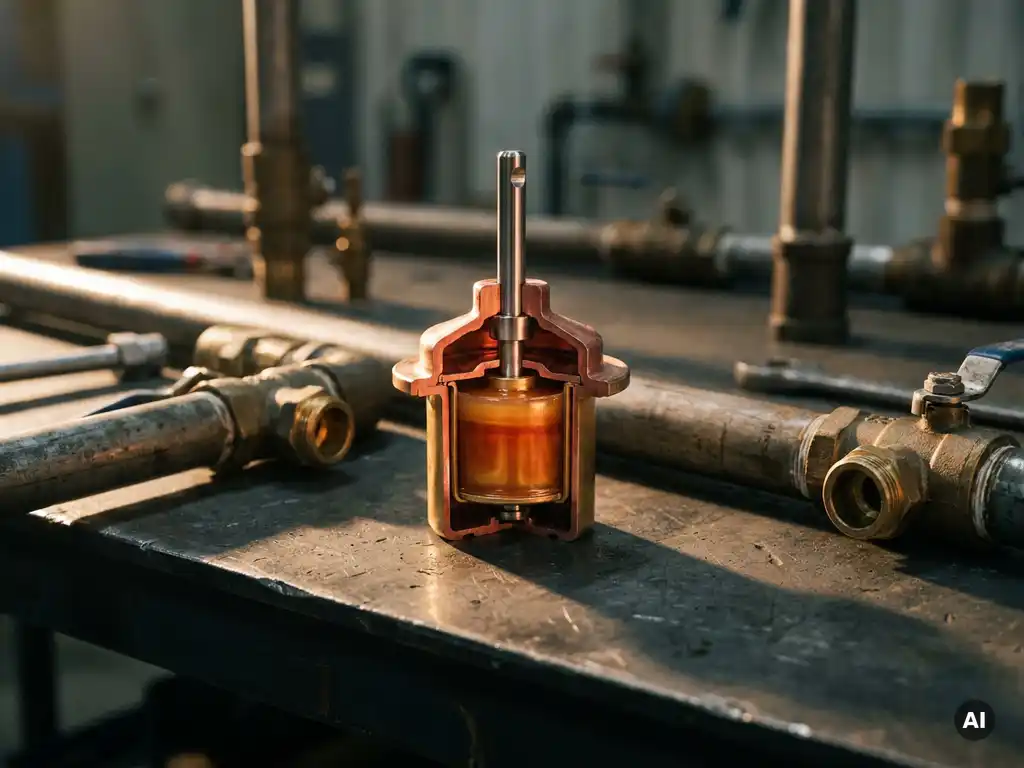
Yes, wax element material can absolutely be used in industrial thermostat applications, and in many cases it performs exceptionally well. The core principle behind wax thermal expansion is simple but remarkably reliable: a precisely formulated wax compound expands when heated and contracts when cooled, generating enough mechanical force to open or close a valve without any external power source. That self-contained, passive operation is exactly what makes wax pellet thermostats so appealing across a wide range of industrial environments. The sections below explore how these components hold up under industrial demands, where they excel, and where engineers should think carefully before specifying them.
What makes wax elements work in extreme industrial conditions?
Wax elements work in extreme industrial conditions because the wax thermal expansion principle generates substantial actuating force relative to the component’s size, requires no electrical input, and maintains consistent response characteristics across repeated thermal cycles. The sealed wax pellet expands volumetrically in a predictable, repeatable way, translating temperature change directly into mechanical movement with very little lag.
What gives wax element material its durability in demanding environments is the combination of a robust metal housing, a flexible membrane or piston seal, and the chemically stable wax compound itself. Unlike bimetallic or electronic alternatives, there are no circuit boards to corrode, no batteries to deplete, and no signal wires to break. The actuator simply responds to heat. That passive reliability makes wax pellet thermostats well suited to environments where maintenance access is limited, contamination is a risk, or power supply is unreliable. Industrial cooling circuits, hydraulic systems, and heavy machinery all benefit from this kind of fail-safe simplicity.
What are the main differences between industrial and automotive thermostat requirements?
The key differences between industrial and automotive thermostat requirements lie in operating pressure, fluid compatibility, cycle frequency, and the range of temperatures involved. Automotive thermostats typically operate within a fairly narrow temperature band and are designed around a single fluid type, whereas industrial applications can involve aggressive chemicals, wide temperature swings, and far higher system pressures.
In automotive contexts, a wax pellet thermostat manages coolant flow in an engine that cycles predictably with driving patterns. Industrial systems are often more varied. A thermostat controlling oil temperature in a compressor faces different stresses than one regulating water flow in a large heating circuit. Industrial duty cycles can also be continuous rather than intermittent, meaning the component must sustain its performance over many more operating hours without drift or fatigue. Pressure ratings, seal materials, and housing geometry all need to be matched to the specific industrial environment rather than assumed from automotive specifications.
Engineers specifying components for industrial thermostat applications should always verify that the wax formulation and housing materials are validated for the actual fluid, pressure, and temperature range in use, not just the nominal automotive equivalent.
Which industrial applications are wax element thermostats best suited for?
Wax element thermostats are best suited for industrial applications where passive, self-regulating temperature control is needed, external power is unavailable or undesirable, and the operating temperature falls within the range that standard or custom wax formulations can address. Hydraulic oil cooling, industrial water heating circuits, and marine engine cooling systems are among the strongest fits.
More specifically, wax pellet thermostats perform well in:
- Hydraulic and lubrication systems where oil temperature must be kept within a defined band to protect seals and maintain viscosity
- Industrial heating circuits including radiant floor heating and large radiator networks where flow regulation improves energy efficiency
- Marine and off-highway equipment where ruggedness and independence from electrical systems are priorities
- Compressor and gearbox cooling where consistent thermal management extends component life
- Process water systems in manufacturing facilities where temperature-controlled flow prevents overheating or condensation
The common thread across these applications is that the temperature control task is well defined, the operating range is stable, and the value of passive reliability outweighs the need for fine electronic adjustment.
What are the limitations of wax elements in industrial thermostat applications?
The main limitations of wax elements in industrial thermostat applications are their fixed response temperature, relatively slow actuation speed, and sensitivity to fluid compatibility. Once a wax pellet thermostat is manufactured with a specific wax formulation, its opening temperature is essentially fixed. It cannot be remotely adjusted or reprogrammed to respond to changing process requirements.
This inflexibility becomes a real constraint in processes where the target temperature needs to shift dynamically or where tight control tolerances are required. Wax thermal expansion is also inherently gradual rather than instantaneous, which means applications demanding rapid thermal response may see some lag before the valve reaches its fully open or closed position.
Fluid compatibility is another practical concern. Certain industrial chemicals, aggressive solvents, or high-pressure steam can degrade the seals or the wax compound itself over time, leading to drift in the set point or mechanical failure. Engineers should also account for the fact that wax elements have a finite stroke, so they are not suited to applications requiring large valve travel or proportional modulation across a wide range.
How does wax element material selection affect industrial thermostat performance?
Wax element material selection directly determines the activation temperature, the force output, the hysteresis band, and the long-term stability of the thermostat. Different wax formulations are engineered to melt and expand at specific temperatures, so choosing the right compound is the single most important factor in matching a wax pellet thermostat to an industrial application.
Beyond the base activation temperature, the wax formulation also influences how sharply the element responds near its set point and how much it contracts on cooling. A formulation with a narrow hysteresis band opens and closes within a tight temperature range, which is valuable in precision cooling circuits. A formulation with broader hysteresis may be preferable in applications where hunting or rapid cycling would cause wear.
The surrounding materials matter too. The housing alloy, piston material, and seal compounds must all be compatible with both the wax and the process fluid. In aggressive industrial environments, stainless steel housings and chemically resistant elastomers are often necessary to prevent corrosion or swelling that would compromise the actuator’s stroke and set-point accuracy. Getting material selection right from the outset avoids costly field failures and premature replacement.
When should engineers choose wax elements over electronic temperature control?
Engineers should choose wax elements over electronic temperature control when the application requires passive operation, high mechanical reliability, low maintenance, and a fixed set-point temperature. If the system has no power supply, operates in a hazardous or explosive environment, or simply needs a self-contained fail-safe mechanism, wax thermal expansion technology is usually the more practical and cost-effective choice.
Electronic temperature control offers advantages in flexibility and precision, but it introduces complexity: sensors can drift, controllers can fail, and wiring adds installation cost and potential fault points. In applications where the target temperature is stable and well understood, that added complexity rarely pays off. Wax pellet thermostats, by contrast, deliver consistent performance over long service lives with minimal intervention.
A useful decision framework for engineers:
- Fixed set-point needed: Wax element is the simpler, more reliable choice
- Adjustable or dynamic set-point needed: Electronic control is more appropriate
- No power available or power reliability is low: Wax element is strongly preferred
- Tight tolerance control below ±1°C required: Electronic control may be necessary
- High cycle count, long service life expected: Wax elements typically outperform electronic alternatives in durability
- Hazardous area classification applies: Passive wax elements avoid the need for intrinsically safe electronics
In practice, many industrial systems use both technologies in complementary roles, with wax elements handling primary flow regulation and electronic sensors providing monitoring or alarm functions on top.
How BTT Solutions supports wax element thermostat specification for industrial use
We work with industrial engineers and procurement teams across automotive, manufacturing, marine, and building technology sectors to identify the right wax element material and thermostat configuration for each specific application. Our team brings deep expertise in wax thermal expansion technology developed over decades of precision component manufacturing, and we apply that knowledge directly to the challenges our customers bring us.
When you work with us, we help you navigate:
- Wax formulation selection matched to your exact activation temperature, hysteresis requirements, and fluid environment
- Housing and seal material compatibility for aggressive industrial fluids, elevated pressures, and long service intervals
- Custom thermostat configurations for applications that fall outside standard automotive specifications
- End-to-end component validation so that what we supply is tested and proven for your operating conditions, not just nominal values
As a focused, mid-sized specialist, we give each customer direct access to our engineering expertise without the delays of a large corporate structure. You can learn more about our background and technical capabilities on our about page, or browse our full product range to see the thermostat and temperature sensor solutions we offer. If you have a specific industrial application in mind and want to discuss whether a wax pellet thermostat is the right fit, get in touch with our team and we will help you find the answer.


