
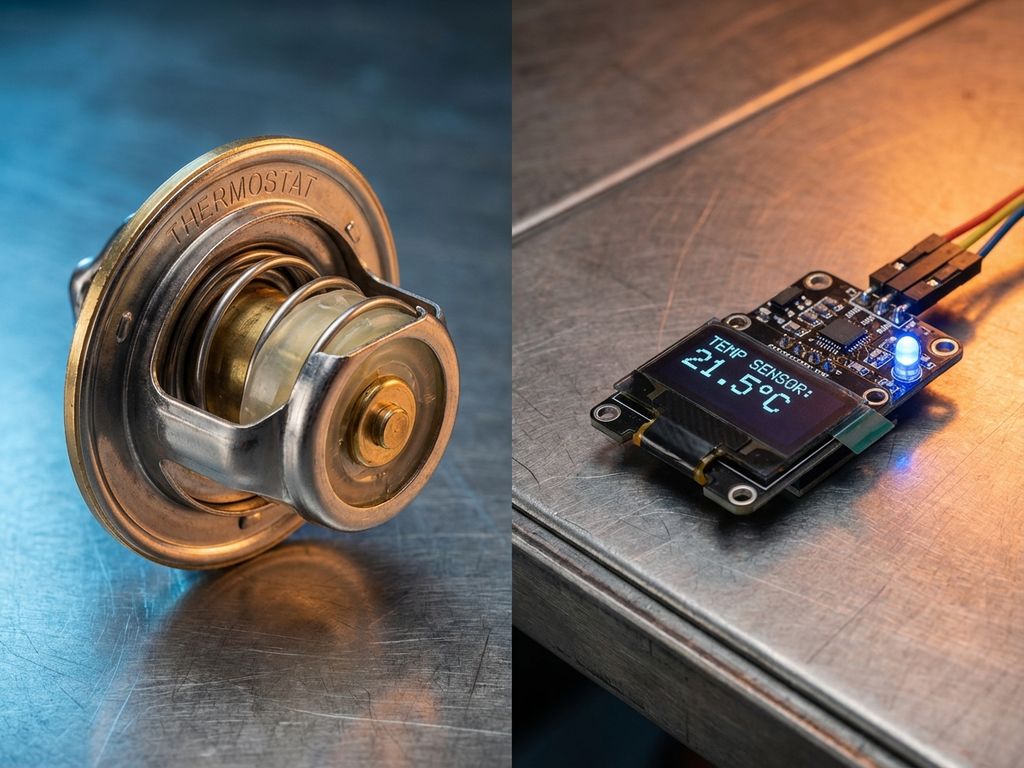
The difference between a thermostat and a temperature sensor lies in their function: thermostats actively control temperature by switching heating or cooling systems on and off, while temperature sensors passively measure and report temperature readings without controlling any equipment. Understanding when to use each component helps optimize thermal management in automotive, industrial, and residential applications.
What exactly is a thermostat and how does it work?
A thermostat is an automatic temperature control device that regulates heating and cooling systems by switching them on or off based on preset temperature thresholds. It acts as the decision-maker in thermal control systems, maintaining desired temperatures without manual intervention.
The core functionality revolves around a sensing element that responds to temperature changes. When the ambient temperature drops below the set point, the thermostat signals the heating system to activate. Once the desired temperature is reached, it switches the system off. This cycling process maintains consistent temperatures within defined parameters.
Modern thermostats use various sensing technologies, including bimetallic strips, wax pellets, and electronic sensors. In automotive applications, thermostat functionality ensures engines reach optimal operating temperatures quickly while preventing overheating. The device opens and closes coolant passages based on engine temperature, directing flow through the radiator when cooling is needed.
Industrial and residential applications rely on similar principles, with thermostats controlling boilers, air conditioning units, and heating systems. The key advantage lies in automatic operation, eliminating the need for constant manual adjustments while maintaining precise temperature control.
What is a temperature sensor and what does it actually do?
A temperature sensor is a measurement device that detects and reports temperature values without controlling any systems. Unlike thermostats, sensors serve purely as information gatherers, providing data for monitoring, logging, or feeding into larger control systems.
Temperature sensor applications span numerous industries and systems. In automotive environments, sensors monitor engine coolant temperature, oil temperature, and cabin air temperature. This data helps engine management systems optimize fuel injection, ignition timing, and emission controls.
Industrial processes rely heavily on temperature sensors for quality control, safety monitoring, and process optimization. Manufacturing facilities use sensors to track temperature variations in production lines, storage areas, and equipment operation. Continuous data collection enables predictive maintenance and ensures product quality standards.
Building management systems incorporate temperature sensors throughout structures to monitor environmental conditions. These sensors provide data for HVAC optimization, energy management, and occupant comfort. The information collected helps facility managers make informed decisions about heating, cooling, and ventilation requirements.
What’s the key difference between how thermostats and temperature sensors function?
The fundamental difference lies in their operational approach: thermostats provide active system management with control capabilities, while temperature sensors offer passive data collection without control functions. This distinction determines their roles within thermal management systems.
Thermostats incorporate decision-making logic, comparing measured temperatures against preset values and triggering appropriate responses. They function as standalone control devices capable of managing entire heating or cooling systems independently. The response mechanism is immediate and automatic, requiring no external intervention.
Temperature sensors focus solely on accurate measurement and data transmission. They convert temperature readings into electrical signals that other devices can interpret. The sensor itself makes no decisions about system operation, instead providing information that control systems, data loggers, or human operators can use.
Response mechanisms differ significantly between the two devices. Thermal control systems using thermostats respond directly to temperature changes with immediate action. Systems using temperature sensors require additional control logic to interpret the data and determine appropriate responses.
Integration complexity also varies considerably. Thermostats often work as plug-and-play solutions requiring minimal setup, while temperature sensor systems typically need additional components such as controllers, displays, or data logging equipment to provide useful functionality.
When should you use a thermostat versus a temperature sensor?
Choose a thermostat when you need automatic temperature control with immediate response capabilities. Applications requiring standalone operation without external control systems benefit most from thermostat implementation. Simple heating and cooling systems work effectively with thermostats as primary control devices.
Automotive temperature control applications often require thermostats for engine cooling systems, where immediate response to temperature changes prevents engine damage. Residential heating systems, water heaters, and basic HVAC applications also suit thermostat control due to their straightforward temperature maintenance requirements.
Temperature sensors suit applications requiring precise monitoring, data logging, or integration with complex control systems. Multi-zone climate control, industrial process monitoring, and building automation systems benefit from sensor-based approaches that provide detailed temperature information.
Consider sensors when you need temperature data for analysis, trending, or remote monitoring. Research applications, quality control processes, and energy management systems require accurate temperature measurement without immediate control responses. Thermal management components in modern vehicles often combine both approaches for optimal performance.
Budget considerations also influence the choice. Simple thermostats typically cost less for basic control applications, while sensor-based systems may require additional investment in controllers and software but offer greater flexibility and functionality.
Can thermostats and temperature sensors work together in the same system?
Integrated thermal management systems commonly combine thermostats and temperature sensors to optimize performance and provide comprehensive temperature control. This approach leverages the strengths of both devices while addressing their individual limitations.
Modern automotive applications demonstrate effective integration, where thermostat temperature sensor comparison reveals complementary functions. Engine cooling systems use thermostats for primary coolant flow control while temperature sensors provide data for engine management computers. This combination ensures optimal engine performance across varying operating conditions.
Industrial applications benefit from hybrid approaches in which thermostats handle immediate safety shutoffs while sensors provide continuous monitoring for process optimization. Manufacturing equipment often incorporates both devices to maintain safe operating temperatures while collecting performance data for maintenance scheduling and efficiency improvements.
Building automation systems increasingly use combined approaches for enhanced comfort and energy efficiency. Thermostats manage zone-based temperature control while sensors throughout the building provide data for system optimization. This integration enables predictive control strategies that anticipate heating and cooling needs.
The key advantage lies in redundancy and enhanced functionality. If primary control systems fail, backup thermostats can maintain safe operating conditions. Meanwhile, continuous sensor monitoring provides early warning of potential issues and enables proactive maintenance strategies.
How does BTT Solutions help with precision thermal management systems?
We specialize in manufacturing high-precision thermal management components that combine advanced thermostat technology with sophisticated temperature sensing capabilities. Our comprehensive approach addresses the complete spectrum of thermal control requirements across automotive, industrial, and residential applications.
Our expertise encompasses:
- Advanced thermostat components with precise temperature control for automotive cooling systems
- High-accuracy temperature sensors for industrial process monitoring and control
- Integrated thermal management solutions combining both technologies
- Custom component development for specific application requirements
- End-to-end thermal control systems for complex industrial applications
We understand that effective thermal management requires both immediate control responses and accurate monitoring capabilities. Our patented technologies deliver optimal performance while reducing energy consumption and improving system reliability. The integration of thermostats and temperature sensors in our solutions ensures comprehensive thermal control that adapts to varying operational demands.
Contact our thermal management specialists to discuss how our precision components can optimize your temperature control systems and improve overall efficiency. Learn more about our company and decades of experience in delivering innovative thermal solutions.


