
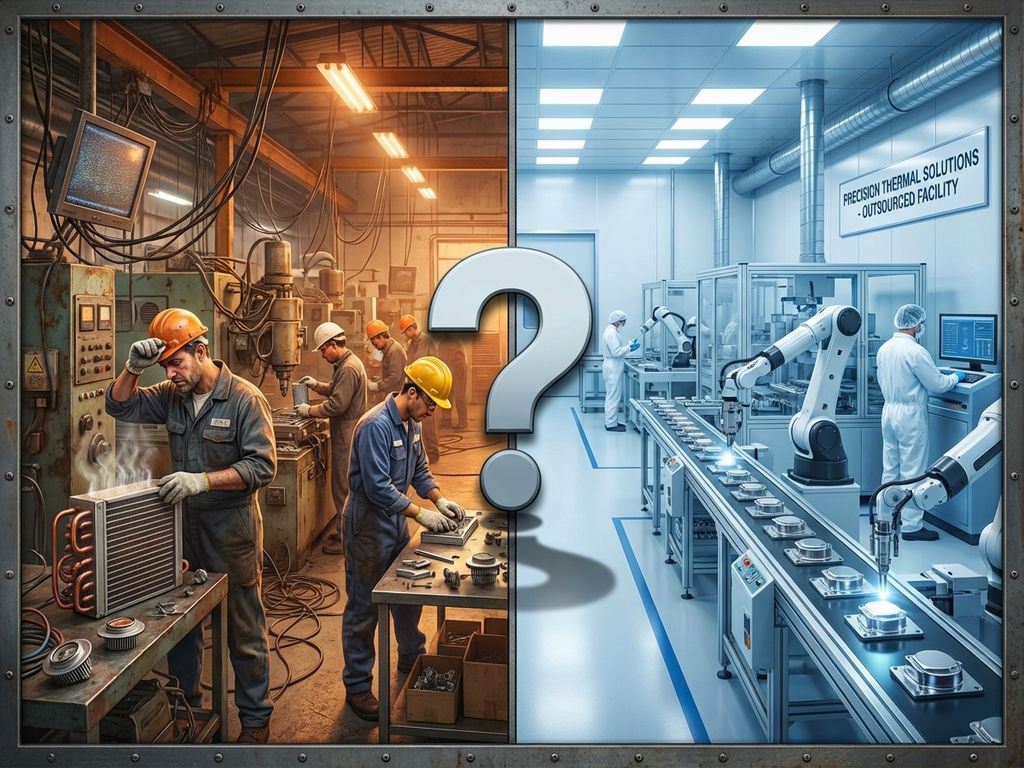
Outsourcing thermal management component manufacturing means partnering with specialised external companies to produce heat control systems and related parts. This approach allows businesses to access advanced manufacturing capabilities without investing in expensive equipment or expertise. Companies can outsource everything from thermostats and temperature sensors to complete thermal management solutions for automotive, industrial and household applications.
What does outsourcing thermal management component manufacturing actually mean?
Thermal management outsourcing involves contracting external manufacturers to produce components that control temperature and heat flow in various systems. These components include thermostats, temperature sensors, heat exchangers, cooling systems and thermal control units used across multiple industries.
Companies can choose between partial and full outsourcing approaches. Partial outsourcing typically involves contracting specific manufacturing processes while maintaining design and quality control internally. Full outsourcing transfers the entire production process to the manufacturing partner, including material sourcing, assembly, testing and packaging.
The process works through detailed specification transfer, where the outsourcing company provides technical drawings, quality standards and performance requirements. The manufacturing partner then sets up production lines, sources materials and establishes quality control procedures to meet these specifications. Regular communication and monitoring ensure the final products meet all requirements.
Why do companies choose to outsource thermal management manufacturing?
Cost reduction is the primary driver for thermal management outsourcing decisions. Manufacturing partners often operate in regions with lower labour costs and have established supply chains that reduce material expenses. This approach eliminates the need for significant capital investment in specialised equipment and facilities.
Access to specialised expertise represents another compelling reason. Thermal component production requires specific knowledge of materials science, precision engineering and temperature control technologies. Manufacturing partners bring years of experience and technical capabilities that would take considerable time and investment to develop internally.
Scalability needs drive many outsourcing decisions. External manufacturers can quickly adjust production volumes based on demand fluctuations without requiring internal capacity planning. This flexibility proves particularly valuable for companies experiencing seasonal demand variations or rapid growth phases.
Companies also outsource to focus resources on their core competencies. Rather than managing complex manufacturing operations, businesses can concentrate on product development, marketing and customer relationships, where they add the most value.
What are the main risks of outsourcing thermal management components?
Quality control challenges pose the most significant risk in thermal management outsourcing. Temperature control components require precise manufacturing tolerances and reliable performance under varying conditions. Distance and communication barriers can make it difficult to maintain consistent quality standards.
Intellectual property concerns arise when sharing detailed technical specifications with external partners. Companies risk losing control over proprietary designs or having sensitive information shared with competitors. This risk increases when working with manufacturers who serve multiple clients in similar industries.
Supply chain vulnerabilities can disrupt production schedules and increase costs. Dependencies on single suppliers, transportation delays and geopolitical factors can all impact component availability. Natural disasters or political instability in manufacturing regions can severely affect production continuity.
Communication barriers often complicate project management and problem resolution. Time zone differences, language barriers and cultural misunderstandings can lead to specification errors, delayed responses and extended project timelines.
How do you choose the right thermal management manufacturing partner?
Technical capabilities assessment should form the foundation of partner selection. Evaluate the manufacturer’s experience with similar thermal components, their understanding of thermal dynamics and their ability to work with the required materials and precision tolerances.
Quality certifications provide crucial insights into manufacturing standards. Look for ISO 9001 certification, automotive quality standards such as IATF 16949 for automotive applications and industry-specific certifications relevant to your thermal management needs. Request documentation of quality control processes and testing procedures.
Production capacity evaluation ensures the partner can meet your volume requirements both currently and as your business grows. Assess their manufacturing facilities, equipment capabilities and ability to scale production without compromising quality or delivery schedules.
Geographic considerations affect logistics costs, communication ease and supply chain reliability. Consider proximity to your operations, shipping costs, delivery times and potential trade or political factors that might impact the partnership.
Partnership evaluation should include an assessment of financial stability, communication responsiveness and cultural compatibility. Request references from existing clients and conduct facility visits when possible to evaluate their operations directly.
What should you expect during the thermal management outsourcing transition?
Timeline expectations typically span three to six months for a complete transition to outsourced thermal component production. This includes partner selection, contract negotiation, knowledge transfer, production setup, testing and quality validation phases.
Knowledge transfer requirements involve detailed documentation of specifications, quality standards, testing procedures and performance criteria. Plan for multiple rounds of prototype development and testing to ensure the manufacturing partner fully understands your requirements.
Quality assurance setup includes establishing inspection protocols, testing procedures and performance validation methods. Develop clear acceptance criteria and implement regular quality audits to maintain standards throughout the production relationship.
Ongoing relationship management requires regular communication schedules, performance reviews and continuous improvement initiatives. Establish clear escalation procedures for quality issues and maintain backup plans for potential supply disruptions.
How BTT Solutions helps with thermal management component manufacturing
We provide comprehensive thermal management manufacturing solutions backed by decades of expertise in precision component production. Our global manufacturing capabilities serve automotive, industrial and household applications with consistent quality standards across all locations.
Our manufacturing advantages include:
- Advanced production facilities equipped with precision manufacturing technology
- Comprehensive quality management systems meeting international standards
- Experienced engineering teams specialising in thermal component design and production
- Flexible production capacity to accommodate varying volume requirements
- Global supply chain management ensuring reliable material sourcing
- End-to-end project management from initial consultation through ongoing support
We address common outsourcing concerns through transparent communication, rigorous quality control and proven intellectual property protection protocols. Our technical expertise in thermostats, temperature sensors and thermal control systems ensures optimal component performance across diverse applications.
Ready to explore thermal management outsourcing for your business? Contact our technical team to discuss your specific requirements and learn how our manufacturing capabilities can support your thermal management component needs.
Related Articles
- How do you validate a thermostat for use in safety-critical applications?
- Can a clogged catalytic converter hurt engine efficiency?
- How do fleet operators meet CO2 reduction targets for vehicles?
- How much does it cost to replace a car thermostat?
- What thermal management components are required for oil temperature control?


