
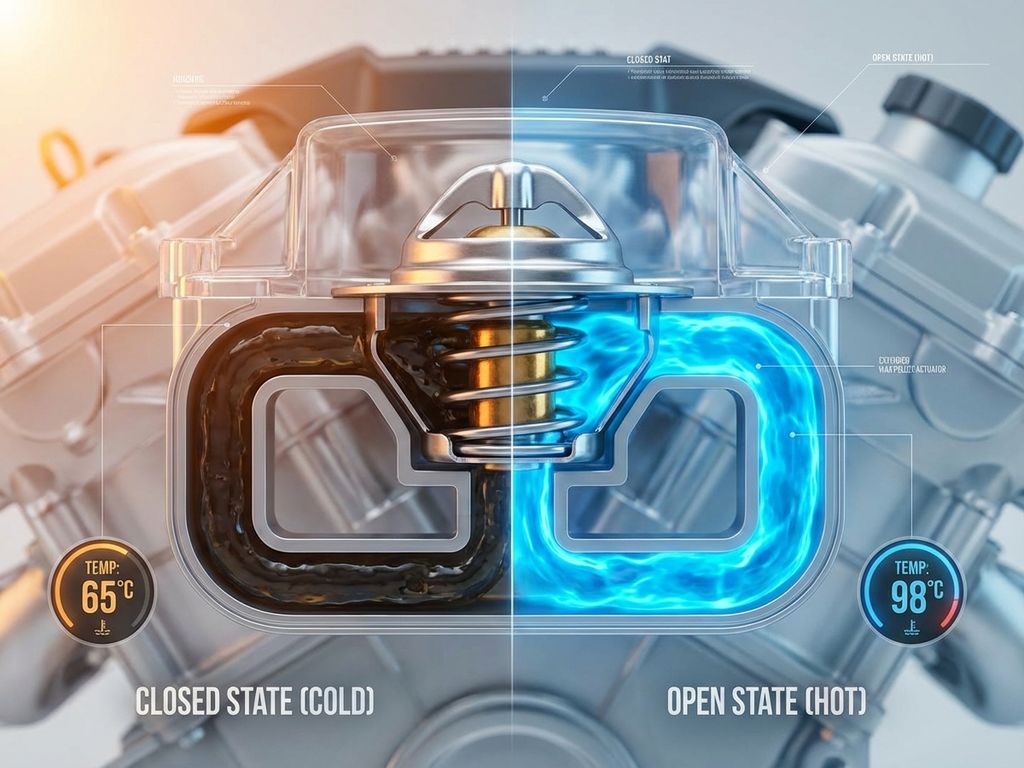
An engine thermostat opens when the coolant reaches roughly 180 to 195°F (82 to 90°C), letting hot coolant move on to the radiator to shed its heat. When the temperature drops again, the thermostat closes to hold coolant back so the engine can warm up quickly. That simple, automatic back-and-forth keeps the engine in its comfortable operating window, guards against overheating, and helps fuel efficiency along the way.
What exactly is an engine thermostat and why is it essential?
An engine thermostat is a temperature-controlled valve that acts as the gatekeeper of your vehicle’s cooling system. It’s a small part, but an important one. It sits between the engine and the radiator and opens or closes depending on how hot the coolant is, which controls how fluid moves through the system.
Think of it as the part that decides when your engine is ready to be cooled. It helps the engine reach its ideal temperature quickly and then keeps it there. Without it, an engine would either run too hot or take far too long to warm up, and both situations mean poor performance and extra wear.
Modern engines depend on precise temperature management to burn fuel efficiently, keep emissions down, and last longer. The thermostat makes that possible by reacting to temperature changes on its own, with no electronics or driver input needed. That’s a big part of why it matters so much for overall engine health.
How does a thermostat valve opening temperature mechanism work?
Engine thermostats work through a temperature-sensitive mechanism that responds directly to how hot the coolant gets. Most modern units contain a wax pellet that expands when heated and contracts when cooled, and that change in volume provides the mechanical force that moves the valve.
The wax pellet sits inside a sealed chamber connected to a spring-loaded valve. As the coolant reaches the thermostat’s opening point (typically 180 to 195°F), the wax expands and pushes against a piston, which forces the valve open against the spring.
When the coolant cools back down, the wax contracts and the spring pulls the valve shut again. Because there’s no external power or control signal involved, the design is remarkably dependable. Some older thermostats use bimetallic springs instead of wax, but the idea is the same: heat makes the material expand, cooling makes it contract, and that movement positions the valve.
What happens inside your engine when the thermostat opens?
Once the thermostat opens, coolant starts circulating from the engine through the radiator, forming a complete loop that carries excess heat away from the parts that need protecting. This is what keeps the engine from overheating while still holding the temperature steady enough for efficient combustion.
Hot coolant leaves the engine block and cylinder head, travels through the upper radiator hose, and passes through the radiator, where airflow and the cooling fans pull the heat out. The cooled fluid then returns through the lower hose and the cycle starts again.
This constant flow spreads heat evenly through the engine and prevents hot spots that could cause damage. Even under heavy loads or on a hot day, the radiator’s heat exchange keeps the engine in a stable range.
An open thermostat also gives the system access to its full cooling capacity, including the radiator fans when they’re needed, so the engine isn’t left struggling against thermal stress.
Why does the thermostat close and what occurs during this phase?
The thermostat stays closed during cold starts and in low-temperature conditions. By blocking coolant flow to the radiator, it forces hot coolant to circulate only inside the engine block. That speeds up warm-up and helps the engine reach its efficient operating temperature sooner.
While the thermostat is closed, coolant moves through a bypass circuit inside the engine. Heat builds up quickly because none of it is being lost to the radiator. This matters because a cold engine runs inefficiently and produces higher emissions.
A fast warm-up brings a few welcome benefits, including better fuel economy, less engine wear, and quicker heat in the cabin. Modern engines are built to run within specific temperature ranges, and the closed phase is how they get there as fast as possible.
The thermostat then stays shut until the coolant reaches its opening temperature, at which point it opens gradually and normal cooling begins. The driver never has to do a thing.
How to test your thermostat function in 5 simple steps
If your temperature gauge is behaving strangely or your heater isn’t performing as expected, the thermostat is often the first place worth looking, and the good news is that you can learn a lot without special tools or removing a single bolt. These practical checks show whether your thermostat is opening and closing the way it should, which can save you time and money on repairs you don’t need.
Step 1: Monitor engine temperature gauge
Start the engine cold and keep an eye on the temperature gauge. With a healthy thermostat, the needle should climb steadily to the normal range (usually around the middle of the gauge) within 5 to 10 minutes. If it shoots up too quickly or barely moves for a long time, the thermostat may be faulty.
Step 2: Compare radiator hose temperatures
Once the engine is up to temperature, carefully feel the upper and lower radiator hoses (switch the engine off and let it cool a little first). When the thermostat opens, both hoses should turn warm within a few minutes. If the upper hose is hot but the lower one stays cool, the thermostat may be stuck closed.
Step 3: Observe coolant circulation
Remove the radiator cap only when the engine is completely cool, then start the engine and watch the coolant. You should see little to no movement at first, then active circulation once the thermostat opens at operating temperature.
Step 4: Check for temperature fluctuations
Pay attention to the gauge during a test drive. A steady reading points to a healthy thermostat, while a needle that wanders up and down suggests it’s sticking or only partly working.
Step 5: Inspect for stuck closed thermostat symptoms
Watch for steam coming from the engine bay, the sound of coolant boiling, or a gauge that climbs quickly. These are classic signs of a stuck-closed thermostat, and they need attention right away to avoid engine damage.
What problems arise when thermostats fail to open or close properly?
Picture this: you’re driving on a cold morning and the temperature gauge never quite reaches the normal range, or you’re stuck in traffic and suddenly notice the needle creeping toward the red. Both situations can point to a failing thermostat, and knowing the difference between the two main failure modes helps you act quickly and avoid expensive repairs.
Thermostat failures usually show up in one of three ways: stuck closed, stuck open, or partial operation. Each one causes its own kind of trouble, from poor performance and higher fuel use to serious engine damage if it’s ignored.
A stuck-closed thermostat stops coolant from reaching the radiator, so the engine overheats fast. That can warp cylinder heads, blow head gaskets, or even crack the engine block. Watch for a rising temperature gauge, steam from the engine bay, and coolant boiling in the reservoir.
A stuck-open thermostat does the opposite. Coolant flows constantly, so the engine never gets properly warm. You’ll notice poor fuel economy, higher emissions, sluggish performance, and a heater that struggles in cold weather.
Partial operation sits somewhere in between and causes erratic temperature control. The swings stress engine components and cut into efficiency. Because these failures tend to develop gradually, they can be hard to spot until the symptoms become obvious.
Frequently Asked Questions About Engine Thermostats
Can I drive with a bad thermostat?
It depends on how it has failed. With a thermostat stuck open, you can usually manage short distances, though you should avoid long trips and cold climates because the engine will run too cool. With one stuck closed, you shouldn’t drive at all, since overheating can do serious damage within minutes. In both cases, we’d recommend replacing the thermostat promptly.
How long does an engine thermostat last?
Under normal conditions, a thermostat typically lasts around 10 years or 100,000 miles. The real figure varies with the vehicle type and how well the coolant has been maintained, since old or contaminated coolant can shorten its life.
How do I know if my thermostat is stuck open or closed?
The two main clues are quite different. If the engine takes forever to warm up or never reaches normal temperature, the thermostat is probably stuck open. If it overheats quickly, it’s likely stuck closed. If you’re wondering how to check a thermostat in your car, or how to test a thermostat in your car, the five steps above walk you through it without removing any parts.
Does a bad thermostat affect fuel economy?
Yes, both failure modes hurt efficiency. A thermostat stuck open lets the engine run cold, which increases fuel consumption. One stuck closed causes overheating, which can trigger protective responses from the engine management system and reduce performance.
What does a thermostat replacement cost?
The part itself is generally inexpensive. Labor is what varies, depending on the vehicle make and how easy it is to reach the thermostat housing. Replacing it early is almost always cheaper than dealing with the damage a failed one can cause, such as a blown head gasket.
How BTT Solutions helps with engine thermostat performance
BTT Solutions provides advanced thermostat technology and precision-engineered components that deliver dependable engine temperature control for automotive, industrial, and marine applications. We design our products to work reliably under demanding conditions while keeping efficiency and performance high.
Our thermostat solutions include:
- Wax pellet mechanisms calibrated to within tight temperature tolerances for precise, repeatable opening and closing
- Valve designs validated through multi-cycle endurance testing to confirm consistent performance over the product lifespan
- Materials selected and tested for resistance to coolant additives, thermal cycling, and corrosion in automotive, industrial, and marine environments
- Custom temperature calibrations developed in collaboration with application engineers to meet OEM or application-specific requirements
- Quality management processes aligned with recognized industry standards to ensure every component meets defined performance criteria
Whether you need standard replacement thermostats or specialized components for a unique application, our engineering expertise and manufacturing capabilities help us deliver solutions that make cooling systems work better. Our manufacturing and testing approach is built around the same quality standards that automotive and industrial OEMs demand, because we know that a thermostat failure in the field is never just a minor inconvenience. If your application requires documented quality assurance or application-specific validation, we’re happy to walk you through our process. Contact us today to find out how our thermostat technology can improve your engine’s temperature management and overall performance.
Related Articles
- What are the key thermostat testing standards for radiator systems?
- What is thermostat hysteresis and how does it affect test results?
- How does coolant temperature affect combustion efficiency?
- 5 Ways Faster Engine Warm-Up Reduces Fleet Fuel Costs
- What thermal management solutions are used in building technology?


