
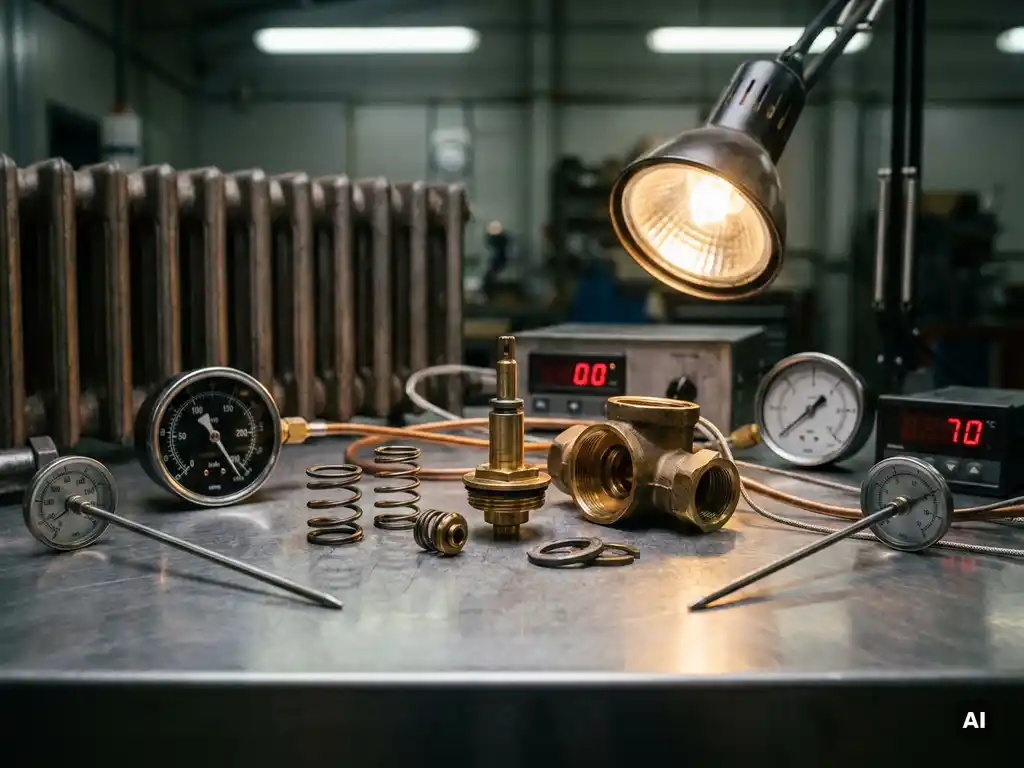
The key thermostat testing standards for radiator systems are defined by bodies such as ISO, SAE, and regional automotive and HVAC standards organizations. These standards govern how thermostats are validated for opening temperature accuracy, flow performance, and durability under real-world thermal stress. The sections below walk through the most important questions engineers and procurement teams ask when specifying or sourcing radiator thermostat components.
Which industry bodies define thermostat testing standards?
Thermostat testing standards for radiator systems are primarily defined by ISO (International Organization for Standardization), SAE International, and DIN (Deutsches Institut für Normung). These organizations publish the technical benchmarks that manufacturers, OEMs, and suppliers use to validate thermostat calibration, opening behavior, and structural integrity across automotive and industrial applications.
ISO 14771 is one of the most widely referenced standards for thermostatic valves used in heating systems, while SAE standards such as SAE J1019 address temperature measurement and thermal performance in automotive cooling systems. In the HVAC and building services space, EN standards published by CEN (the European Committee for Standardization) set the framework for thermostatic components used in radiator and underfloor heating systems.
Beyond these global bodies, national regulators and industry consortia often layer additional requirements on top. In North America, ASTM International contributes material and performance testing frameworks, while in Asia-Pacific markets, JIS (Japanese Industrial Standards) and GB standards from China apply to locally manufactured and imported components. Understanding which body governs your specific application is the first step in building a compliant thermostat specification.
What performance parameters are tested in radiator thermostat validation?
Radiator thermostat validation tests cover opening temperature accuracy, full-stroke travel, flow rate at defined temperature points, closing hysteresis, and response time. These parameters collectively confirm that a thermostat will regulate coolant or fluid flow within the tight tolerances that modern radiator systems demand.
Opening temperature is the most fundamental parameter. Standards typically require the thermostat to begin opening within a defined tolerance band, often plus or minus 1.5 to 2 degrees Celsius from the rated value. Full-stroke travel confirms the valve opens completely at a specified temperature above the nominal rating, ensuring maximum flow when the system needs it most.
Flow rate testing validates that the thermostat passes the correct volume of fluid at given temperatures, which directly affects heat rejection capacity. Closing hysteresis, the temperature difference between when a thermostat opens and when it fully closes again on cooling, matters for system stability and prevents rapid cycling. Response time is particularly critical in automotive applications where engine warm-up speed influences both fuel efficiency and emissions output. Taken together, these thermostat specifications form the technical backbone of any radiator validation program.
How does thermal cycling testing work for radiator thermostats?
Thermal cycling testing subjects a radiator thermostat to repeated heating and cooling cycles between defined temperature extremes to assess long-term durability and calibration stability. The goal is to confirm that the thermostat maintains its opening temperature accuracy and mechanical integrity after thousands of operational cycles that mimic real service life.
During a typical thermal cycling test, the thermostat is immersed in a temperature-controlled fluid bath that ramps up to the full-open temperature, holds there briefly, then drops back below the closing point. This sequence is repeated continuously, with the number of cycles specified by the relevant standard or OEM requirement. Automotive thermostats are commonly tested to tens of thousands of cycles to simulate the expected lifespan of a vehicle.
Engineers monitor opening temperature drift, stroke reduction, and any signs of wax element degradation throughout the process. Wax-based thermostatic elements, which are the most common technology in radiator applications, can experience slight recalibration over time if the wax formulation or housing seals degrade. Thermal cycling testing catches these failure modes early, long before a component reaches the field. It also validates that the thermostat specifications printed on a datasheet hold up under sustained operational stress, not just under ideal laboratory conditions.
What’s the difference between OEM and aftermarket thermostat testing requirements?
OEM thermostat testing requirements are typically more stringent than aftermarket standards because OEMs validate components for specific vehicle or system architectures, often adding proprietary test cycles on top of baseline industry standards. Aftermarket thermostats must meet general thermostat calibration benchmarks but are rarely subjected to the same depth of system-level integration testing.
OEM validation programs often include engine dyno testing, real-world drive cycle simulation, and compatibility checks with the specific cooling system geometry of a given platform. An OEM thermostat might be validated to open within 1 degree Celsius of its rated value across a defined temperature range, with full traceability documentation for every production batch.
Aftermarket components are generally validated against published standards like ISO or SAE specifications, which set minimum performance thresholds but allow wider tolerances. This does not mean aftermarket thermostats are unreliable, but it does mean that buyers sourcing for demanding industrial or automotive applications should scrutinize the test documentation carefully. For high-performance or emissions-sensitive applications, the gap between OEM-grade validation and standard aftermarket certification can have measurable effects on system efficiency and regulatory compliance. Understanding this distinction is essential when evaluating thermostat component options for a specific application.
How do testing standards differ across automotive, industrial, and HVAC radiator applications?
Testing standards differ significantly across these three sectors because each application imposes different temperature ranges, fluid types, pressure conditions, and duty cycles. Automotive standards prioritize rapid thermal response and tight calibration tolerances, industrial standards emphasize durability under continuous operation, and HVAC standards focus on energy efficiency and compatibility with water-based heating circuits.
Automotive radiator thermostats
In automotive applications, thermostats are validated under SAE and OEM-specific protocols that account for aggressive thermal cycling, vibration, and compatibility with coolant additives. Opening temperatures typically fall between 80 and 105 degrees Celsius, and response speed is critical because slow-opening thermostats delay engine warm-up and increase fuel consumption and emissions.
Industrial and HVAC radiator thermostats
Industrial thermostats used in process cooling or oil temperature management face longer continuous duty cycles and often operate with fluids other than water-glycol mixtures, requiring additional compatibility and corrosion testing. HVAC thermostats for radiator and underfloor heating systems are governed by EN standards that emphasize energy labeling compliance and interoperability with modern building management systems. These components generally operate at lower temperatures, around 40 to 80 degrees Celsius, but must maintain precise control over extended periods to support building energy efficiency targets. The differences in thermostat specifications across these sectors mean that a component validated for one application cannot simply be transferred to another without reevaluation.
What documentation is required to prove thermostat compliance?
Proving thermostat compliance requires a combination of test reports, calibration certificates, material declarations, and traceability records that together demonstrate the component meets the relevant thermostat testing standards for its intended application. The exact documentation set depends on the governing standard and the customer’s quality system requirements.
At a minimum, buyers and specifiers should expect to receive a test report confirming that the thermostat was validated against the cited standard, including the specific parameters tested, the equipment used, and the results achieved. Thermostat calibration records showing the opening temperature of individual production batches, or statistical process control data across a production run, are standard in automotive supply chains.
Material declarations such as IMDS submissions (for automotive) or REACH compliance statements (for European markets) confirm that the component’s materials meet regulatory requirements. For HVAC applications, CE marking documentation and the associated declaration of conformity are typically required. In industrial settings, ISO 9001 certification of the manufacturing facility is often a baseline expectation, with additional product-specific certifications layered on depending on the end-use environment. Keeping this documentation organized and current is not just a regulatory exercise. It directly supports faster customer qualification processes and reduces the risk of supply chain disruptions when standards are updated.
How BTT Solutions supports your thermostat compliance requirements
We understand that navigating thermostat testing standards across multiple industries is genuinely complex, and getting it wrong has real consequences for system performance, regulatory approval, and customer trust. That is why we build compliance into every stage of our component development and manufacturing process, rather than treating it as a final checkbox.
- Validated to relevant standards: Our thermostat components are developed and tested against applicable ISO, SAE, EN, and OEM-specific requirements, with full documentation available for customer qualification programs.
- Precise thermostat calibration: We maintain tight opening temperature tolerances across production batches, supported by calibration records and statistical process data that give engineering and procurement teams the confidence they need.
- Cross-sector expertise: Whether your application is automotive cooling, industrial fluid management, or building HVAC, we bring the technical knowledge to match the right thermostat specifications to your system requirements.
- Flexible, responsive support: As a focused, mid-sized organization, we provide direct access to our engineering team, faster response times, and the individual attention that larger suppliers often cannot offer.
- End-to-end documentation: From test reports and calibration certificates to material declarations and traceability records, we prepare the compliance documentation your quality team needs from day one.
If you are specifying thermostat components for a radiator system and want to work with a partner who takes testing standards as seriously as you do, we would be glad to talk through your requirements. Get in touch with our team to start the conversation, or learn more about who we are and the experience we bring to every project.
Related Articles
- What is the difference between a thermostat valve and thermostat bellows?
- How does the choice of insulation material affect thermostat component safety?
- How do I determine what type of thermostat I need?
- What factors should you consider when selecting thermostat elements?
- What are the benefits of thermal management systems?


