
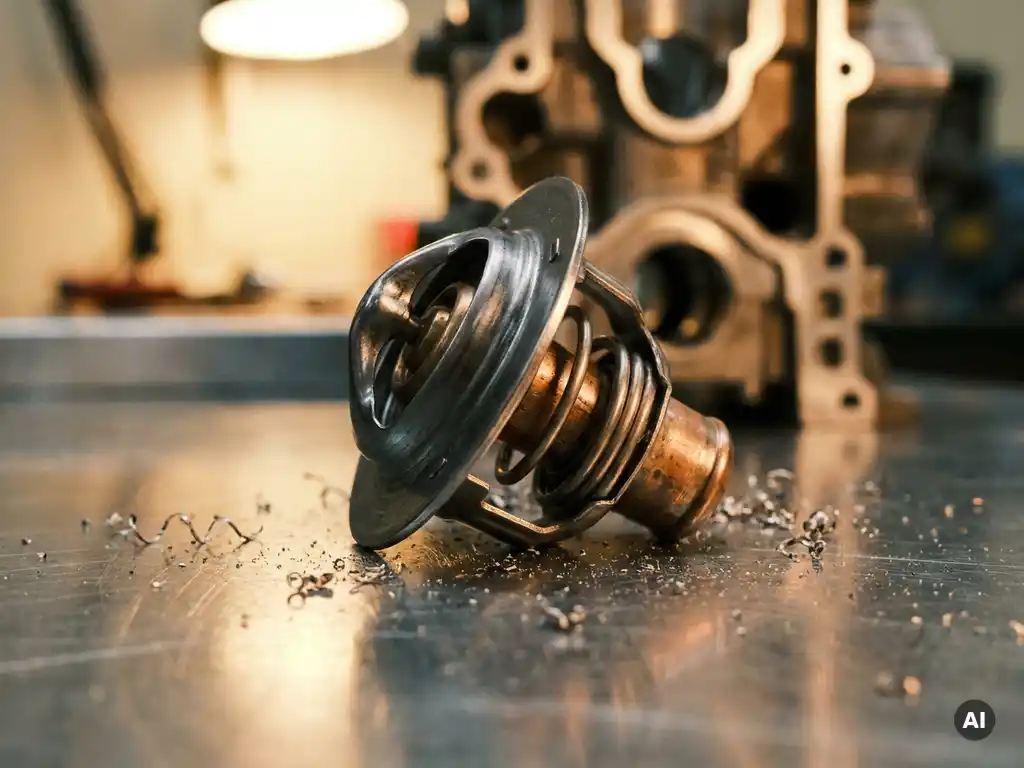
Yes, better thermostat materials can meaningfully reduce engine energy consumption. The material composition of a thermostat directly affects how quickly and accurately it responds to temperature changes, which in turn shapes how long an engine runs in its inefficient cold-start phase. Below, we unpack the key questions engineers and procurement teams are asking about thermostat materials in 2026.
Which thermostat materials are used in modern engines?
Modern engine thermostats are built around a core wax element housed within a thermostat frame, typically made from materials such as brass, aluminum, or engineering plastics. The wax element itself is the active component, expanding as it heats up to open the valve and allow coolant to flow through the radiator. The choice of frame and insert materials determines durability, response speed, and thermal precision.
Brass has historically been the go-to material for thermostat frames because of its corrosion resistance and machinability. However, aluminum alloys have gained ground in recent years due to their lighter weight and good thermal conductivity. Engineering plastics, often reinforced with glass fiber, are increasingly used in housings and bypass components where weight reduction is a priority and direct heat exposure is lower.
The wax compound inside the insert is where the real variation lies. Different wax blends are engineered to activate at specific temperature thresholds, and the quality of thermostat insert manufacturing directly affects how consistently that activation happens across thousands of thermal cycles.
How does thermostat material affect engine warm-up time?
Thermostat material affects engine warm-up time by influencing how quickly the thermostat itself reaches its opening temperature and how precisely it holds the coolant in the engine block during the warm-up phase. A thermostat made from materials with good thermal conductivity responds faster to temperature changes, which helps the engine reach its optimal operating temperature more efficiently.
During a cold start, the thermostat keeps coolant circulating only within the engine, bypassing the radiator. The faster this loop stabilizes at operating temperature, the sooner the engine management system can optimize fuel injection and ignition timing. If the thermostat material is slow to respond or inconsistent in its opening behavior, the engine spends more time in a thermally suboptimal state, burning more fuel in the process.
Frame material also plays a supporting role. A thermostat frame that conducts heat away too aggressively can slow the wax element’s activation, while one that insulates too well may cause the valve to open unevenly. Getting this balance right is one of the quieter challenges in thermostat design.
What role does thermal precision play in fuel efficiency?
Thermal precision plays a central role in fuel efficiency because modern engines are tuned to operate within a narrow temperature window. When a thermostat opens too early or too late relative to its rated temperature, the engine management system compensates in ways that increase fuel consumption and emissions. A thermostat that holds its set point accurately keeps the engine in its optimal combustion zone for longer.
Even a few degrees of deviation from the target temperature can shift combustion efficiency. Engines running slightly too cool tend to produce more unburned hydrocarbons, while engines running too hot risk knock and require fuel enrichment to protect components. Precision in both the thermostat insert manufacturing process and the wax compound formulation is what keeps the valve behavior consistent across varying load conditions and ambient temperatures.
For fleet operators and OEMs focused on emissions compliance, this precision is not a minor detail. It is a measurable factor in meeting regulatory targets cycle after cycle.
How do advanced thermostat materials compare to standard wax elements?
Advanced thermostat materials, including refined wax blends, composite thermostat frames, and electronically assisted actuators, offer tighter temperature tolerances and longer service life compared to standard wax elements. Standard wax elements are reliable and cost-effective, but they have inherent variability in their activation curve that more engineered materials can reduce significantly.
Refined wax compounds
Higher-grade wax formulations are processed to tighter specifications, which means the expansion curve is more predictable across temperature ranges. This reduces the spread between the point where the valve begins to open and where it is fully open, giving the engine management system a more consistent signal to work with.
Composite and metal thermostat frames
Advanced thermostat frames made from aluminum alloys or high-performance composites offer better dimensional stability under thermal cycling. Standard plastic frames can creep or distort over time, affecting valve seating and potentially causing small leaks or erratic behavior. A well-engineered thermostat frame maintains its geometry across a wider range of temperatures and pressures, which keeps the entire assembly performing as designed for longer.
Electronically controlled thermostats, which use a heating element to trigger the wax element on demand rather than relying solely on coolant temperature, represent the furthest step along this spectrum. They allow the engine control unit to actively manage coolant temperature in real time, but they also introduce electrical complexity and cost that are not always justified outside of high-efficiency or hybrid applications.
What are the limits of material improvements alone?
Material improvements alone cannot fully optimize engine thermal management. Even the most precisely manufactured thermostat insert or advanced thermostat frame operates within a system that includes the cooling circuit design, the engine control strategy, the radiator capacity, and the operating profile of the vehicle or machine. Material quality raises the ceiling of what is achievable, but it does not replace good system integration.
A high-quality wax element installed in a poorly designed housing will still underperform. Similarly, a thermostat with excellent material properties will not compensate for a cooling system that is undersized for the application or a control strategy that does not account for real-world load variation. The thermostat is one node in a larger thermal network, and its contribution to efficiency depends on how well the surrounding system is designed to work with it.
There is also a practical ceiling to how much wax-based technology can improve without crossing into electronic actuation. For applications where passive thermostatic control is sufficient, material refinement delivers genuine gains. For applications demanding active temperature management, the conversation shifts from materials to system architecture.
How BTT Solutions approaches thermostat material engineering
We develop thermostat components where material selection is treated as an engineering decision, not a commodity choice. Our work spans automotive, industrial, and building technology applications, and across all of them the same principle applies: the right material in the right configuration makes a measurable difference in system performance.
- Precision thermostat insert manufacturing with refined wax compounds engineered for tight activation tolerances across demanding thermal cycles
- Thermostat frame development in brass, aluminum, and engineering plastics, matched to the thermal and mechanical requirements of each application
- End-to-end component solutions covering thermostats and temperature sensors for automotive, industrial, and HVAC applications
- Direct engineering collaboration with procurement and technical teams to select the right material specification for each use case
As a focused, mid-sized specialist, we offer the kind of individual attention and fast response that larger suppliers often cannot. If you are evaluating thermostat materials for a new application or looking to improve an existing system, we would be glad to talk through the specifics. Get in touch with our team to start the conversation.
Related Articles
- What is the role of housing materials in thermostat component design?
- How does engine efficiency compare between naturally aspirated and turbocharged engines?
- How does optimal engine temperature affect fuel efficiency?
- What is the difference between OEM and aftermarket thermostats?
- What is the response time of a wax element thermostat?


