
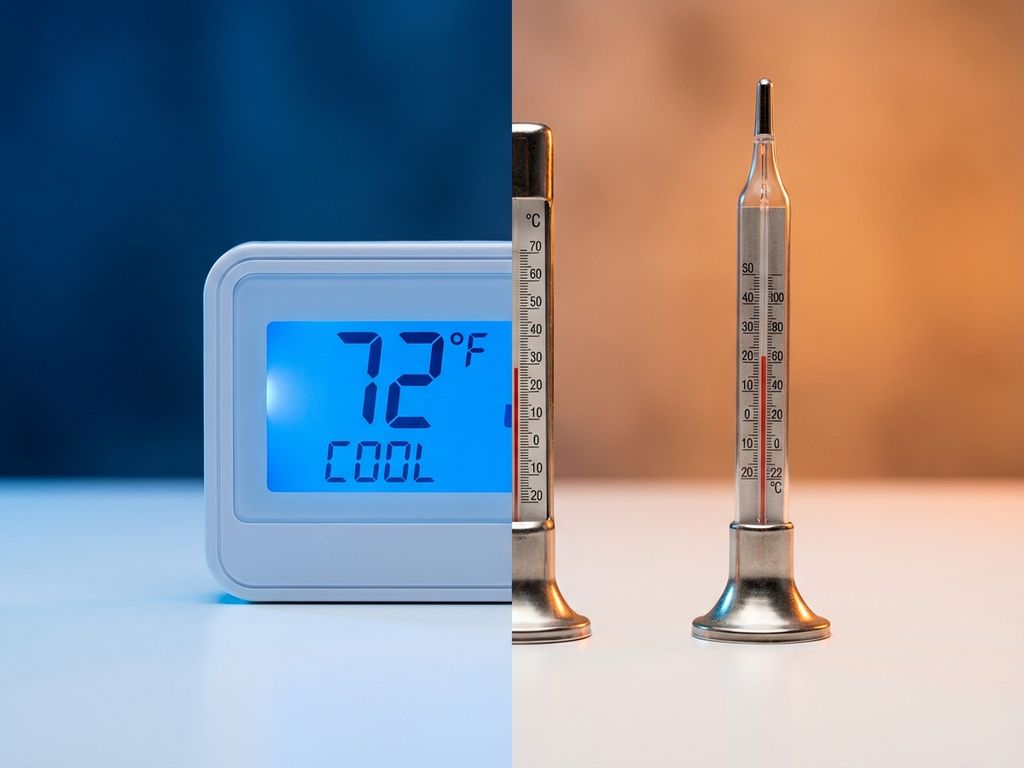
Picture a cold winter morning. You glance at the thermometer on your wall and it reads 14°C. That is useful to know, but the room stays cold until you do something about it. Now picture a thermostat set to 21°C: the moment that same reading drops below your target, it quietly tells your boiler to fire up, and you never have to lift a finger. That is the whole idea in a nutshell, measuring versus acting.
The difference between a thermostat and a thermometer comes down to purpose: a thermometer measures temperature, while a thermostat controls it. Thermometers show you the current reading, whereas thermostats keep a space at the temperature you want by switching heating or cooling systems on and off. Once you know whether you need to measure or to control, picking the right device gets much easier.
| Thermostat | Thermometer | |
|---|---|---|
| Primary function | Controls temperature | Measures temperature |
| How it works | Senses temperature, compares it to a set point, switches system on or off | Senses temperature, converts it to a display value |
| Output | Automatic on/off command to equipment | A reading on a screen or dial |
| Automation | Yes, acts without manual input | No, provides data only |
| Typical use cases | Home heating, industrial control, car cooling circuits | Cooking, medical checks, weather, quality control |
| Common types | Mechanical, electronic, programmable, smart | Digital, analogue, infrared, thermocouple, RTD |
What exactly is the difference between a thermostat and a thermometer?
A thermostat is a temperature control device that automatically regulates heating and cooling systems, while a thermometer is purely a measurement instrument that displays temperature readings. That one distinction shapes how each device behaves in any thermal management setup.
Thermostats contain sensing elements that detect temperature changes and switching mechanisms that activate or deactivate connected equipment. When room temperature drops below your set point, the thermostat signals your heating system to start. Once the desired temperature is reached, it switches the system off. This creates an automated control loop that keeps conditions steady without anyone having to step in.
Thermometers, by contrast, give you information and nothing more. They use sensing technologies like digital sensors, infrared detectors, and liquid expansion to measure ambient or surface temperatures accurately. Whether you’re checking indoor conditions, monitoring an industrial process, or taking someone’s temperature, a thermometer hands you precise data but won’t act on it.
The difference really shows in everyday use. You’d rely on a thermostat to hold your home at 21°C automatically, but you’d reach for a thermometer to check whether your refrigerator is sitting at the right 4°C.
How does a thermostat actually control temperature?
Thermostats control temperature through a three step process: sensing the current temperature, comparing it to your desired setting, and switching connected equipment on or off accordingly. This automated cycle keeps temperatures within your chosen range while helping to save energy and protect equipment.
Mechanical thermostats use bimetallic strips or gas-filled bellows that expand and contract with temperature changes. As these components move, they physically open or close electrical contacts that control your heating or cooling system. These reliable devices have been used for decades in homes and commercial buildings.
Electronic thermostats employ digital sensors like thermistors or resistance temperature detectors (RTDs) to measure temperature precisely. Microprocessors compare sensor readings to your programmed settings and send electrical signals to control equipment. This digital approach allows tighter control and extras such as programmable schedules.
The switching function is what makes this kind of control work. Rather than running nonstop, your heating or cooling system cycles on and off to hold the set temperature, which saves energy and reduces wear while keeping conditions comfortable. Modern thermostats also include anticipation circuits that help limit temperature swings by accounting for how quickly a system responds.
What are the main types of thermostats and when should you use each?
The four main thermostat types are mechanical, electronic, programmable, and smart thermostats, each suited to different applications and user needs. Your choice depends on the features you want, your budget, how hard the installation is, and whether it works with your system.
Mechanical thermostats offer simple, reliable temperature control using bimetallic elements or gas-filled sensors. They’re a good fit for basic applications where you just want steady temperatures without extra features. These units work well in rental properties, workshops, or anywhere you’d rather skip the programming.
Electronic thermostats provide more precise temperature control through digital sensors and displays. They make sense when accuracy matters, such as in laboratories, medical facilities, or precision manufacturing. The digital interface is also easier to read and adjust than a mechanical dial.
Programmable thermostats automatically adjust temperatures based on daily and weekly schedules you create. They’re excellent for homes and offices where occupancy patterns are predictable. You can set different temperatures for morning, daytime, evening, and night, cutting energy use when nobody is around.
Smart thermostats connect to your Wi‑Fi network, letting you control them from a smartphone app while they learn your preferences over time. As of 2025, smart thermostats are among the most widely adopted home energy upgrades, with many models now compatible with open standards that allow seamless integration across different smart home ecosystems. They suit tech‑savvy users who want maximum convenience and energy savings, and they’re particularly handy in modern homes with variable schedules or for property managers overseeing several buildings.
How do thermometers measure temperature accurately?
Thermometers measure temperature by detecting thermal energy through various sensing technologies that turn heat into a readable value. Accuracy depends on the sensing method, how well the device is calibrated, where you place it, and environmental factors like humidity and air circulation.
Digital thermometers use electronic sensors such as thermistors, which change electrical resistance as temperature varies. These sensors connect to circuits that convert the resistance change into a reading on an LCD screen. Digital units typically reach accuracy within ±0.1°C and respond quickly, which makes them ideal when you need precise measurement and fast results.
Analogue thermometers rely on the physical expansion of materials like mercury or alcohol in glass tubes, or on bimetallic strips in dial gauges. As temperature rises, the material expands proportionally, moving up the scale or rotating the pointer. They’re less precise than digital versions, but they’re dependable and don’t need batteries or frequent calibration.
Infrared thermometers measure thermal radiation emitted by surfaces without touching them, which makes them a safe choice when direct contact isn’t an option. They’re invaluable for hot surfaces, moving objects, or hazardous materials. To get accurate readings, though, you need to understand emissivity and surface conditions.
Specialised measurement devices include thermocouples for extreme temperatures, resistance temperature detectors (RTDs) for precision work, and thermal imaging cameras for mapping the temperature of an area. Which one suits you best depends on your environment, the accuracy you need, and what you plan to do with the readings.
When do you need a thermostat versus just a thermometer?
Choose a thermostat when you want automatic temperature control that keeps conditions consistent, and a thermometer when you only need to monitor temperatures without any automated response. Asking yourself whether you want measurement data or active temperature management will usually settle the question.
Thermostats are essential for comfort control such as home heating, air conditioning, and industrial processes where holding a specific temperature is critical. You need one wherever temperature swings could damage equipment, affect product quality, or ruin your comfort. Examples include residential HVAC systems, laboratory incubators, and manufacturing processes that depend on precise thermal conditions.
Thermometers are enough when you simply need temperature information for monitoring, checking, or making a manual decision. They’re ideal for testing food temperatures, watching outdoor conditions, verifying equipment performance, or running quality control checks in kitchens, weather stations, medical settings, and maintenance work.
Think about how you’ll respond to the reading. If it will prompt you to take action yourself, a thermometer gives you what you need. If you’d rather have the system react on its own, a thermostat removes the need for constant monitoring and manual adjustments, since it handles both sensing and control.
Plenty of setups benefit from using both. A thermostat might handle primary control while extra thermometers monitor and verify what’s happening, adding a safety backup and a clearer picture of performance.
Frequently asked questions about thermostats and thermometers
Can a thermostat work as a thermometer?
Sort of. Most thermostats have a built-in temperature sensor, so they often display the current room temperature. But their main job is control, not precise measurement. If you need an accurate reading for its own sake, a dedicated thermometer is the better tool.
Which is more accurate, a thermostat or a thermometer?
Dedicated thermometers are generally more accurate, because they’re calibrated for that one purpose. Thermostat sensors are built to switch reliably rather than to deliver laboratory-grade precision. For everyday comfort control the difference rarely matters, but for exact measurement a thermometer wins.
Do I need both a thermostat and a thermometer?
In many home and industrial setups, yes. The thermostat runs the system, while additional thermometers confirm that it’s performing as expected and provide a useful backup check. For a simple home heating setup, a thermostat alone often does the job.
What is the difference between a thermostat and a thermometer in HVAC systems?
In HVAC, the thermostat is the control hub: it reads room temperature and tells the system when to heat or cool. Separate thermometers may be installed at supply and return air vents to track airflow temperatures and spot efficiency problems.
How BTT Solutions helps with advanced thermal management systems
We specialise in precision thermostat technology and thermal management components for automotive, industrial, and building applications. Our thermostatic solutions help optimise energy efficiency while holding exact temperatures across demanding operating conditions, bridging the gap between simple measurement and intelligent climate control. And with energy-saving expectations continuing to rise in 2026, we keep refining our designs to meet them.
Our product range tackles key thermal management challenges through:
- High‑precision thermostats that reduce energy consumption through efficient fluid control in automotive and industrial systems
- Advanced temperature sensors providing accurate feedback for optimal system performance and emissions reduction
- Integrated control units that combine sensing and switching functions for seamless thermal management
- Specialised components for building systems including floor heating, radiators, and wall heating applications
- Custom solutions tailored to specific automotive, marine, and industrial thermal control requirements
Our patented end to end thermal management solutions support strong performance, fuel efficiency, and lower emissions across several industries. Whether you need precise temperature control for a vehicle or efficient thermal management for an industrial process, our BTT thermostat components deliver reliable, long term performance that pairs accurate sensing with intelligent control.
Contact us today to talk about how our thermostat technology can improve the efficiency and performance of your thermal management system.
Related Articles
- How do you verify thermostat specifications for OEM component sourcing?
- How do you validate a thermostat for use in safety-critical applications?
- How does optimal engine temperature affect fuel efficiency?
- What is the difference between standard and precision thermostat inserts?
- When should you consider liquid cooling for thermal management?


