
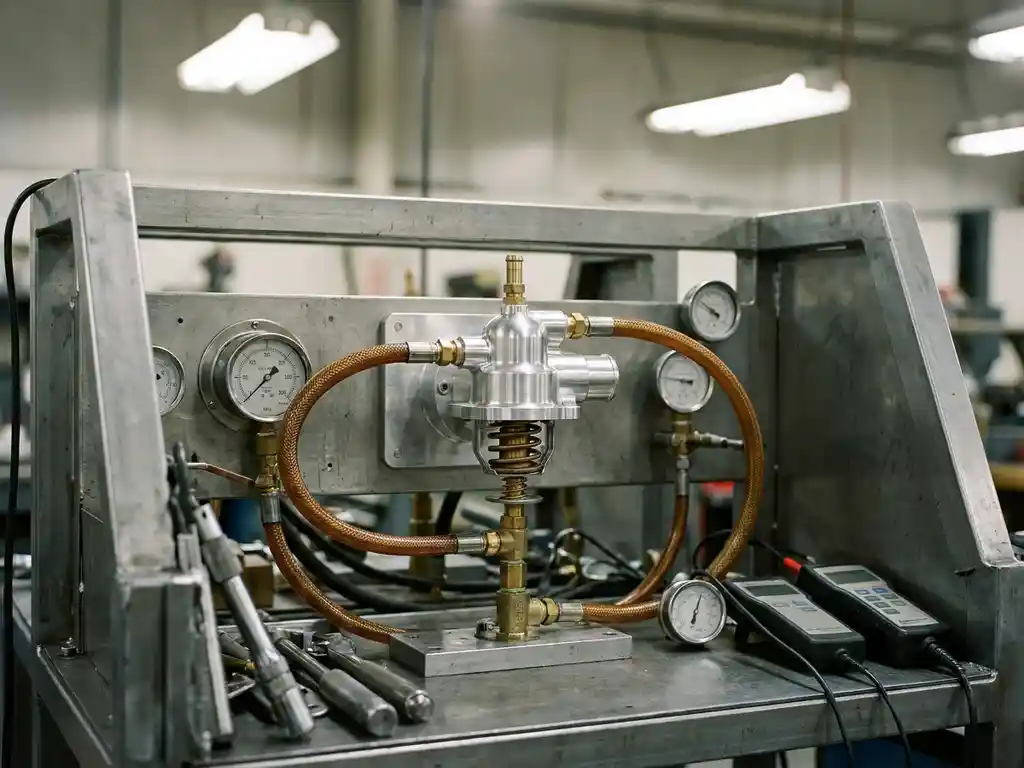
A test bench plays a central role in thermostat performance evaluation by providing a controlled, repeatable environment where a thermostat’s thermal response can be measured with precision. Rather than relying on real-world engine conditions that vary constantly, a test bench isolates the thermostat as a single component and subjects it to defined temperature profiles, fluid flows, and pressure conditions. The sections below walk through exactly how this process works, what gets measured, and when re-testing makes sense.
How does a test bench actually measure thermostat performance?
A thermostat test bench measures performance by immersing the thermostat in a temperature-controlled fluid bath and recording how the valve responds as temperature rises and falls. Sensors capture the exact moment the valve begins to open, the rate at which it opens, and the point at which it reaches full stroke. This gives engineers a precise, reproducible picture of thermal behavior under defined conditions.
The bench typically circulates a calibrated fluid, often water or a water-glycol mixture, through a heated chamber. Temperature probes positioned close to the thermostat element record the fluid temperature in real time, while displacement sensors track valve lift. A data acquisition system logs all readings continuously, allowing engineers to plot the full opening curve from initial crack-open through maximum stroke. Because every variable is controlled, results from one test run can be compared directly against previous runs or against supplier data sheets.
Modern test benches also apply back-pressure conditions to simulate the resistance a thermostat faces inside an actual cooling circuit. This matters because a valve that opens freely in still water may behave differently when fluid is actively pushing against it. Combining thermal and hydraulic inputs on the same bench brings the evaluation much closer to real operating conditions without the complexity of a running engine.
What parameters does a thermostat test bench evaluate?
A thermostat test bench evaluates several key parameters: opening temperature, full-stroke temperature, valve lift distance, closing temperature, and response time. Together these measurements define the thermostat’s complete thermal profile and determine whether the component meets its design specification.
- Opening temperature: The fluid temperature at which the valve first begins to move. This is the most critical single value in thermostat performance evaluation because it directly determines when coolant starts circulating through the radiator.
- Full-stroke temperature: The temperature at which the valve reaches its maximum designed lift, allowing full coolant flow.
- Valve lift: The physical distance the valve travels, measured in millimetres. Insufficient lift restricts flow even if opening temperature is correct.
- Closing temperature: The temperature at which the valve returns to its seat as the fluid cools. Hysteresis between opening and closing is expected and is evaluated against tolerances.
- Response time: How quickly the thermostat reacts to a defined rate of temperature change. Slow response can cause thermal overshoot in the engine.
Some advanced benches also measure leak rate across the closed valve seat, which is relevant for precision applications where even small bypass flows affect system efficiency. For a broader look at the components involved in these measurements, our thermostat component range gives a useful overview of the physical elements being evaluated.
How does test bench validation differ from real-world engine testing?
Test bench validation isolates the thermostat as a standalone component under controlled conditions, while real-world engine testing evaluates how the thermostat interacts with an entire cooling system under dynamic loads. Both approaches are valuable, but they answer different questions and serve different stages of the development process.
On a test bench, engineers control every variable: fluid temperature, flow rate, and pressure. This makes it straightforward to verify whether a component meets its specification and to compare batches or design variants directly. The tradeoff is that a bench cannot fully replicate the rapid temperature swings, vibration, or variable flow rates that occur during actual driving cycles.
Real-world engine testing, by contrast, captures system-level interactions. A thermostat might pass bench validation perfectly but perform differently when installed next to a heat-soaked engine block or subjected to cold-start conditions in low ambient temperatures. This is why thermostat validation typically uses both methods in sequence: bench testing confirms the component specification is met, and engine testing confirms the component works correctly within the full system.
For thermomanagement applications outside the automotive sector, such as industrial cooling circuits or heating systems, analogous rig testing serves the same function as engine testing, replacing the vehicle environment with the relevant industrial or building system.
What causes a thermostat to fail bench testing?
The most common causes of thermostat bench test failure are an incorrect opening temperature, insufficient valve lift, slow thermal response, and valve seat leakage. Each failure mode points to a specific issue in the wax element, the valve geometry, or the manufacturing process.
Opening temperature failures usually trace back to the wax formulation inside the expansion element. The wax blend determines the precise temperature at which the element begins to expand. Contamination, inconsistent mixing, or an incorrect wax grade will shift the opening temperature outside the specified tolerance band. Even a deviation of a few degrees can cause a component to fail, particularly for applications with tight thermal windows.
Insufficient valve lift often results from a worn or incorrectly assembled spring, a dimensional error in the valve housing, or degradation of the wax element after thermal cycling. If the valve does not reach full stroke, coolant flow is restricted and the engine or system cannot shed heat effectively.
Slow response time is typically linked to poor thermal contact between the fluid and the wax element, which can result from surface contamination or a design issue with the element housing. Valve seat leakage, meanwhile, usually indicates wear, debris on the seating surface, or a dimensional tolerance issue in the seat geometry.
Which industry standards govern thermostat bench testing?
Thermostat bench testing for automotive applications is primarily governed by standards from organizations such as ISO, DIN, and SAE, as well as OEM-specific test specifications that individual vehicle manufacturers apply to their supply chains. These standards define the test conditions, acceptable tolerances, and reporting requirements that a component must satisfy.
ISO standards relevant to cooling system components set out general requirements for dimensional measurement and functional testing. SAE standards, widely used in North American and global automotive supply chains, specify test fluid composition, temperature ramp rates, and the number of thermal cycles a thermostat must survive before re-evaluation. DIN standards play a similar role in European supply chains and are often referenced alongside OEM specifications.
In practice, most automotive OEMs layer their own requirements on top of these baseline standards. A thermostat destined for a specific vehicle platform may need to pass both the relevant ISO or SAE bench test and a proprietary OEM validation protocol before it is approved for production. Industrial and building technology applications follow their own sector-specific standards, which vary by region and application type but share the same underlying principle: defining a repeatable test method that produces comparable, traceable results.
When should thermostat components be re-tested on the bench?
Thermostat components should be re-tested on the bench after any change to the design, materials, or manufacturing process, after a defined period of field service, and whenever a quality concern arises in production or in the field. Re-testing is also standard practice when a component is being qualified for a new application or a new customer specification.
Design or material changes, even minor ones, can shift the opening temperature or affect valve lift in ways that are not always predictable from calculations alone. Running a full bench evaluation after any engineering change confirms that performance remains within specification before the updated component enters production.
Periodic re-testing of production samples is a normal part of quality assurance in high-volume manufacturing. Sample testing at defined intervals catches drift caused by raw material variation, tooling wear, or process changes that accumulate gradually over time. When field returns or warranty claims point to a potential thermal performance issue, bench testing of returned parts helps distinguish between a design problem, a manufacturing defect, and normal end-of-life wear.
For components moving into a new application, such as a thermostat originally validated for an automotive cooling circuit being considered for an industrial process cooling system, re-testing against the new application’s requirements is essential. The operating temperatures, fluid types, and pressure conditions may differ significantly from the original validation environment.
How BTT Solutions supports thermostat component selection and validation
Choosing the right thermostat component for a demanding application involves more than matching a part number to a temperature specification. We work directly with engineers and procurement teams to make sure the components they select are validated for their specific operating conditions, fluid environments, and performance tolerances. Our product advisory service covers:
- Component selection guidance for wax elements, thermostat inserts, and engineered housings across automotive, industrial, and building technology applications
- Technical consultation on opening temperature tolerances, valve lift requirements, and compatibility with specific coolant or process fluid formulations
- Support for qualification processes, including documentation and technical data to support bench testing and OEM approval workflows
- Flexibility for non-standard requirements, drawing on our experience across diverse thermomanagement applications from engine cooling to floor heating systems and marine applications
As a focused, independent specialist, we give every customer direct access to technical expertise without the delays that come with larger organisational structures. If you are evaluating thermostat components for a new application or working through a validation process, we would be glad to help. Get in touch with our team to discuss your requirements and find the right solution.


