
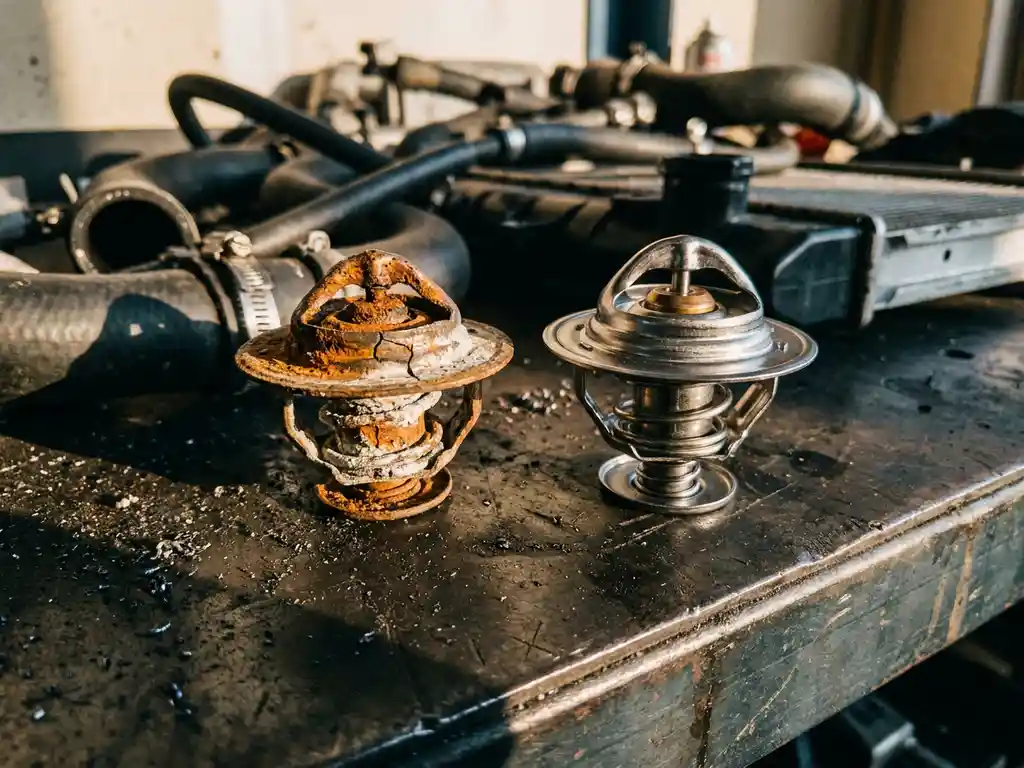
Thermostats do degrade over time, and that degradation directly affects how well they regulate temperature. The core mechanisms that drive a thermostat’s operation, particularly the wax element that expands and contracts in response to heat, gradually lose their precision as materials fatigue, contaminants accumulate, and mechanical components wear. This article unpacks the most common questions engineers and procurement teams ask about thermostat aging, wear, and what to do when performance starts to slip.
What physical changes happen inside a thermostat as it ages?
As a thermostat ages, the wax element at its core undergoes gradual material fatigue, the sealing surfaces experience micro-wear, and internal spring tension shifts. These changes are slow and cumulative, but they alter the thermostat’s ability to respond accurately to temperature changes over thousands of operating cycles.
The wax element is the heart of most thermostatic components. It works by expanding as it absorbs heat and contracting as it cools, physically pushing a valve open or closed. Over time, repeated thermal cycling causes the wax to lose some of its volumetric consistency. The expansion curve becomes less predictable, which means the valve no longer opens at exactly the right temperature.
Beyond the wax, the return spring that closes the valve after cooling also weakens with age. Metal fatigue is a well-understood phenomenon, and springs operating in high-temperature environments are particularly vulnerable. A weaker spring means slower valve closure and a higher risk of the thermostat remaining partially open when it should be fully closed. Sealing surfaces, especially in thermostats exposed to coolant or oil, can also develop deposits or surface corrosion that interfere with proper valve seating.
How does wear affect a thermostat’s opening and closing accuracy?
Wear shifts a thermostat’s opening temperature threshold, widens its hysteresis band, and slows its response speed. In practical terms, this means the valve may open too early, close too late, or fail to reach its fully open or fully closed position within the expected temperature range.
Precision matters enormously in thermostat components. A deviation of just a few degrees in the opening point can have measurable consequences for engine efficiency, coolant circuit behavior, or heating system performance. In automotive applications, an early-opening thermostat allows coolant to circulate before the engine reaches its optimal operating temperature, which increases fuel consumption and emissions. A late-opening thermostat risks overheating.
The closing behavior is equally important and often overlooked. If the thermostat does not close cleanly and completely, a small bypass flow continues even when the system should be running in a closed-loop warm-up mode. This thermal leak adds up over time, particularly in systems designed for tight efficiency margins.
What are the symptoms of a thermostat that has degraded over time?
The most common symptoms of thermostat degradation include longer warm-up times, unstable operating temperatures, increased fuel consumption, and, in more advanced cases, overheating or heater performance loss. These signs often appear gradually, making them easy to misattribute to other system components.
In engine cooling systems, a degraded thermostat often shows up as a temperature gauge that fluctuates more than usual or settles at a lower-than-normal operating point. Drivers or operators may notice the heater producing less warmth than expected, which is a direct result of coolant circulating before the engine is fully warm.
In industrial or building applications, the symptoms translate to inconsistent output temperatures, increased energy draw, and control systems that compensate by running longer or harder to maintain setpoints. These secondary effects can mask the root cause for a long time before the thermostat itself is identified as the problem.
One reliable diagnostic indicator is comparing actual operating temperatures against the thermostat’s rated opening point. If the system consistently runs below or above its design temperature without another obvious cause, thermostat wear is a strong candidate.
How long do thermostats typically last before performance drops?
Thermostat lifespan varies significantly depending on application, operating conditions, and component quality, but in automotive use, most thermostats are designed to last the service life of the vehicle or a minimum of several hundred thousand thermal cycles. In more demanding industrial or marine environments, performance degradation can occur earlier.
Temperature extremes accelerate aging. A thermostat operating near the upper end of its rated range will experience more rapid wax fatigue and spring wear than one running in moderate conditions. Coolant quality also plays a major role. Contaminated or acidic coolant attacks sealing surfaces and can cause deposits to form on the wax element, effectively insulating it and slowing its thermal response.
Vibration is another underestimated factor. In high-vibration environments such as heavy vehicles, marine engines, or industrial machinery, mechanical wear on valve seats and guide surfaces accumulates faster. The result is a thermostat that may still function, but no longer functions accurately. For teams managing thermomanagement systems across a fleet or production line, understanding these environmental factors helps predict replacement intervals more reliably than relying on calendar-based schedules alone.
Can a degraded thermostat be recalibrated, or does it need replacing?
In most cases, a degraded thermostat cannot be meaningfully recalibrated in the field and should be replaced. The physical changes driving thermostat degradation, including wax element fatigue and spring weakening, are material-level changes that cannot be reversed through adjustment or cleaning.
Some industrial thermostat assemblies are designed with replaceable inserts, which allows the wax element or valve cartridge to be swapped out without replacing the entire housing. This is a practical and cost-effective approach in applications where the housing is integrated into a larger assembly or where downtime is expensive. However, this only applies to purpose-built modular designs, not standard thermostat units.
Attempting to compensate for a degraded thermostat by adjusting system setpoints elsewhere, such as raising a fan activation threshold to account for a late-opening thermostat, introduces secondary inefficiencies and masks the underlying problem. The right answer in almost every case is component replacement with a part that meets the original specification.
How can thermostat lifespan be extended in demanding applications?
Thermostat lifespan in demanding applications can be extended through correct component selection for the operating environment, regular coolant maintenance, vibration isolation where possible, and monitoring operating temperatures to catch drift before it becomes failure.
Selecting the right thermostat for the application is the single most effective step. A component rated for a higher temperature range than the application demands will operate with more margin and experience less thermal stress per cycle. Similarly, choosing a thermostat with a housing material suited to the fluid chemistry it will contact, whether coolant, oil, or water, prevents premature corrosion and deposit formation.
Coolant maintenance is frequently underestimated. Fresh, correctly formulated coolant maintains the right pH balance and inhibitor levels that protect metal and elastomer surfaces inside the thermostat. Degraded coolant becomes corrosive and can accelerate wear on exactly the surfaces that matter most for sealing accuracy.
For high-vibration or high-cycle applications, specifying components built to tighter manufacturing tolerances pays dividends over time. A thermostat with a more precise wax element formulation and a higher-grade return spring will maintain its opening accuracy longer under stress than a commodity component, even if both carry the same nominal specification on paper.
How BTT Solutions supports thermostat performance across the full product lifecycle
Understanding how thermostat aging and wear affect system performance is one thing. Having the right components and the right guidance to address it is another. At BTT Solutions, we work directly with engineers, procurement teams, and technical decision-makers to identify the best thermostat components for their specific application and operating conditions.
Our product advisory service covers the full range of thermostatic components, and we bring deep expertise in matching the right solution to the right environment. Whether you are dealing with early thermostat degradation in a demanding industrial system, planning a replacement program for an automotive application, or specifying components for a new build, we can help you get it right from the start. Here is what we bring to that conversation:
- Component selection guidance across wax elements, thermostat inserts, and engineered housings, matched to your thermal range, fluid type, and cycle demands
- Application-specific advice for automotive, industrial, marine, and building technology environments
- Precision-engineered products designed for long service life and accurate opening behavior across thousands of thermal cycles
- Direct access to our technical team, without the delays of a large corporate structure, so you get answers and samples quickly
If you are evaluating your current thermostat components or planning ahead for a new application, we are ready to help. Get in touch with our team to start the conversation, or explore our product range to see what we offer.
Related Articles
- How does a thermostat valve regulate coolant flow in industrial systems?
- What is the best and easiest thermostat to use?
- 5 Ways Map-Controlled Thermostats Improve Fuel Efficiency and Reduce Emissions
- How do you specify a custom thermostat for a new vehicle application?
- What factors should OEMs consider when selecting a thermostat supplier?


