
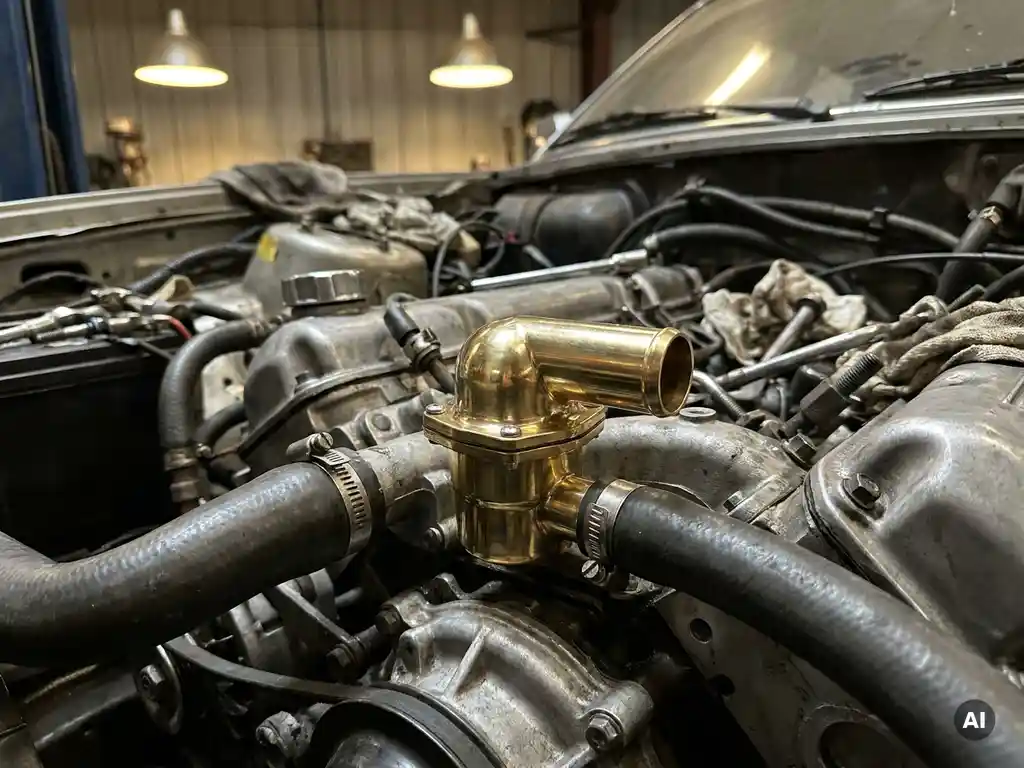
Brass thermostat housings are used in automotive applications to enclose and protect the thermostat valve that regulates coolant flow between the engine and the radiator. Because brass resists corrosion, handles thermal cycling reliably, and machines to tight tolerances, it has long been a trusted material for this critical component. The sections below walk through the most common questions engineers and procurement teams ask about brass thermostat housings.
What makes brass the preferred material for thermostat housings?
Brass is preferred for thermostat housings because it combines excellent corrosion resistance with high dimensional stability under repeated heating and cooling cycles. Unlike many metals, brass does not react aggressively with engine coolant additives, which extends the service life of the housing and reduces the risk of internal deposits blocking coolant passages.
Beyond corrosion resistance, brass machines exceptionally well. Manufacturers can hold tight tolerances on sealing surfaces and threaded ports, which matters enormously when a housing must maintain a leak-free seal at operating pressures. The material also has a relatively high thermal conductivity, meaning it responds quickly to temperature changes rather than acting as an insulating barrier around the thermostat itself.
There is also a practical reliability argument. Brass housings have a proven track record across decades of automotive use, and their performance characteristics are well understood by both engineers and quality teams. When a component sits at the heart of an engine’s thermal management system, that kind of predictability carries real weight.
Where exactly is the thermostat housing located in an engine?
The thermostat housing sits at the point where the coolant exits the engine block or cylinder head and enters the upper radiator hose. In most passenger vehicles, this means it is bolted directly to the engine at the top of the coolant outlet, making it one of the first components you see when you open the bonnet and trace the large radiator hose back to the engine.
Its position is deliberate. By sitting at the coolant outlet, the housing and the thermostat inside it can sense the actual temperature of the coolant leaving the engine rather than the temperature somewhere mid-circuit. This placement gives the thermostat the most accurate possible signal for deciding when to open and allow hot coolant to flow toward the radiator for cooling.
On some engine layouts, particularly inline engines with front-mounted accessories, the housing is easy to access. On transversely mounted engines in front-wheel-drive vehicles, it can be tucked behind other components, but its function and position in the coolant circuit remain the same.
How does a brass thermostat housing regulate engine temperature?
The brass thermostat housing itself does not regulate temperature directly. Instead, it is the structural enclosure that holds the thermostat valve in the correct position within the coolant circuit. The thermostat valve inside the housing is what actually controls coolant flow, and the housing ensures that the valve is sealed, aligned, and exposed to the right coolant stream.
When the engine is cold, the thermostat valve remains closed. Coolant circulates in a short loop through the engine block without passing through the radiator, which lets the engine reach operating temperature quickly. Once coolant temperature rises to the thermostat’s opening point, typically somewhere between 80 and 95 degrees Celsius depending on the application, the valve opens and hot coolant flows through the housing outlet into the radiator hose.
The housing’s role is to make this process reliable. A well-machined brass housing ensures the thermostat sits squarely in the coolant stream, that the sealing surfaces prevent bypass leaks, and that the correct coolant volume reaches the thermostat element for accurate sensing. A poorly sealed or corroded housing can cause the thermostat to read incorrect temperatures, leading to either overheating or an engine that never fully warms up. You can explore the full range of thermostat components that support this kind of precision across different engine types.
What’s the difference between brass and aluminum thermostat housings?
The key difference between brass and aluminum thermostat housings is the trade-off between weight and corrosion resistance. Aluminum is significantly lighter, which is why many modern vehicles use it to shave grams from the cooling system. Brass, however, offers superior resistance to the electrochemical corrosion that can occur when dissimilar metals meet in the presence of coolant.
Brass thermostat housing strengths
Brass handles long-term coolant exposure better, particularly in systems where coolant maintenance intervals are extended or where the coolant chemistry varies. It also holds threaded connections more reliably over time, since brass does not strip or crack as easily as aluminum when fittings are tightened or replaced during servicing. For heavy-duty applications or vehicles that operate in demanding environments, this durability often outweighs the weight penalty.
Aluminum thermostat housing strengths
Aluminum housings are the dominant choice in high-volume passenger car production because they reduce overall vehicle weight and are cost-effective to cast in large quantities. Modern aluminum alloys and improved coolant formulations have closed the corrosion gap considerably, making aluminum a viable choice when the cooling system is well maintained. The trade-off is that aluminum housings are more vulnerable to damage from over-tightening, galvanic corrosion in mixed-metal systems, and physical impact.
What are the most common failure points in automotive thermostat housings?
The most common failure points in automotive thermostat housings are gasket or seal degradation, cracking at bolt holes, and internal corrosion that narrows coolant passages. These failures almost always show up as coolant leaks, which can range from a slow seep that leaves residue around the housing to a sudden loss of coolant that causes rapid overheating.
Gasket failure is the most frequent issue. The housing gasket compresses between the housing and the engine surface to create a seal, and after years of thermal cycling it can harden, shrink, or tear. Brass housings tend to be more forgiving here because the material does not warp as easily as aluminum when exposed to high heat, meaning the sealing surface stays flatter for longer.
Cracking around the bolt holes is more common in aluminum housings but can occur in any material if the housing is over-torqued during installation or if it experiences physical stress from vibration or an impact. Internal corrosion is a longer-term concern, particularly in systems where coolant has not been changed regularly and acidic breakdown products have accumulated. Keeping coolant in good condition is the single most effective way to extend housing life regardless of the material.
Which automotive systems use brass thermostat housings beyond the engine cooling circuit?
Brass thermostat housings appear in several automotive systems beyond the main engine cooling circuit, including engine oil temperature management, transmission fluid cooling, and cabin heating circuits. Anywhere a vehicle needs to regulate the temperature of a fluid precisely, a thermostat housing may be part of the design.
In oil temperature management, a thermostat housing controls when engine oil bypasses or flows through an oil cooler. Keeping oil at the right temperature protects the engine during cold starts and prevents overheating under sustained high load. Brass is a natural fit here because oil systems can run hotter than coolant circuits and the housing must handle both the thermal stress and the chemical environment of engine oil.
Transmission fluid circuits use similar logic. Automatic transmissions generate significant heat, and a thermostat housing in the fluid circuit ensures the transmission reaches operating temperature quickly while preventing it from overheating during towing or spirited driving. Cabin heating systems also use thermostat-controlled valves to regulate how much hot coolant flows through the heater core, directly affecting passenger comfort. The principles that make brass a strong choice in the main cooling circuit apply equally across all of these applications.
How BTT Solutions supports your thermostat housing requirements
We at BTT Solutions have built our entire focus around precision thermostat components, and brass thermostat housings sit squarely within our core expertise. Whether you are sourcing for an automotive OEM application, an industrial cooling system, or a building technology project, we offer end-to-end solutions designed to perform reliably across the full service life of your product.
Here is what working with us looks like in practice:
- Custom engineering support: Our team works with you from the design stage to select the right material specification, tolerances, and sealing approach for your specific application and coolant chemistry.
- Precision manufacturing: We produce thermostat housings and thermostat components to tight dimensional tolerances, ensuring consistent sealing performance across every unit in a production run.
- Cross-industry experience: Our background spans automotive, industrial, and building technology applications, so we understand the different demands each environment places on a housing.
- Responsive partnership: As a focused, mid-sized company, we give each customer direct access to our technical and commercial teams, which means faster answers and more flexible solutions than you typically get from a large supplier.
If you are evaluating thermostat housing options for an upcoming project or looking to improve the reliability of an existing design, we would be glad to discuss your requirements. Get in touch with our team and let us find the right solution together. You can also learn more about us and the expertise we bring to every thermostat application.
Related Articles
- Can software simulation replace physical thermostat testing in 2026?
- How are thermostat components manufactured at scale?
- How do aging and wear change thermostat performance over time?
- How do electric vehicle thermostats differ from gas engines?
- What is the difference between OEM and aftermarket thermostats?


