
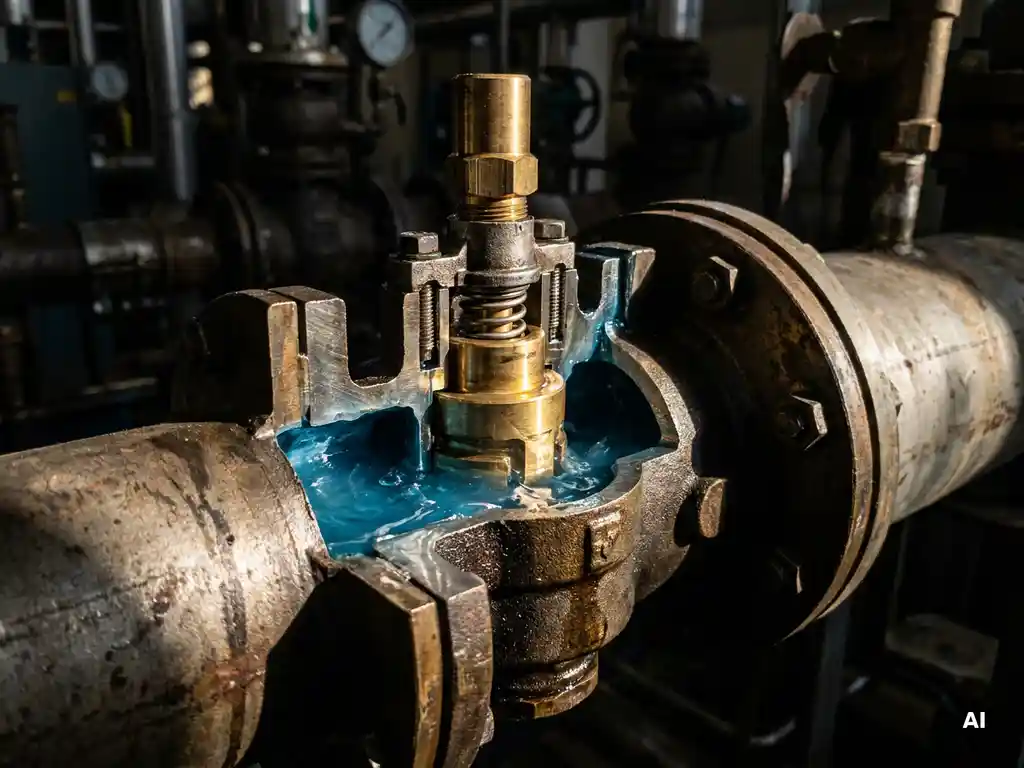
A thermostat valve regulates coolant flow in industrial systems by using a temperature-sensitive element to open or close a flow path automatically, without any external control signal. When coolant reaches a set temperature, the valve opens to allow fluid to circulate through a cooler or heat exchanger; below that threshold, it stays closed and keeps the fluid recirculating within the system. The sections below unpack how that mechanism works, what can go wrong, and how to choose the right valve for your application.
What happens inside a thermostat valve when coolant temperature rises?
When coolant temperature rises toward the valve’s set point, a wax-filled sensing element inside the thermostat valve expands. That expansion pushes against a piston or spindle, which physically opens the valve disc and allows hot coolant to flow toward the cooler or radiator. Once the fluid temperature drops back below the threshold, the wax contracts, the spring returns the disc to its seat, and flow is restricted again.
The sensing element at the heart of this thermostat mechanism is typically a wax pellet or a thermostat bellows. Wax elements are the more common choice in industrial cooling circuits because they generate significant actuating force in a compact package. A thermostat bellows, by contrast, uses a sealed chamber filled with a volatile fluid or gas that expands when heated, pushing out a corrugated metal wall to move the valve stem. Both approaches achieve the same goal: converting a temperature change directly into mechanical movement, with no electronics, no actuator, and no external power source required.
The elegance of this design is that regulation is continuous rather than stepped. As temperature climbs gradually, the valve opens progressively, allowing just enough coolant through the cooling circuit to stabilize the system at its target operating temperature. This proportional behavior is what separates a thermostat valve from a simple switch.
What are the main types of thermostat valves used in industrial systems?
Industrial thermostat valves fall into three broad categories: wax-element valves, bellows-type valves, and bimetallic valves. Wax-element designs dominate heavy-duty applications because of their high actuating force and reliability across a wide temperature range. Bellows-type valves suit more precise, lower-force applications. Bimetallic valves, which rely on two bonded metals with different expansion rates, are generally found in lower-cost or lower-stakes installations.
Wax-element thermostat valves
These are the workhorses of industrial coolant management. The wax compound inside the sensing element is formulated to melt at a very specific temperature, giving engineers tight control over the opening point. Different wax blends allow manufacturers to produce valves calibrated to open anywhere from around 60°C to well above 100°C. Their robustness makes them ideal for engine cooling, hydraulic oil temperature management, and large-scale industrial process cooling.
Bellows-type thermostat valves
A thermostat bellows valve uses a sealed, accordion-shaped chamber that expands as its internal fluid vaporizes or its gas pressure increases with heat. These valves tend to respond quickly to temperature changes and can be manufactured to very fine tolerances, making them well suited to precision applications such as laboratory cooling circuits or fluid systems where temperature swings must be kept extremely narrow.
How does a thermostat valve differ from a simple on/off valve?
A thermostat valve modulates flow proportionally based on temperature, while a simple on/off valve is either fully open or fully closed, with no middle state. The key distinction is that a thermostat valve acts as both a sensor and an actuator in one unit, responding autonomously to the fluid’s own heat without any external signal or manual intervention.
In practical terms, this matters enormously for system stability. An on/off valve creates temperature swings because it swings between two extremes, which can stress components, reduce energy efficiency, and shorten equipment life. A thermostat valve, by contrast, finds an equilibrium point and holds the system close to its target temperature continuously. For industrial cooling circuits where consistent operating temperatures protect machinery and extend service intervals, that proportional control is not a luxury but a necessity.
Another important difference is response time and energy use. Because a thermostat valve reacts to the fluid itself, there is no lag from a sensor sending a signal to a controller, which then commands an actuator. The thermostat mechanism responds the moment the fluid temperature changes, making it inherently faster and simpler than electrically controlled alternatives for many standard applications.
What causes a thermostat valve to fail in industrial cooling circuits?
The most common causes of thermostat valve failure are wax element degradation, contamination of the coolant, corrosion of internal components, and mechanical fatigue of the spring or bellows. In most cases, failure means the valve either sticks open, causing the system to run too cool and lose efficiency, or sticks closed, allowing temperatures to climb dangerously high.
Coolant contamination is a particularly frequent culprit. Particles, scale, or incompatible fluid additives can lodge between the valve disc and its seat, preventing a proper seal. Over time, corrosive coolants can also attack the metal housing or the sensing element itself, altering the calibrated opening temperature or causing the wax element to leak. This is why coolant quality and regular fluid maintenance schedules matter as much as the valve’s own specification.
Thermal cycling stress is another factor that shortens valve life in demanding industrial environments. Every time the valve opens and closes, the spring compresses and relaxes, and the wax element expands and contracts. In high-cycle applications, metal fatigue can eventually cause the spring to weaken or the bellows to crack. Selecting a valve rated for the expected number of thermal cycles, not just the temperature range, is essential for long service life.
How do you select the right thermostat valve for an industrial application?
Selecting the right thermostat valve starts with defining four core parameters: the target operating temperature, the flow rate required, the pressure rating of the system, and the chemical compatibility of the valve materials with your coolant. Getting these four factors right narrows the field considerably before you consider secondary factors like response speed or physical envelope.
- Opening temperature: Choose a set point that matches the system’s ideal operating temperature, not just its maximum safe temperature. A valve that opens too late will allow overheating before it responds.
- Flow capacity: The valve must pass enough coolant at full open to handle peak heat load. Undersizing the valve creates a bottleneck that limits cooling even when the valve is fully open.
- Pressure rating: Industrial systems often operate at elevated pressures. Confirm the valve’s rated working pressure exceeds your system’s maximum, including any pressure spikes.
- Material compatibility: Brass, stainless steel, and engineered polymers each have different resistance profiles against coolant additives, glycols, and process fluids. Match the housing and seal materials to your specific coolant chemistry.
- Sensing element type: For most heavy industrial applications, a wax-element design offers the best balance of force, reliability, and cost. A thermostat bellows design is worth considering where faster response or tighter temperature tolerances are needed.
Beyond the technical specification, consider the supplier’s ability to provide custom calibration. Standard catalogue valves are calibrated to common set points, but many industrial processes benefit from a valve tuned to a specific opening temperature that falls between standard options. Working with a supplier who understands the thermostat mechanism at a component level, rather than simply distributing off-the-shelf parts, makes that kind of precision achievable.
How BTT Solutions supports your industrial thermostat valve needs
We at BTT Solutions design and manufacture high-precision thermostat valves and temperature management components for industrial, automotive, and building technology applications. Our engineering team works directly with customers to specify, calibrate, and validate the right solution for each cooling circuit, whether that means a standard wax-element valve or a fully custom thermostat bellows assembly tuned to a specific opening temperature.
Here is what working with us looks like in practice:
- Custom calibration: We formulate wax elements and bellows assemblies to precise set points, so your system operates at exactly the temperature it needs, not just the nearest standard option.
- End-to-end component supply: From the sensing element through to the valve housing and temperature sensors, we supply complete thermostat mechanism assemblies rather than individual parts, reducing integration complexity for your engineering team.
- Material and compatibility guidance: Our engineers help you match housing materials, seals, and coolant chemistry to avoid the corrosion and contamination failures that cut valve life short.
- Flexible, responsive service: As a focused, mid-sized specialist, we give your project direct attention and can move quickly on specification changes or urgent delivery requirements.
If you are specifying a thermostat valve for a new industrial cooling circuit or looking to replace an underperforming component, we would be glad to help you get it right. Get in touch with our team to discuss your application, and we will work with you to find the most effective solution.
Related Articles
- What is the difference between type testing and routine testing for thermostats?
- How do OEMs design for thermal stress reduction in high-performance applications?
- What is the cost impact of poor thermal management on fleet fuel bills?
- How does thermal management impact engine performance?
- When should you consider liquid cooling for thermal management?


