
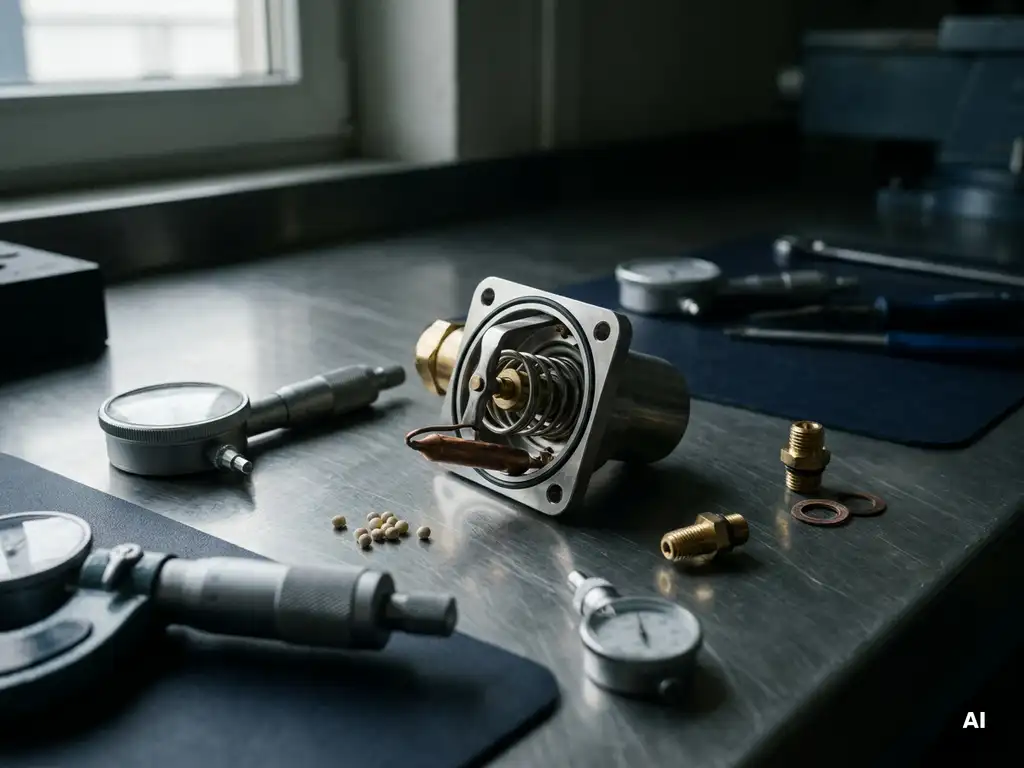
Thermostat insert manufacturing is complex because it requires the precise coordination of sensitive materials, microscopic tolerances, and thermal calibration processes that must perform reliably across thousands of operating cycles and extreme temperature conditions. A single deviation in the wax element composition or housing geometry can cause the entire thermal regulation system to fail. The questions below break down exactly where that complexity lies and why it matters to engineers and procurement teams working with these components.
What materials are used inside a thermostat insert?
A thermostat insert is built from a carefully selected combination of wax compounds, rubber seals, metal housings, and spring elements. Each material must tolerate repeated thermal cycling without degrading, and the interaction between these materials is just as critical as the individual properties of each one.
The core of any thermostat insert is the wax element, a specially formulated blend of hydrocarbons that expands and contracts with temperature changes. The specific wax formulation determines the opening temperature of the thermostat, and even minor variations in the blend can shift that target temperature by several degrees. Surrounding the wax is a rubber diaphragm or cup that translates the volumetric expansion into mechanical movement. This rubber component must remain flexible at low temperatures while resisting deformation at high ones.
The outer housing is typically made from brass, stainless steel, or engineered polymers, depending on the application. Metal housings offer superior durability in high-pressure environments like automotive cooling systems, while polymer variants can be appropriate in lower-pressure industrial or HVAC contexts. Spring elements, usually made from stainless steel, provide the return force that closes the valve once temperatures drop. The tolerances between these components are extremely tight, which is why thermostat material selection is not a one-size-fits-all decision.
Why is wax element precision so critical in thermostat inserts?
The wax element is the functional heart of a thermostat insert. Its precision is critical because the entire thermal regulation system depends on the wax expanding at a predictable, repeatable temperature. If the opening point drifts even a few degrees, the engine or industrial system it controls can run too hot or too cold, leading to efficiency losses or component damage.
Wax elements work through a phase-change principle: solid wax transitions to a semi-liquid state as temperature rises, and this expansion pushes a piston or diaphragm to open the valve. The challenge is that this transition must happen within a very narrow temperature band, consistently, across the entire service life of the component. Manufacturers must control the wax blend composition, fill volume, and encapsulation process with exceptional care.
Contamination during filling, air pockets inside the wax cavity, or inconsistent fill volumes can all shift the activation temperature or reduce the stroke length of the piston. These are not visible defects that can be caught by visual inspection alone, which is why thermal calibration and functional testing are mandatory at the end of the production line.
What tolerances are required in thermostat insert production?
Thermostat insert production typically requires dimensional tolerances in the range of a few hundredths of a millimeter for critical features like the valve seat, piston bore, and housing diameter. Thermal tolerances for the opening temperature are often specified within a band of plus or minus 1 to 2 degrees Celsius, depending on the application.
These tolerances exist because the thermostat insert must interface precisely with the surrounding system. In an automotive application, the insert sits inside a thermostat frame or housing that is bolted into the cooling circuit. If the insert dimensions are off, the valve may not seal correctly, leading to coolant bypass even when the thermostat is meant to be fully closed. This causes the engine to warm up more slowly, increasing fuel consumption and emissions.
On the thermal side, the opening temperature tolerance is specified by the OEM or system designer and must be maintained across the full production batch. Achieving this requires tight control over wax formulation, fill volume, and the calibration process. Statistical process control is commonly used to monitor production output and catch drift before it produces out-of-specification parts.
How does thermal calibration work during manufacturing?
Thermal calibration is the process of verifying and adjusting each thermostat insert so that it opens and closes at the correct temperature. During manufacturing, finished inserts are submerged in a temperature-controlled fluid bath, brought to the specified activation temperature, and measured for valve lift and stroke. Units that fall outside the target range are either adjusted or rejected.
The calibration bath is held at precise temperatures using high-accuracy heating and circulation systems. Sensors measure the exact moment the valve begins to open and the full stroke it achieves at maximum temperature. This data is compared against the specification, and in some production setups, individual units can be fine-tuned by adjusting the spring preload or wax fill level before final assembly.
For high-volume production, calibration is often integrated into an automated test station that processes units continuously and flags outliers in real time. This approach is essential for maintaining consistent quality across large batches, particularly when supplying automotive OEMs that require documented evidence of conformance for each production lot.
What causes thermostat inserts to fail in the field?
Thermostat inserts most commonly fail because of wax degradation, contamination of the coolant or fluid, mechanical wear on the valve seat, or spring fatigue. Each of these failure modes has a distinct root cause, and understanding them helps engineers design more robust systems and set appropriate maintenance intervals.
- Wax degradation: Over time, the wax compound can oxidize or absorb contaminants from the surrounding fluid, altering its phase-change characteristics and shifting the opening temperature.
- Contamination: Particles or chemical deposits in the coolant can lodge under the valve seat, preventing it from closing fully. This causes the thermostat to stick open, keeping the system at a lower operating temperature than intended.
- Rubber seal failure: The rubber diaphragm surrounding the wax element can harden, crack, or delaminate after prolonged exposure to heat and chemical stress, reducing the mechanical stroke of the piston.
- Spring fatigue: The return spring loses tension over many thermal cycles, which can cause the valve to close sluggishly or incompletely.
- Thermal shock: Rapid temperature changes, particularly in systems that experience frequent cold starts followed by high-load operation, accelerate wear on all internal components simultaneously.
Many field failures can be traced back to manufacturing decisions made earlier in the process. Components produced with marginal materials or calibrated at the edge of the specification are statistically more likely to fail early in service.
How do automotive and industrial thermostat inserts differ in complexity?
Automotive thermostat inserts are generally more complex than industrial ones because they must meet stricter temperature tolerances, survive higher pressures, and perform reliably across a much wider range of operating conditions, from cold starts in sub-zero climates to sustained high-load operation at elevated temperatures.
In an automotive cooling system, the thermostat insert is part of a tightly integrated circuit where even small deviations in opening temperature affect fuel consumption, emissions, and engine wear. Modern vehicles also increasingly use electronically controlled or map-controlled thermostats, which add a layer of electromechanical complexity on top of the basic wax element mechanism.
Industrial thermostat inserts, by contrast, often operate in more stable environments with less dramatic temperature swings. However, they frequently face different challenges such as compatibility with aggressive fluids, longer service intervals without maintenance access, and the need to function in systems with very high flow rates or pressures. Applications in shipping systems, industrial cooling circuits, and floor heating infrastructure each impose their own specific demands on the insert design and materials.
The key distinction is not that one is harder than the other in absolute terms, but that the complexity is different in character. Automotive inserts demand extreme precision in a small, lightweight package. Industrial inserts often demand robustness and chemical resistance over extended service lives. Both require a deep understanding of thermostat insert manufacturing principles to get right.
How BTT Solutions approaches thermostat insert manufacturing
We understand this complexity from the inside. At BTT Solutions, we design and manufacture high-precision thermostat inserts and wax elements for automotive, industrial, and building technology applications, combining decades of engineering expertise with the flexibility of a focused, mid-sized organization. Here is what that looks like in practice:
- Material expertise: We work with a range of wax formulations, rubber compounds, and housing materials to match the exact requirements of each application, whether that is a passenger vehicle cooling system or an industrial heat exchanger.
- Tight-tolerance production: Our manufacturing processes are built around the kind of dimensional and thermal tolerances that automotive OEMs demand, with statistical process control integrated throughout the production line.
- Thermal calibration: Every insert we produce goes through functional calibration testing to verify opening temperature and stroke before it leaves our facility.
- Application-specific development: We work directly with engineers and procurement teams to develop thermostat components tailored to their specific system requirements, including new applications in floor heating, marine systems, and industrial cooling.
- End-to-end supply: As a global thermostat specialist, we offer complete solutions from component design through series production, backed by a team that gives every customer direct, undivided attention.
If you are working on a project that requires precise thermostat inserts or wax elements and want to talk through the technical requirements, we would be glad to help. Get in touch with our team and let us find the right solution together.


