
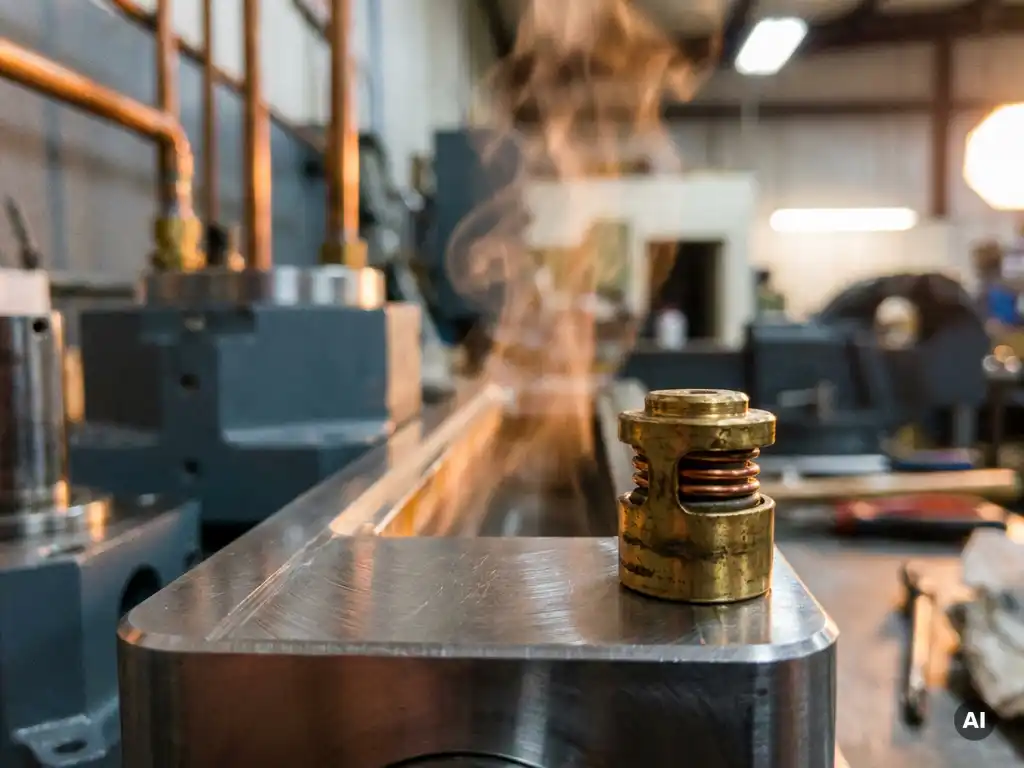
A wax pellet thermostat is a highly reliable, self-contained temperature control device that uses the natural expansion of a wax element material to open and close a valve. It requires no external power source, no electronics, and no complex control systems. The sections below cover how it works, where it excels, and how it compares to modern alternatives.
How does a wax pellet thermostat actually work?
A wax pellet thermostat works by exploiting the physical principle of wax thermal expansion. Inside a sealed chamber, a specially formulated wax element material changes from solid to liquid as temperature rises. This phase change causes a significant volume increase, which pushes a piston outward and opens a valve. When the temperature drops, the wax contracts and a return spring closes the valve again.
The wax used is not ordinary wax. It is a precisely engineered blend, often based on paraffin or hydrocarbon compounds, calibrated to expand at a very specific temperature range. This precision is what makes the mechanism so effective. The opening and closing action is smooth, repeatable, and entirely mechanical, meaning the thermostat responds to actual fluid temperature rather than an estimated or programmed value.
Because the entire operation depends on the physical chemistry of the wax element material rather than sensors, software, or electrical signals, the system is inherently self-regulating. There is nothing to program, calibrate externally, or replace due to software failure.
What are the main benefits of a wax pellet thermostat?
The main benefits of a wax pellet thermostat are its mechanical simplicity, long service life, and precise temperature response without any electrical input. These qualities make it one of the most cost-effective and dependable temperature control solutions available across a wide range of industries.
- No power required: The wax thermal expansion mechanism is entirely self-powered. The thermostat responds to heat alone, which eliminates the risk of failure due to power loss or electrical fault.
- High repeatability: Because the wax element material expands and contracts at a consistent temperature, the valve opens and closes at the same point every cycle, providing stable and predictable control.
- Robust construction: With few moving parts and no electronic components, there is very little that can wear out or corrode under normal operating conditions.
- Cost efficiency: Wax pellet thermostats are relatively inexpensive to manufacture and maintain, making them attractive for high-volume applications in automotive, industrial, and building systems.
- Passive safety: If something goes wrong, the device fails in a predictable way. In most designs, a failed thermostat defaults to an open position, which protects the system from overheating.
For engineers and procurement teams sourcing components for fluid management systems, these characteristics translate directly into lower total cost of ownership and fewer unplanned maintenance events.
How does a wax pellet thermostat compare to electronic thermostats?
The key distinction is that a wax pellet thermostat responds directly to physical temperature through wax thermal expansion, while an electronic thermostat uses sensors, actuators, and control logic to manage temperature. Each approach suits different application requirements.
Where wax pellet thermostats have the advantage
Wax pellet thermostats win on simplicity, durability, and independence from electronics. They function without wiring, control units, or software, which makes them ideal for environments where electrical reliability is a concern or where the component needs to last decades with minimal servicing. They are also unaffected by electromagnetic interference.
Where electronic thermostats have the advantage
Electronic or electromechanical thermostats offer a significant edge in flexibility. They can be adjusted remotely, integrated into engine management systems, and programmed to respond to multiple variables beyond just local fluid temperature. In modern automotive applications, this allows the engine to run at different temperature set points depending on load, speed, and driving mode, which can improve fuel economy and reduce emissions.
In practice, the two technologies are not always in direct competition. Many systems use a wax pellet thermostat as the primary control element and layer electronic monitoring on top. You can explore the range of thermal management components that serve both approaches across different industries.
What applications use wax pellet thermostats?
Wax pellet thermostats are used in any application that requires reliable, passive fluid temperature control. Their versatility means they appear across automotive, industrial, and building technology sectors.
- Automotive cooling systems: Engine coolant thermostats are among the most common uses. The wax element material opens the valve to the main radiator once the engine reaches operating temperature, preventing overcooling during warm-up and overheating during sustained load.
- Transmission and oil temperature management: Wax pellet thermostats regulate oil flow to coolers in gearboxes and engines, protecting components during cold starts and high-load conditions.
- Heating systems in buildings: Radiator thermostatic valves in residential and commercial heating systems rely on the same wax thermal expansion principle to maintain room temperature without electrical input.
- Underfloor heating: Mixing valves in floor heating circuits use wax element actuators to blend hot and return water to a safe surface temperature.
- Marine and industrial cooling: Ships, generators, and heavy industrial machinery use wax pellet thermostats to manage coolant and lubricant temperatures in demanding environments.
The breadth of these applications reflects how well the underlying mechanism translates across different fluids, temperatures, and operating conditions.
How long does a wax pellet thermostat last?
A well-made wax pellet thermostat typically lasts between 10 and 15 years under normal operating conditions, and in some applications it will outlast the system it is installed in. Longevity depends on the quality of the wax element material, the operating temperature range, fluid compatibility, and the number of thermal cycles the component experiences.
Because the mechanism involves no electronics and very few moving parts, degradation tends to be gradual rather than sudden. The wax can slowly lose its calibration accuracy over many thousands of cycles, and seals may harden with age. Neither of these failure modes is typically catastrophic, which gives operators time to identify and address the issue during routine servicing.
In automotive applications, thermostats are often replaced as a precautionary measure during major cooling system services, even if they have not yet failed. This is a sensible practice given how central the thermostat is to engine protection and efficiency.
When should a wax pellet thermostat be replaced?
A wax pellet thermostat should be replaced when it no longer opens or closes at its rated temperature, when it sticks in one position, or when visible damage or seal failure is present. In practice, most replacements are triggered by symptoms in the wider system rather than a direct inspection of the thermostat itself.
Common signs that a wax pellet thermostat needs attention include:
- Engine or system overheating, which may indicate the thermostat is stuck closed
- Slow warm-up or consistently low operating temperature, which may indicate the thermostat is stuck open
- Heater output that is weaker than expected in automotive applications
- Radiator thermostatic valves in heating systems that no longer respond to temperature changes
- Visible leaking or corrosion around the thermostat housing
If you are unsure whether a thermostat is functioning correctly, the simplest test is to measure the actual fluid temperature at which the valve begins to open and compare it to the rated value stamped on the component. A significant deviation is a clear indicator that replacement is due.
How BTT Solutions supports your thermal management needs
At BTT Solutions, we design and manufacture high-precision wax pellet thermostats and thermal management components for automotive, industrial, and building technology applications. Our engineering team works with customers from specification through to production, ensuring that the wax element material and overall component design are precisely matched to the application’s temperature range, fluid type, and service life requirements.
Here is what working with us looks like in practice:
- Custom engineering: We develop thermostat components tailored to specific operating conditions, whether that means a narrow activation range for a precision industrial process or a robust design for a marine environment.
- End-to-end solutions: From wax element formulation to final assembly, our patented processes cover the full production chain, giving customers a single, accountable partner.
- Cross-industry expertise: Our background spans automotive OEM supply, building heating systems, and heavy industrial applications, so we bring relevant experience regardless of your sector.
- Responsive partnership: As a focused, mid-sized company, we offer the individual attention and flexibility that larger suppliers often cannot. Decisions are made quickly and communication stays direct.
If you are evaluating wax pellet thermostats for a new project or looking to improve the reliability of an existing system, we would be glad to talk through the options. Get in touch with our team to start the conversation, or learn more about BTT Solutions and how we became a global leader in thermal management components.
Related Articles
- How do you know when a thermostat valve needs replacing?
- What is the impact of carbon buildup on long-term engine efficiency?
- What role do thermal components play in meeting real-world driving emission tests?
- What are the latest thermal management technologies for vehicles?
- What thermal management solutions are used in building technology?


