
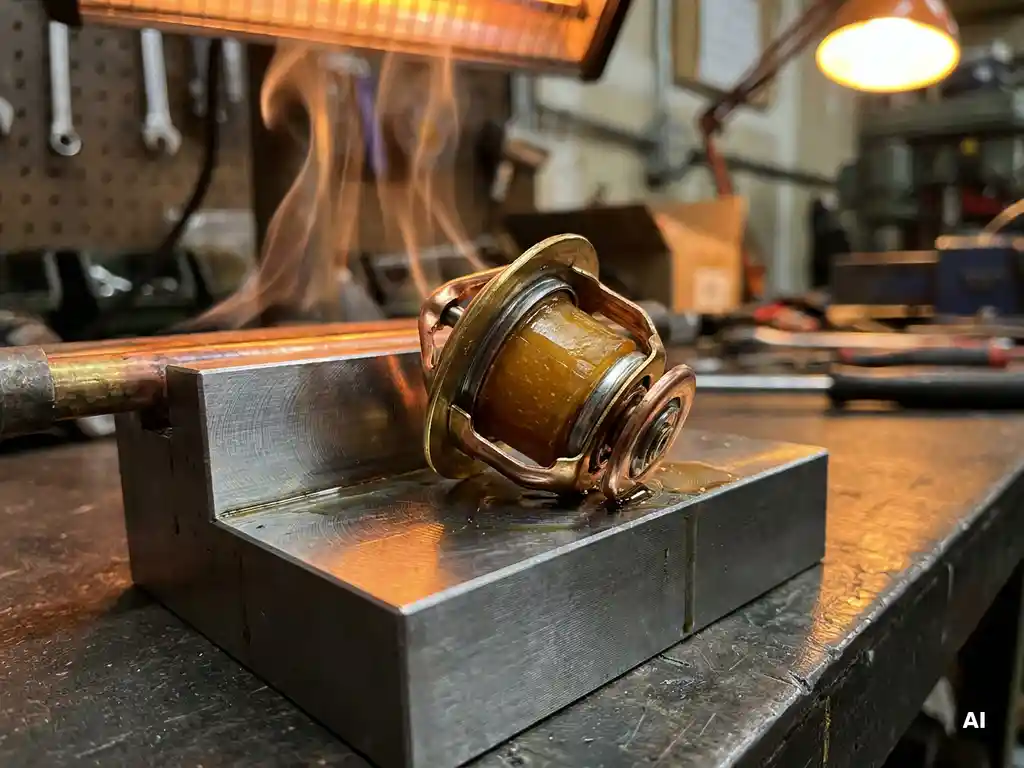
A wax element material typically operates within a temperature range of 0°C to 120°C (32°F to 248°F), though the precise window depends on the specific wax grade used. Different formulations are engineered to activate at different set points, so a single element might only span a 10-20°C working range within that broader envelope. The sections below break down how these ranges work, what shifts them, and how engineers select the right grade for a given application.
How does a wax element generate mechanical movement from heat?
A wax element generates mechanical movement by exploiting the volumetric expansion of a specially formulated wax as it transitions from solid to liquid. When heat is applied, the wax expands significantly, pushing against a flexible membrane or piston and converting thermal energy directly into linear mechanical force, with no electrical input required.
The core of the mechanism is elegantly simple. A sealed metal housing contains a precisely blended wax compound. As the surrounding fluid or air temperature rises toward the wax’s melting point, the material begins to change phase. Because wax expands by roughly 10-15% in volume during this transition, it exerts considerable pressure on the internal membrane. That pressure drives a piston outward, which in turn opens a valve, actuates a lever, or triggers whatever mechanical response the system demands.
When the temperature drops, the wax solidifies and contracts. A return spring pushes the piston back, and the element resets. This self-contained, reversible action is what makes wax pellet thermostat components so reliable across decades of continuous cycling. There are no electronics to fail, no software to update, and no external power source needed.
What temperature ranges do different wax element grades cover?
Different wax element grades are formulated to activate across distinct temperature bands, typically spanning from around 0°C up to 120°C in total. Individual grades are usually calibrated to a specific set point, with a working stroke range of roughly 10-20°C around that point. Common automotive grades activate between 70°C and 95°C, while industrial and HVAC grades may be tuned higher or lower depending on the application.
Wax blends are engineered by adjusting the composition of the hydrocarbon mixture. Adding different paraffins, polymers, or fillers shifts the melting point up or down. This means manufacturers can produce a family of elements that share the same housing geometry but respond to entirely different thermal conditions. A few broad categories illustrate the landscape:
- Low-temperature grades (0°C to 40°C): Used in cold-climate applications, freeze protection systems, and certain HVAC mixing valves where early-stage thermal response is critical.
- Mid-range grades (40°C to 80°C): Common in domestic heating systems, radiator thermostats, and some industrial cooling circuits.
- High-temperature grades (80°C to 120°C): The standard territory for automotive engine thermostats, oil temperature management, and heavy-duty industrial equipment.
Beyond 120°C, wax thermal expansion becomes less predictable and the housing materials face significant stress. Specialized compounds can push this boundary, but they are purpose-engineered for specific environments rather than general use.
What factors shift a wax element’s effective operating temperature?
Several factors can shift a wax element’s effective operating temperature away from its nominal set point. The most significant are fluid pressure, flow rate, element aging, and the thermal conductivity of the surrounding medium. Even a well-calibrated element will behave differently if these conditions change substantially.
Pressure is one of the most direct influences. Higher system pressure raises the boiling point of the surrounding fluid and also compresses the wax slightly, which can delay the onset of expansion. In high-pressure cooling circuits, this effect is sometimes deliberately used to allow higher operating temperatures without triggering premature valve opening.
Flow rate matters because a faster-moving fluid transfers heat to the wax element more efficiently. An element sitting in a sluggish flow will respond more slowly and may appear to have a higher effective set point than one in turbulent, fast-moving coolant. This is why installation position within a circuit can measurably affect performance.
Material fatigue over time also plays a role. After thousands of thermal cycles, the wax compound can fractionally change its expansion characteristics, and the membrane or piston seals may lose some elasticity. This is why long-service elements sometimes open at slightly different temperatures than when new. Selecting a quality-manufactured element with consistent wax formulation is the most reliable way to minimize this drift.
How does operating temperature differ across automotive, industrial, and HVAC applications?
Operating temperature requirements differ substantially across these three sectors. Automotive applications typically demand set points between 80°C and 95°C to match engine coolant conditions. Industrial systems vary widely, from 60°C to over 110°C depending on the process. HVAC and building applications generally operate in a much lower band, often between 20°C and 60°C, reflecting the milder thermal environments of heating circuits and mixing valves.
Automotive thermal management
In passenger vehicles and commercial trucks, the engine coolant thermostat is the most familiar wax element application. The element must open precisely enough to maintain the engine within its optimal efficiency window, balancing fuel economy against thermal stress. Modern engine designs increasingly push toward higher coolant temperatures, which is why some contemporary automotive elements are calibrated to 95°C or even higher. Wax thermal expansion characteristics must remain consistent across a wide ambient temperature range, from cold starts in winter to sustained highway driving in summer heat.
Industrial and process applications
Industrial environments introduce far more variability. A hydraulic system managing oil temperature operates differently from a marine cooling circuit or a compressor intercooler. Set points in these contexts can range from below 60°C for sensitive equipment to above 110°C for heavy machinery. The wax element must also withstand exposure to oils, glycol mixtures, or other process fluids rather than just water-based coolant, which places additional demands on seal materials and housing construction.
HVAC and building systems
Radiator thermostats and underfloor heating mixing valves operate in a comparatively gentle thermal environment, but precision still matters. A domestic radiator thermostat set to open at 45°C needs to do so consistently across years of daily cycling. In these applications, the lower operating temperatures mean the wax formulation must be particularly sensitive to small temperature changes, since the thermal differential driving the expansion is much narrower than in an automotive context.
What happens when a wax element exceeds its rated temperature range?
When a wax element exceeds its rated temperature range, the consequences range from reduced accuracy to permanent mechanical failure. At moderately excessive temperatures, the wax may fully liquefy and the piston may reach its maximum stroke, leaving the valve stuck fully open. At severely elevated temperatures, the housing seals can fail, the membrane may rupture, and wax can leak into the surrounding system.
The immediate functional problem is loss of control. A thermostat that is fully open because the wax has overheated provides no regulation at all. In an engine cooling system, this means coolant flows constantly through the radiator regardless of actual thermal need, which can cause the engine to run too cold during warm-up and reduce efficiency. In an industrial circuit, uncontrolled flow can disrupt process temperatures downstream.
Physical damage is the more serious concern. If temperatures are high enough to degrade the seal materials, wax contamination of the cooling or process fluid becomes a real risk. Replacing a failed element is straightforward, but cleaning a contaminated circuit is time-consuming and costly. This is why specifying an element with an appropriate safety margin above the expected maximum operating temperature is standard engineering practice, not an optional precaution.
How is the correct wax element temperature range selected for a given application?
Selecting the correct wax element temperature range starts with identifying the target set point, the maximum and minimum fluid temperatures the system will experience, and the required stroke force. From there, the appropriate wax grade is matched to those parameters, with a safety margin built in above the system’s expected thermal peak.
The process typically follows a structured sequence:
- Define the target opening temperature: This is the fluid temperature at which the valve must begin to open. It should correspond to the system’s optimal operating condition, not simply the maximum temperature.
- Establish the full operating range: Account for cold-start conditions, maximum load temperatures, and any transient spikes the system might experience under fault conditions.
- Select the wax grade: Choose a formulation whose set point and stroke range align with the target opening temperature and the required travel distance for the valve.
- Verify compatibility with the process fluid: Ensure the element housing, seals, and membrane materials are chemically compatible with whatever fluid surrounds the element in service.
- Confirm stroke force requirements: The wax element must generate enough force to actuate the valve against system pressure and spring resistance throughout its full stroke.
In practice, close collaboration between the system designer and the component manufacturer makes this process significantly more reliable. Off-the-shelf grades cover most standard applications, but demanding or unusual environments often benefit from a custom-calibrated element. Visiting the full product range can help engineers identify which standard configurations are closest to their requirements before moving to a custom specification.
How BTT Solutions supports precise wax element selection
At BTT Solutions, we work directly with engineers and procurement teams to match the right wax element material to the right application, whether that is an automotive cooling circuit, an industrial heat exchanger, or a building HVAC system. Our background in high-precision thermostat components means we understand the nuances that separate a reliable, long-life element from one that drifts or fails under real-world conditions.
Here is what working with us looks like in practice:
- Application-specific calibration: We engineer wax grades to precise set points, so your element opens and closes exactly where your system needs it to, not approximately.
- Material compatibility review: We assess seal and housing materials against your process fluid to prevent degradation and contamination risks from the start.
- Custom stroke and force specifications: Where standard grades do not match your actuator geometry or pressure requirements, we develop elements to your exact mechanical parameters.
- Cross-sector expertise: Our experience spans automotive OEMs, industrial equipment manufacturers, and building technology specialists, giving us practical insight into how wax thermal expansion behaves across very different operating environments.
- Responsive support: As a focused, mid-sized team, we give each customer direct access to technical expertise without the delays of a large corporate structure.
If you are specifying a wax pellet thermostat component or evaluating options for a new thermal management design, we would be glad to help you find the right solution. Get in touch with our team to discuss your application requirements directly.


