
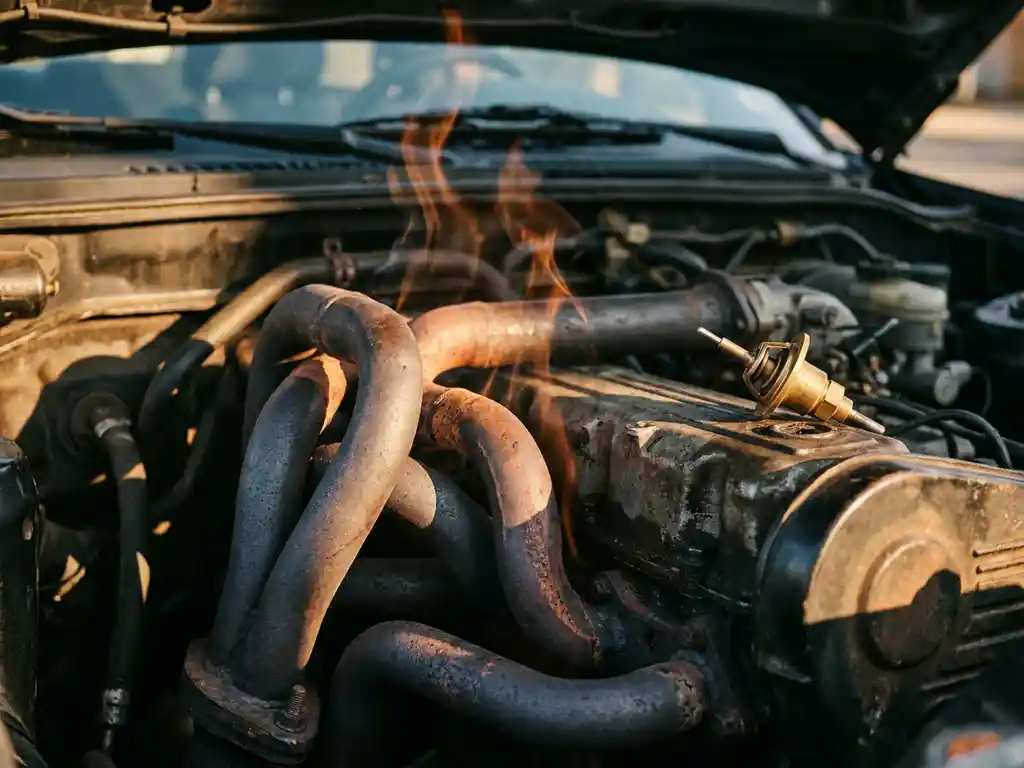
Engine backpressure reduces overall efficiency by forcing the engine to work harder to expel exhaust gases, which directly increases fuel consumption and heat generation. When exhaust flow is restricted, the engine loses power it would otherwise convert into useful work. The sections below unpack exactly how this happens and what it means for your cooling and thermal management systems.
What causes backpressure to build up inside an engine?
Backpressure builds up when exhaust gases cannot exit the engine freely, creating resistance in the exhaust system that pushes back against the outgoing flow. The most common causes are restrictions in the exhaust path, including clogged catalytic converters, damaged mufflers, collapsed exhaust pipes, or poorly designed bends that reduce the internal diameter of the exhaust line.
At its core, an engine is a pump. On the exhaust stroke, the piston pushes spent combustion gases out of the cylinder. If those gases meet resistance on their way out, the piston has to push harder, consuming energy that would otherwise contribute to moving the vehicle or driving industrial machinery. Over time, carbon deposits, corrosion, and physical damage narrow the exhaust path and compound the problem.
In high-load conditions, such as sustained highway driving or heavy industrial operation, the volume of exhaust gases increases significantly. Any restriction that might be tolerable at low RPM becomes a serious bottleneck at higher engine speeds, which is why backpressure problems often feel most pronounced under load.
How does backpressure affect fuel consumption and emissions?
Excess exhaust backpressure directly increases fuel consumption because the engine must burn more fuel to compensate for the lost power caused by restricted exhaust flow. At the same time, incomplete scavenging of exhaust gases leaves residual combustion products in the cylinder, which dilutes the incoming fresh air-fuel mixture and leads to less efficient combustion and higher emissions.
When exhaust gases are not fully expelled, a portion remains in the combustion chamber during the next intake cycle. This residual gas displaces fresh charge, reducing the effective compression ratio and lowering the energy released per combustion event. The engine management system typically responds by injecting more fuel to maintain power output, which raises fuel consumption without a proportional gain in performance.
From an emissions standpoint, the incomplete combustion that follows poor scavenging increases unburned hydrocarbons and particulate matter in the exhaust stream. For manufacturers working toward tighter emissions targets, even moderate backpressure problems can push an engine outside acceptable limits during certification testing or real-world driving cycles.
What is the relationship between backpressure and engine heat?
Backpressure and engine heat have a direct relationship: the greater the restriction in the exhaust system, the more heat accumulates in the engine. When exhaust gases are held back, they retain their thermal energy inside the engine longer than intended, raising temperatures in the cylinder head, exhaust valves, and surrounding components.
Under normal conditions, a significant portion of combustion heat exits the engine with the exhaust gases. Backpressure disrupts this natural heat exit route. The retained heat transfers into the engine block and coolant circuit, placing additional demand on the cooling system to manage temperatures that the exhaust would otherwise have carried away.
In sustained high-load situations, this thermal accumulation can push coolant temperatures well above the designed operating range. Components like exhaust valves and turbocharger housings are particularly vulnerable because they sit closest to the restricted flow and absorb the most residual heat. This is why backpressure problems often show up first as overheating events rather than obvious power loss.
How do thermostats and cooling components respond to backpressure-induced heat?
Thermostats and cooling components respond to backpressure-induced heat the same way they respond to any excess thermal load: by opening coolant flow earlier and more fully to carry heat away from the engine. However, if the heat input from backpressure is sustained and significant, the cooling system can be pushed toward the limits of its design capacity.
A well-calibrated thermostat regulates coolant flow based on engine temperature, opening progressively as heat rises and closing when temperatures return to the optimal range. When backpressure consistently adds heat to the system, the thermostat spends more time in a fully open position, the coolant pump works harder, and the radiator must dissipate more energy per unit of time. This reduces the margin available to handle additional thermal events, such as towing, climbing grades, or operating in high ambient temperatures.
Precision matters here. A thermostat that opens too late allows heat to spike before the coolant circuit can respond. One that opens too early reduces thermal efficiency by overcooling the engine. In engines already stressed by backpressure, a thermostat calibrated to tight tolerances helps prevent the compounding effect where one thermal problem accelerates another. Exploring thermostat component options designed for demanding operating conditions is a practical starting point when reviewing cooling system resilience.
Can backpressure be reduced without replacing the entire exhaust system?
Yes, backpressure can often be reduced without a full exhaust system replacement. The right approach depends on identifying where the restriction is located and addressing that specific component rather than replacing everything upstream and downstream of it.
Common targeted interventions include:
- Catalytic converter cleaning or replacement: A clogged catalyst is one of the most frequent causes of sudden backpressure increases and can often be replaced as a standalone component.
- Muffler inspection and repair: Internal baffles can collapse over time, creating unexpected flow restrictions that are not visible from outside the unit.
- Pipe section replacement: Crushed or corroded sections of exhaust pipe can be cut out and replaced without disturbing the rest of the system.
- Header upgrades: In performance or industrial applications, upgrading the exhaust manifold to a better-flowing design reduces restriction at the source, before gases even enter the main exhaust line.
Diagnosing the exact location of the restriction before spending on parts is always worthwhile. A pressure gauge inserted at different points along the exhaust path will show where the resistance is greatest, allowing targeted repair rather than speculative replacement.
What’s the difference between acceptable and harmful backpressure levels?
Acceptable backpressure is the baseline resistance inherent to any functional exhaust system, including the catalytic converter and muffler, that falls within the engine manufacturer’s design tolerances. Harmful backpressure exceeds those tolerances and measurably reduces power output, increases fuel consumption, raises exhaust temperatures, or pushes emissions above acceptable limits.
Every engine produces some backpressure under normal operation. A certain level of exhaust resistance is actually built into engine tuning, particularly in lower RPM ranges where some backpressure helps exhaust gas velocity and scavenging efficiency. The problem begins when restrictions push beyond the range the engine was designed to handle.
Signs that backpressure has crossed into harmful territory
Rather than relying on a universal pressure number, engineers typically look for functional indicators that suggest backpressure has become a problem:
- Noticeable power loss under load that cannot be explained by fuel or ignition issues
- Coolant temperatures running consistently higher than the normal operating band
- Increased fuel consumption without a change in operating conditions
- Exhaust gas temperatures at the tailpipe that are higher than baseline measurements
- Emissions test failures that do not correspond to fuel system or sensor faults
How design tolerances define the threshold
Engine manufacturers specify maximum allowable exhaust backpressure in their technical documentation, typically expressed in kilopascals or inches of water column at a defined RPM and load point. Staying within this range means the exhaust system is doing its job without penalizing efficiency. Exceeding it consistently, even by a moderate margin, compounds wear on valves, turbochargers, and the entire thermal management circuit over time.
How BTT Solutions supports engine heat management
When backpressure adds unexpected heat to an engine, the cooling and thermal management system becomes the last line of defense against overheating and efficiency loss. Getting the thermostat and cooling components right is not a detail – it is central to how well the whole system holds up under stress.
At BTT Solutions, we work directly with engineers and procurement teams to identify the right thermostat components for their specific operating conditions. Our product advisory covers:
- Wax elements calibrated to precise opening temperatures, ensuring the coolant circuit responds at exactly the right moment
- Thermostat inserts designed for reliability under sustained thermal load, including applications where backpressure regularly elevates engine temperatures
- Engineered housings built to fit the exact requirements of automotive, industrial, and building technology applications
We serve customers across the automotive, industrial, and HVAC sectors from eight locations worldwide, and our team gives every client direct, undivided attention rather than routing inquiries through layers of account management. If you are reviewing your thermal management setup or sourcing components for a new application, get in touch with our team and we will help you find the right solution. You can also learn more about who we are and browse our full range of thermostat components to see what fits your requirements.


