
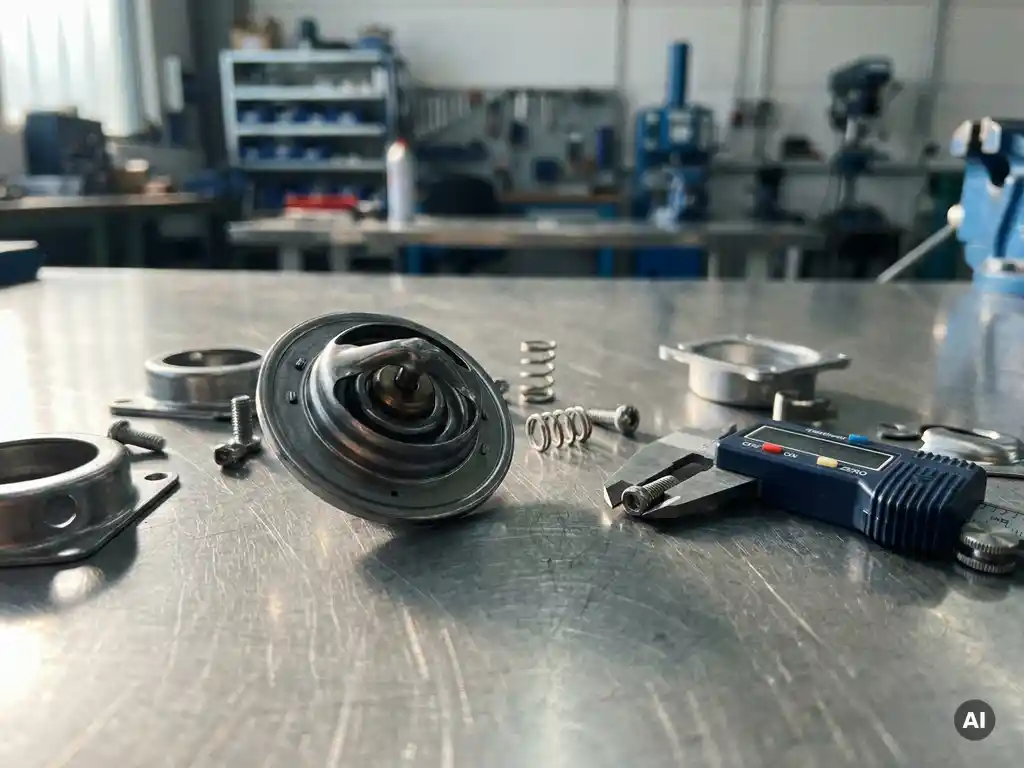
A thermostat frame is the structural housing that holds all the components of a thermostat assembly in place, including the wax element, valve, and spring. It acts as the backbone of the entire unit, keeping each part correctly aligned so the thermostat can open and close at precisely the right temperature. The sections below walk through what the frame is made from, how it functions, what can go wrong, and what engineers should consider when specifying one.
What materials is a thermostat frame made from?
Thermostat frames are most commonly made from stamped steel, cast aluminum, or engineering-grade plastics, depending on the application’s temperature range, pressure requirements, and cost targets. Each material brings a different balance of strength, thermal resistance, and corrosion behavior, which is why thermostat insert manufacturing involves careful material selection from the outset.
Steel frames are the traditional choice for high-pressure automotive cooling circuits. They handle mechanical stress well and tolerate the continuous thermal cycling that happens in an engine bay. Aluminum frames are popular where weight reduction matters, offering good thermal conductivity and corrosion resistance without adding unnecessary mass. In lower-temperature environments, such as certain HVAC or domestic heating applications, glass-fiber-reinforced polymers are a practical option. They resist corrosion, reduce manufacturing costs, and are light, though they cannot cope with the extreme heat of a heavy-duty engine cooling system.
The choice of thermostat materials is not just about surviving peak temperatures. The frame also needs to resist the fluids it contacts, whether that is engine coolant, oil, or water treated with various inhibitors. Compatibility between frame material and system fluid is a detail that is easy to overlook during specification but becomes very obvious when a frame starts to corrode or swell prematurely.
How does a thermostat frame hold the assembly together?
The thermostat frame holds the assembly together by providing fixed mounting points for the wax element housing, the main valve, the bypass valve where fitted, and the return spring. The frame is typically crimped, welded, or mechanically fastened into the thermostat housing seat, creating a self-contained insert that can be installed or replaced as a single unit.
The geometry of the frame is what keeps everything concentric and aligned. If the wax element sits off-center, the valve will not seal cleanly against its seat, and the thermostat will leak internally at the wrong temperature. The frame prevents this by holding the element rigidly along the central axis throughout the full range of valve travel.
In many designs, the frame also acts as a guide rail for the valve itself, ensuring it moves in a straight, controlled path as the wax element expands and contracts. This guided movement is critical for repeatable opening and closing behavior. A frame that has distorted even slightly can introduce friction or misalignment that shifts the thermostat’s response temperature, which is exactly the kind of drift that causes fuel economy and emissions problems in modern engines. You can explore the range of precision components involved by looking at our thermostat product range.
What happens when a thermostat frame fails or degrades?
When a thermostat frame fails or degrades, the most immediate consequence is loss of positional accuracy. The wax element or valve can shift out of alignment, causing the thermostat to open too early, too late, or not fully, which disrupts coolant flow and throws off the engine’s or system’s thermal management.
Corrosion is the most common failure mode in automotive applications. If the frame material is not well matched to the coolant chemistry, pitting or surface oxidation can weaken the structure over time. In severe cases, the frame can crack or deform under pressure, which risks the entire insert becoming loose inside the housing. A loose insert means unpredictable flow behavior, which in an engine cooling circuit can lead to overheating or overcooling depending on which position the valve settles in.
Fatigue is another risk, particularly in applications where the thermostat cycles frequently between open and closed states. Every cycle puts mechanical stress on the frame’s joints and crimped edges. Over thousands of cycles, this can initiate microcracks that eventually compromise structural integrity. This is why material selection and manufacturing quality in thermostat insert manufacturing are not just cost considerations but reliability ones. A frame that degrades quietly over time is often harder to diagnose than one that fails outright.
How does the thermostat frame differ across automotive, industrial, and HVAC applications?
The thermostat frame varies significantly across automotive, industrial, and HVAC applications in terms of size, material, pressure rating, and temperature range. Each environment places different demands on the frame, and a design that works perfectly in a passenger car engine would be over-engineered for a domestic heating circuit and potentially under-rated for a heavy industrial process.
Automotive applications
In automotive contexts, thermostat frames need to be compact, lightweight, and capable of handling coolant pressures that can exceed several bar while withstanding continuous thermal cycling between cold start and operating temperature. Stamped steel or aluminum frames are standard here. The tolerances are tight because modern engine management systems rely on the thermostat opening within a narrow temperature window to meet emissions targets.
Industrial and HVAC applications
Industrial thermostat frames are often larger and built for long service intervals rather than minimal weight. Applications like oil temperature management in hydraulic systems or coolant regulation in large machinery prioritize durability and chemical compatibility over compactness. HVAC and building services applications, by contrast, typically operate at lower pressures and temperatures, which opens the door to polymer frames that are cost-effective and corrosion-resistant in water-based systems. Radiator thermostats and underfloor heating circuits fall into this category, where the frame geometry may also differ to accommodate different flow directions and valve configurations.
What should engineers look for when specifying a thermostat frame?
When specifying a thermostat frame, engineers should evaluate material compatibility with system fluids, the frame’s pressure and temperature ratings, dimensional tolerances relative to the housing, and the manufacturer’s quality controls in thermostat insert manufacturing. Getting these four factors right from the start avoids costly redesigns and field failures.
- Fluid compatibility: Confirm the frame material is rated for the specific coolant, oil, or water chemistry in the system, including any inhibitor packages used.
- Temperature and pressure envelope: The frame must be rated comfortably above the system’s peak operating conditions, not just its nominal values.
- Dimensional accuracy: Tight tolerances on the frame’s seating diameter and valve guide geometry directly affect how consistently the thermostat opens and closes. Ask for tolerance stack-up data if it is not provided upfront.
- Fatigue and cycle life: For high-cycle applications, ask about the frame’s validated cycle life and the testing conditions used to establish it.
- Corrosion testing: Look for evidence of accelerated corrosion testing relevant to your fluid environment, not just generic salt spray data.
- Supplier traceability: In regulated industries, the ability to trace frame materials and manufacturing batches back to source is often a non-negotiable requirement.
It is also worth considering the full thermostat assembly as a system rather than specifying the frame in isolation. The frame’s stiffness affects how the spring loads the valve, which in turn affects the opening temperature. Changes to frame geometry or material can shift the calibrated response of an otherwise unchanged wax element. Working with a supplier who understands the entire assembly, not just individual components, reduces the risk of these interactions causing problems downstream. For context on how integrated thermostat solutions are developed, our company background gives a good overview of the engineering depth involved.
How BTT Solutions approaches thermostat frame design and supply
At BTT Solutions, we design and manufacture thermostat frames and complete thermostat assemblies for automotive, industrial, and building services applications. Our end-to-end approach means we handle material selection, precision manufacturing, and full assembly validation under one roof, which gives our customers a single point of accountability and faster response when requirements change.
Here is what working with us typically looks like in practice:
- Application-specific material selection: We match frame materials to your fluid chemistry, temperature range, and pressure conditions rather than applying a one-size-fits-all approach.
- Tight manufacturing tolerances: Our thermostat insert manufacturing processes are built around the dimensional accuracy that modern engine and industrial systems demand.
- Full assembly testing: We validate the complete thermostat unit, not just the frame in isolation, so the opening temperature and valve behavior are confirmed before delivery.
- Cross-industry expertise: We bring experience from automotive, industrial, and HVAC applications, which means we can draw on a broader knowledge base when solving application-specific challenges.
- Direct engineering support: As a focused, mid-sized business, our engineers are accessible and can work closely with your team during specification and development.
If you are specifying a thermostat frame for a new application or reviewing an existing design, we are glad to help. Get in touch with our team to discuss your requirements directly with an engineer who knows thermostat technology inside and out.


