
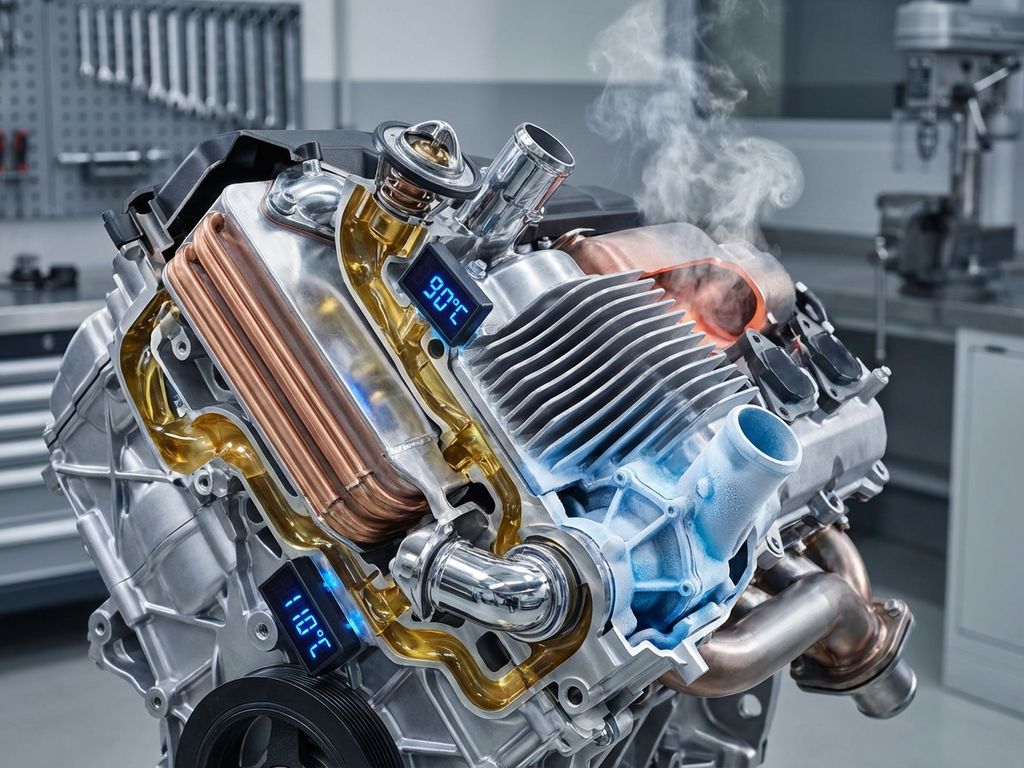
Proper oil temperature control requires several key thermal management components working together as an integrated system. Essential components include thermostats for regulating flow, temperature sensors for monitoring, oil coolers for heat dissipation, and control valves for precise adjustment. These components maintain optimal operating temperatures in automotive engines, industrial machinery, and hydraulic systems, preventing overheating while ensuring efficient lubrication and system performance.
What are the essential thermal management components for oil temperature control?
The core thermal management components for oil temperature control include thermostats, temperature sensors, oil coolers, and control valves. These components work together to maintain optimal oil temperatures between 80–120°C in most applications. Each component serves a specific function in the overall thermal regulation system.
Thermostats act as the primary control mechanism, opening and closing to regulate oil flow based on temperature changes. They respond automatically to temperature variations without requiring external power or control signals. Modern thermostats use either wax-element technology or electronic controls for precise temperature regulation.
Oil coolers provide the heat dissipation capacity needed to remove excess thermal energy from the system. These heat exchangers transfer heat from hot oil to ambient air or coolant, preventing temperatures from exceeding safe operating limits. Proper sizing ensures adequate cooling capacity for peak operating conditions.
Temperature sensors monitor oil temperatures throughout the system, providing real-time feedback for control systems. Common sensor types include thermocouples, resistance temperature detectors (RTDs), and thermistors, each offering different accuracy levels and response characteristics for specific applications.
How do thermostats regulate oil temperature in different systems?
Thermostats regulate oil temperature by automatically controlling flow paths based on thermal expansion principles. Wax-element thermostats use expanding wax to open valves when temperatures rise, while electronic thermostats use programmable controls for precise temperature management. Both types respond to temperature changes by adjusting oil circulation patterns.
In automotive applications, thermostats typically open at predetermined temperatures around 85–95°C, allowing oil to flow through cooling circuits. The wax element expands as temperature increases, pushing a valve open to redirect hot oil through the cooler. When temperatures drop, the wax contracts and spring pressure closes the valve, reducing cooling flow.
Electronic thermostats offer more sophisticated control through programmable temperature setpoints and response curves. These systems can adjust opening characteristics based on operating conditions, providing optimal temperature regulation for varying loads and environmental conditions. They integrate with engine management systems for coordinated thermal control.
Industrial systems often use multiple thermostats in series or parallel configurations to handle larger flow volumes and provide redundancy. This arrangement ensures continued operation even if one thermostat fails, maintaining system reliability in critical applications.
What role do temperature sensors play in oil temperature monitoring?
Temperature sensors provide continuous monitoring and feedback for oil temperature control systems. They measure actual oil temperatures at critical points and send signals to control units for system adjustments. Accurate temperature monitoring prevents overheating, optimizes performance, and enables predictive maintenance scheduling.
Thermocouples offer fast response times and wide temperature ranges, making them suitable for high-temperature applications. They generate voltage signals proportional to temperature differences and work reliably in harsh environments. However, they require cold junction compensation for accurate readings.
Resistance temperature detectors (RTDs) provide excellent accuracy and stability over long periods. They change electrical resistance predictably with temperature variations, offering precise measurements for critical applications. RTDs typically use platinum elements for consistent performance across wide temperature ranges.
Thermistors provide high sensitivity for precise temperature control in moderate temperature ranges. These semiconductor devices change resistance dramatically with small temperature changes, enabling very accurate control. They work particularly well in applications requiring tight temperature tolerances.
Sensor placement strategies involve positioning sensors at oil inlet and outlet points, reservoir locations, and critical component areas. Multiple sensors provide comprehensive temperature mapping and enable advanced control algorithms for optimal system performance.
Why is precise oil temperature control critical for system performance?
Precise oil temperature control directly affects lubrication efficiency, component longevity, and overall system performance. Temperatures that are too low increase oil viscosity, creating excessive drag and reducing efficiency. Temperatures that are too high break down oil molecules, reducing lubrication properties and causing accelerated component wear.
Optimal oil temperatures maintain proper viscosity for effective lubrication while minimizing energy losses. Most systems operate best with oil temperatures between 80–120°C, depending on oil type and application requirements. This range provides adequate flow characteristics while preserving oil chemical stability.
Poor temperature control leads to several performance issues. Cold oil creates increased pumping loads, higher energy consumption, and inadequate lubrication during startup. Hot oil loses viscosity, reduces lubrication effectiveness, and accelerates oxidation processes that create harmful deposits.
Energy efficiency improves significantly with proper temperature control. Maintaining optimal oil temperatures reduces parasitic losses from excessive viscosity while preventing thermal energy waste. Systems with effective thermal management components typically achieve 5–15% better fuel economy in automotive applications.
Component protection relies heavily on consistent oil temperatures. Proper thermal regulation prevents thermal shock, reduces expansion-related stress, and maintains seal integrity. This protection extends component life and reduces maintenance requirements across all system applications.
How do you select the right thermal management components for your application?
Selecting appropriate thermal management components requires careful consideration of operating conditions, system requirements, and performance objectives. Key factors include operating temperature ranges, flow rates, system pressures, environmental conditions, and compatibility with specific oil types. Proper component sizing ensures adequate capacity for peak operating conditions.
Temperature range requirements determine thermostat opening points and sensor specifications. Components must handle both normal operating temperatures and extreme conditions during startup or high-load operation. Consider temperature cycling effects and thermal shock resistance for demanding applications.
Flow rate calculations determine component sizing for adequate thermal capacity. Oil coolers must handle peak flow volumes while maintaining acceptable pressure drops. Thermostats require proper flow coefficients to avoid restriction during full-open operation.
System pressure considerations affect component construction and sealing requirements. High-pressure applications need robust housings and seals to prevent leakage. Pressure drop across thermal management components impacts overall system efficiency and pump sizing requirements.
Environmental factors include ambient temperature ranges, vibration levels, contamination exposure, and space constraints. Marine applications require corrosion-resistant materials, while mobile equipment needs compact, lightweight designs that withstand constant vibration and shock loads.
How BTT Solutions helps with oil temperature control systems
We provide comprehensive thermal management solutions specifically designed for precise oil temperature control across automotive, industrial, and residential applications. Our expertise in high-precision thermostat technology and advanced temperature sensing enables optimal system performance while reducing energy consumption and extending component life.
Our oil temperature control solutions include:
- Precision wax-element and electronic thermostats with customized opening temperatures
- High-accuracy temperature sensors including thermocouples, RTDs, and thermistors
- Integrated control systems that coordinate multiple thermal management components
- Custom-engineered solutions for specific flow rates, pressures, and environmental conditions
- Complete system design support from component selection through installation guidance
Our global manufacturing capabilities and extensive application experience ensure reliable thermal management solutions that meet the demanding requirements of modern oil temperature control systems. Our expertise in thermal management engineering allows us to deliver customized solutions that optimize performance while reducing operational costs. Contact us today to discuss your specific oil temperature control requirements and discover how our thermal management expertise can optimize your system performance.
Related Articles
- What equipment is used in professional thermostat performance testing?
- Can thermostat test results vary between laboratories?
- How do emission regulations like Euro 7 impact powertrain development?
- Can a faulty thermostat cause transmission overheating in modern cars?
- How to select thermal management systems for industrial use?


