
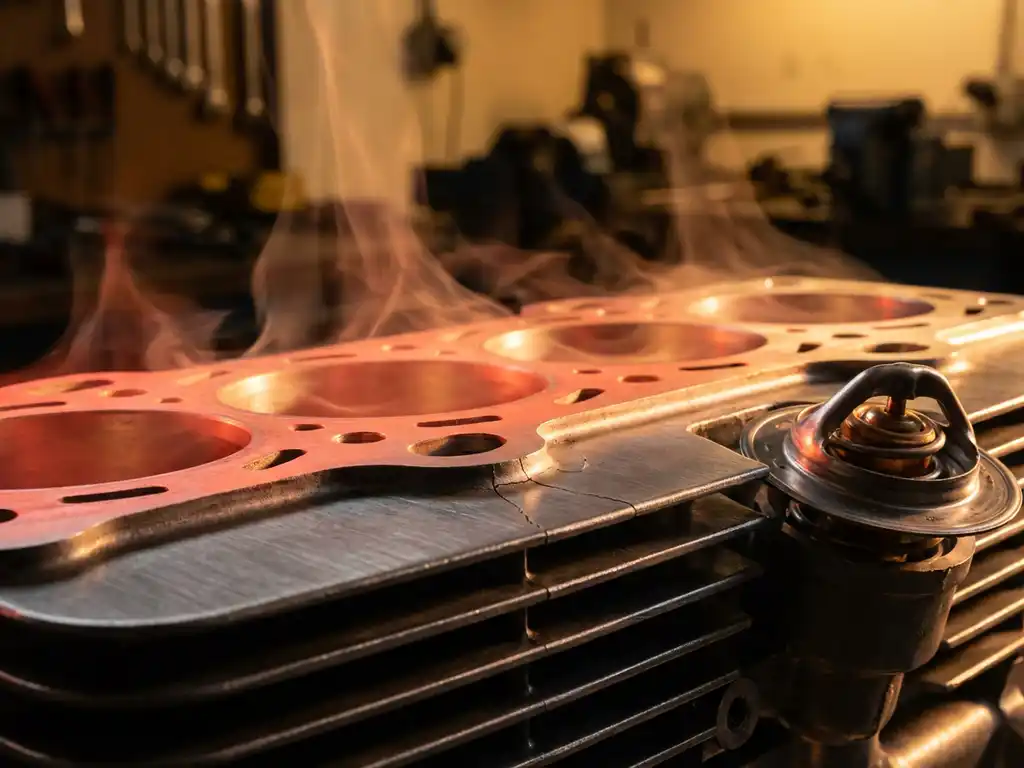
Engine components face a constant battle against extreme heat, and understanding what drives this thermal stress can mean the difference between reliable performance and costly failures. When metal parts repeatedly expand and contract as temperatures fluctuate, they experience forces that can gradually weaken even the strongest materials.
The intricate interplay among heat generation, thermal expansion, and cooling cycles creates a complex environment in which components must withstand tremendous strain. Let’s explore the root causes of this phenomenon and how it affects engine reliability.
What Is Thermal Stress in Engines?
Thermal stress occurs when engine components experience uneven heating and cooling, causing different areas to expand and contract at different rates. This creates internal forces within materials as they struggle to accommodate dimensional changes while remaining connected to other components.
The process begins when heat causes metals to expand. However, because different materials and component sections heat up at different speeds, some areas try to grow while others remain relatively stable. This mismatch generates mechanical stress that accumulates over time. Engine blocks, cylinder heads, and pistons all experience these forces differently due to their varying sizes, materials, and exposure to heat sources.
Temperature differentials across a single component can reach hundreds of degrees Celsius, creating significant expansion mismatches. For example, the combustion-chamber side of a cylinder head operates at much higher temperatures than the coolant passages, leading to warping forces that challenge the material’s structural integrity.
Primary Heat Sources Creating Engine Stress
Combustion is the most intense heat source, with flame temperatures exceeding 2000°C during peak firing events. This extreme heat directly affects pistons, cylinder heads, and valve components, creating rapid temperature spikes that demand an immediate thermal-management response.
Friction between moving parts generates substantial heat throughout the engine. Piston rings sliding against cylinder walls, bearings supporting rotating shafts, and valvetrain components operating at high frequencies all contribute to the thermal load. This friction-generated heat often concentrates in specific areas, creating hot spots that experience disproportionate stress.
Heat-transfer inefficiencies compound the problem when cooling systems cannot adequately remove thermal energy from critical zones. Poor coolant circulation, insufficient heat-exchanger capacity, or compromised thermal pathways allow temperatures to rise beyond design limits. These situations force components to operate under thermal conditions they were not engineered to handle, accelerating stress accumulation and increasing the risk of failure.
How Thermal Cycling Damages Components
Thermal cycling creates a repetitive stress pattern that gradually weakens materials through fatigue mechanisms. Each heating and cooling cycle forces components through expansion and contraction phases, with accumulated strain eventually exceeding the material’s endurance limit.
During startup, engines experience rapid temperature changes as cold components quickly absorb combustion heat. This thermal shock creates high stress concentrations, particularly at interfaces between different materials or between component sections with different thermal masses. Cast-iron blocks paired with aluminum heads exemplify this challenge, as the materials expand at different rates.
The cooling phase presents equally demanding conditions as components contract and thermal gradients reverse. Rapid cooling can create tensile stresses in areas that experienced compression during heating, leading to crack initiation and propagation. Over thousands of thermal cycles, these microscopic cracks can grow into visible damage that compromises component integrity and performance.
Critical Components Most Vulnerable to Stress
Cylinder heads bear the brunt of thermal stress due to their direct exposure to combustion events and complex internal geometries. Intricate passages for coolant, oil, and gases create stress-concentration points where cracks commonly initiate. Valve seats and spark plug threads are particularly vulnerable areas where thermal-expansion mismatches can cause warping or thread damage.
Pistons operate in the most extreme thermal environment, with crown temperatures often exceeding 300°C while the skirt remains relatively cool. This temperature gradient creates bending stresses that can lead to crown cracking or skirt distortion. Piston-ring grooves also experience thermal fatigue as they repeatedly expand and contract with temperature cycling.
Exhaust manifolds and turbocharger housings face severe thermal cycling as they transition from ambient temperature to over 800°C during operation. The combination of high temperatures and rapid thermal changes makes these components prone to cracking, particularly at weld joints and mounting points where thermal expansion creates additional mechanical stress.
How BTT Solutions Helps with Engine Thermal Management
We specialize in developing advanced thermal-management components that help mitigate thermal stress in engine systems. Our precision-engineered thermostats and temperature-control solutions provide reliable thermal regulation that reduces the severity of temperature cycling and helps maintain optimal operating conditions.
Our comprehensive approach to thermal management includes:
- High-precision thermostats that respond quickly to temperature changes, minimizing thermal shock during startup and operation
- Advanced temperature sensors that provide accurate monitoring for optimal cooling-system control
- Customized thermal-management solutions designed for specific engine applications and operating conditions
- Proven components that help reduce the severity of thermal cycling and extend component life
If you’re dealing with thermal-stress challenges in your engine applications, contact our engineering team to discuss how our thermal management solutions can help protect your critical components and improve system reliability.


