
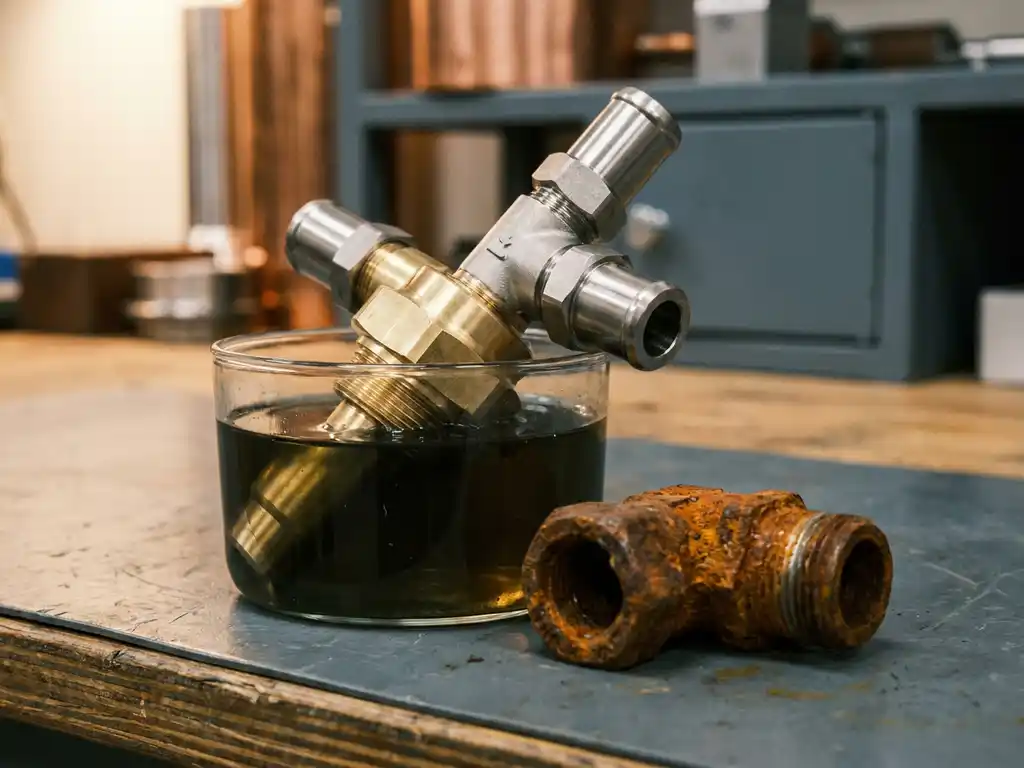
Corrosion resistance is one of the most critical factors in thermostat material selection because thermostats operate in chemically aggressive environments where degradation can cause complete system failure. The fluid a thermostat contacts, the operating temperature, and the surrounding environment all determine which materials will hold up over time. The questions below break down the specific corrosion challenges engineers face when specifying thermostat components across different applications.
Which materials are most vulnerable to corrosion in thermostat applications?
Among the materials commonly used in thermostat construction, uncoated steel and certain aluminium alloys are the most vulnerable to corrosion. Both react readily with water-based coolants, especially when those coolants become acidic over time or when dissimilar metals create galvanic couples within the same assembly.
Brass and copper alloys offer better inherent corrosion resistance and have historically been popular choices for thermostat housings and valve seats. However, they are not immune. In systems where coolant inhibitor packages have depleted, brass can experience dezincification, where zinc selectively leaches out of the alloy and leaves behind a porous, weakened copper structure.
Engineered plastics and thermoset polymers have become increasingly common in thermostat component design precisely because they are chemically inert to most coolant formulations. They do not corrode in the electrochemical sense, though they can swell, soften, or crack under sustained thermal or chemical stress if the wrong polymer grade is specified. Stainless steel grades, particularly those with higher molybdenum content, offer excellent corrosion resistance but add cost and machining complexity.
How does coolant chemistry affect thermostat material degradation?
Coolant chemistry is the single biggest driver of thermostat material degradation. The pH level, inhibitor type, water quality, and age of the coolant all determine how aggressively the fluid attacks the materials it contacts. A coolant that has dropped below its recommended pH range becomes acidic and will corrode metals far more rapidly than fresh, properly buffered fluid.
Modern coolants fall into several categories: Inorganic Additive Technology (IAT), Organic Acid Technology (OAT), and Hybrid Organic Acid Technology (HOAT). Each uses a different inhibitor chemistry that is optimised for specific metal combinations. Using an OAT coolant in a system designed around IAT inhibitor chemistry, or mixing the two, can neutralise the protective film that inhibitors form on metal surfaces and accelerate localised corrosion.
Hard water used to dilute coolant concentrate introduces chlorides and sulphates that are particularly damaging to aluminium components. Deionised or distilled water is strongly recommended in systems where aluminium thermostat housings or engine blocks are present. Even small concentrations of chloride ions can initiate pitting corrosion on aluminium surfaces, which is difficult to detect visually until the damage is already significant.
What’s the difference between corrosion resistance in automotive versus industrial thermostat environments?
Automotive and industrial thermostat environments differ primarily in the nature of the fluid contact, the range of operating temperatures, and the maintenance intervals expected over the product’s life. Automotive thermostats mainly contact glycol-water coolant mixtures, while industrial thermostats may be exposed to oils, process water, steam, or a wide range of industrial fluids depending on the application.
Automotive thermostat environments
In automotive applications, the corrosion challenge is well-defined: the thermostat must resist glycol-based coolants across a temperature range typically between 80°C and 120°C, with a service life that may span ten years or more. The primary concerns are galvanic corrosion between dissimilar metals, inhibitor depletion in long-life coolants, and the ingress of contaminants through a poorly sealed system. Material selection for automotive thermostat materials tends to favour proven combinations of brass, engineered plastics, and stainless steel springs.
Industrial thermostat environments
Industrial environments introduce far greater variability. A thermostat managing oil temperature in a hydraulic system faces very different chemical stresses than one regulating coolant in a marine engine or process water in a heat exchanger. Oil systems are generally less corrosive to metals but can degrade certain elastomers and plastics. Marine environments add the severe challenge of saltwater exposure, which demands high-grade stainless steel or specialist coatings. Industrial thermostat material selection therefore requires a detailed fluid compatibility analysis before any choice is finalised, rather than relying on standard automotive-grade specifications.
How do engineers test thermostat components for corrosion resistance?
Engineers test thermostat components for corrosion resistance through a combination of accelerated laboratory testing, fluid immersion trials, and real-world validation in representative operating conditions. The goal is to simulate years of service exposure in a compressed timeframe so that material weaknesses are identified before production.
Salt spray testing is one of the most widely used accelerated corrosion methods. Components are exposed to a fine mist of sodium chloride solution in a controlled chamber, and the time to first visible corrosion is recorded. While salt spray testing does not perfectly replicate coolant chemistry, it provides a reliable comparative benchmark between material options and surface treatments.
Fluid immersion testing is more directly relevant to thermostat applications. Components are submerged in representative coolant formulations, often at elevated temperatures to accelerate chemical reactions, and then evaluated for mass loss, dimensional change, surface pitting, and mechanical property retention. This type of testing can also identify compatibility issues between the fluid and any seals, gaskets, or plastic components in the assembly.
Electrochemical testing methods, including potentiodynamic polarisation and electrochemical impedance spectroscopy, give engineers a detailed picture of how a material behaves at the electrochemical level. These techniques are particularly useful when evaluating new alloy compositions or surface coatings where historical performance data is limited.
When should corrosion resistance be prioritised over other material properties?
Corrosion resistance should be prioritised over other material properties when the operating environment is chemically aggressive, maintenance intervals are long, or system failure carries high safety or cost consequences. In these situations, a material that offers slightly lower mechanical strength but excellent chemical stability will outperform a stronger material that degrades prematurely.
In sealed or inaccessible systems, such as thermostats embedded within complex engine assemblies or industrial machinery, the ability to inspect or replace components is limited. Here, the cost of a corrosion-related failure, in terms of downtime, warranty claims, or safety risk, far outweighs any savings made by choosing a cheaper, less corrosion-resistant material at the design stage.
Conversely, in applications where coolant is changed frequently, the system is easily accessible, and operating temperatures are moderate, other properties such as thermal conductivity, weight, or cost may reasonably take precedence. The key is always to match material selection to the actual service conditions rather than applying a universal hierarchy of properties across all applications.
How BTT Solutions supports thermostat material selection
Selecting the right thermostat materials for a corrosive environment is not a decision that should be made in isolation from the broader system design. At BTT Solutions, we work directly with engineers and procurement teams to identify the best-fit components for their specific application requirements, including fluid type, operating temperature range, service life expectations, and regulatory constraints. Our product advisory service covers:
- Material compatibility assessment for wax elements, thermostat inserts, and engineered housings across automotive, industrial, and building technology applications
- Guidance on coolant chemistry interactions and how they affect long-term component integrity
- Support in matching corrosion resistance requirements to the right product specification without over-engineering or unnecessary cost
- Flexible, responsive consultation from a team that offers individual attention rather than a one-size-fits-all catalogue approach
Whether you are developing a new platform or re-evaluating materials on an existing design, we are here to help you make the right call. Get in touch with our team to discuss your thermostat material selection challenges and find out how our thermomanagement components can be specified to meet your exact requirements.
Related Articles
- What is the relationship between compression ratio and engine efficiency?
- How do aging and wear change thermostat performance over time?
- How are OEMs targeting fuel efficiency gains through thermal components?
- What are the cost benefits of advanced thermal management systems?
- What does a thermostat do in thermal management systems?


