
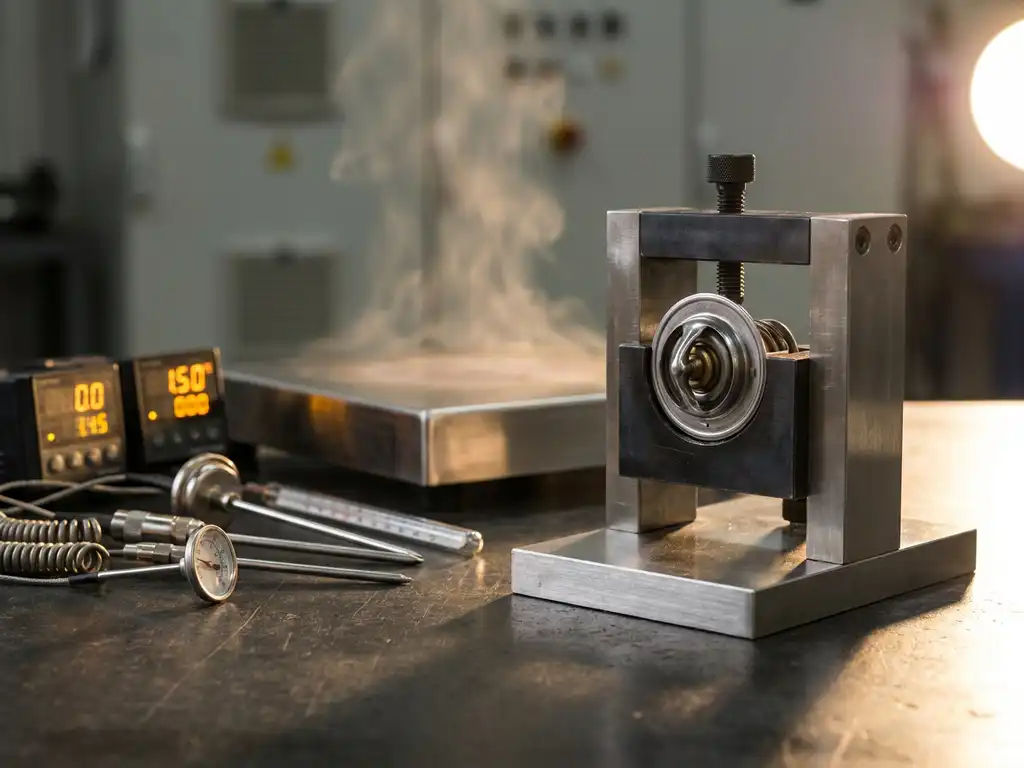
Validating a thermostat for safety-critical applications means putting it through a structured qualification process that confirms it will perform reliably under real-world conditions without causing system failure. This involves a combination of standards compliance, failure mode analysis, environmental testing, and documented traceability. The sections below walk through each stage of that process in detail.
What standards govern thermostat validation in safety-critical systems?
Thermostat validation in safety-critical systems is governed by a combination of industry-specific standards that define testing requirements, performance thresholds, and documentation obligations. The applicable standards depend on the application sector, but the most widely referenced frameworks include ISO 9001 for quality management, IATF 16949 for automotive suppliers, and IEC 60730 for automatic electrical controls used in household and similar applications.
In automotive contexts, thermostat qualification also aligns with ASPICE (Automotive SPICE) process requirements and, where electronic control is involved, with ISO 26262 for functional safety. Industrial thermomanagement components may additionally fall under sector-specific directives such as the Pressure Equipment Directive (PED) in Europe or ASME standards in North America, depending on the fluid systems they regulate.
Understanding which standards apply before testing begins is essential. A thermostat destined for an engine cooling circuit in a passenger vehicle faces a different compliance landscape than one embedded in an industrial heat exchange system. Mapping the regulatory environment early prevents costly re-testing and ensures that validation activities are structured to produce evidence that satisfies every relevant authority.
What failure modes must be assessed before a thermostat is approved?
Before a thermostat can be approved for use in a safety-critical application, engineers must systematically assess the failure modes that could cause it to malfunction and identify the consequences of each. The primary tool for this is a Failure Mode and Effects Analysis (FMEA), which documents every foreseeable way the component could fail, how likely each failure is, and how severe the downstream impact would be.
For a wax-element thermostat, the most critical failure modes typically include:
- Stuck closed: The valve fails to open, blocking coolant flow and causing overheating.
- Stuck open: The valve fails to close, preventing the engine from reaching operating temperature and increasing emissions.
- Degraded response: The wax element loses sensitivity over time, causing delayed or incomplete opening.
- Seal failure: Internal or external leakage that compromises fluid management.
- Housing fatigue: Cracking or deformation under thermal cycling stress.
Each failure mode is assigned a Risk Priority Number (RPN) based on severity, occurrence probability, and detectability. High-RPN items drive design changes or additional safeguards before the component advances through the thermostat qualification process. This structured approach ensures that no plausible failure scenario is overlooked before the component enters service.
How does environmental and life-cycle testing work for thermostats?
Environmental and life-cycle testing for thermostats simulates the full range of conditions a component will encounter during its operational life, from extreme temperatures and pressure fluctuations to vibration, corrosive fluids, and repeated thermal cycling. The goal is to confirm that the thermostat maintains its specified performance throughout its intended service life, not just at the point of manufacture.
Thermal cycling and endurance tests
Thermal cycling tests expose the thermostat to repeated transitions between low and high temperatures, replicating the heating and cooling cycles it will experience in service. Endurance tests run the component through tens of thousands of open-close cycles to detect wear, fatigue, or drift in opening temperature. Any deviation beyond the specified tolerance band is treated as a failure.
Environmental stress screening
Environmental stress screening covers exposure to humidity, salt spray, chemical compatibility with coolants and oils, and mechanical vibration profiles derived from real-world vehicle or equipment data. These tests are designed to surface latent defects that would not appear under standard operating conditions but could cause field failures over time. Components that survive this battery of tests with performance intact are considered candidates for approval.
What is the difference between functional validation and design validation?
Functional validation confirms that a thermostat performs its intended function correctly, while design validation confirms that the overall design meets the customer’s stated requirements under real-world conditions. These are related but distinct stages in the qualification process, and both are required before a thermostat enters production for safety-critical use.
Functional validation is typically conducted in controlled laboratory conditions. It verifies that the thermostat opens and closes at the correct temperatures, responds within the specified time window, and maintains the required flow rates. It answers the question: does this component do what it is supposed to do?
Design validation goes further. It involves testing production-representative parts in the actual application environment, or a validated simulation of it, to confirm that the design as a whole meets end-user requirements. This stage often includes vehicle-level or system-level testing and is documented through a Design Validation Plan and Report (DVP&R). Together, these two stages form the backbone of any credible thermostat validation programme.
When does a thermostat require third-party certification?
A thermostat requires third-party certification when the applicable standard or regulatory framework mandates independent verification, or when the customer requires it as a condition of supply. In many automotive and industrial contexts, self-certification by the manufacturer is acceptable if supported by robust internal testing records. However, certain markets and applications make independent certification mandatory.
Third-party certification is most commonly required in these situations:
- Components used in systems subject to CE marking under European directives, where a notified body review is triggered.
- Marine and offshore applications governed by classification societies such as DNV, Lloyd’s Register, or Bureau Veritas.
- Medical or pharmaceutical process equipment where regulatory bodies require independent validation evidence.
- Public infrastructure or safety systems where procurement rules mandate accredited test results.
Even when third-party certification is not legally required, some OEM customers specify it contractually as a risk management measure. In those cases, early engagement with an accredited testing laboratory avoids delays in the approval timeline. It is always worth clarifying certification expectations at the start of a project rather than discovering them at the qualification gate.
How does traceability documentation support the validation process?
Traceability documentation supports thermostat validation by creating a verifiable chain of evidence that links every test result, design decision, and production batch back to the original requirements. Without it, even a well-tested component cannot be fully approved for safety-critical use, because there is no way to confirm that the tested sample represents what will actually be delivered.
Effective traceability in a thermostat validation programme typically includes:
- A requirements traceability matrix that maps each customer or regulatory requirement to a specific test or analysis.
- Unique part identification that connects physical samples to their manufacturing records.
- Calibrated measurement records that confirm test equipment was within tolerance at the time of testing.
- Change control logs that document any design or process modifications and trigger re-validation where necessary.
- Approved supplier records for materials and sub-components used in the validated design.
This documentation serves multiple purposes. It supports internal quality assurance, satisfies customer audit requirements, and provides the evidence base needed for regulatory submissions. In the event of a field issue, a complete traceability record also makes root cause analysis significantly faster and more reliable. Building traceability into the process from the start is far less costly than reconstructing it after the fact.
How BTT Solutions supports thermostat validation for safety-critical applications
We work alongside engineers and procurement teams who need more than a catalogue component. Our expertise in thermomanagement components means we understand the qualification demands that come with safety-critical applications, and we structure our product development and support accordingly.
When you work with us on thermostat qualification, here is what that looks like in practice:
- Component selection guidance: We help you identify the right wax elements, thermostat inserts, or engineered housings for your application requirements and operating environment.
- Technical documentation support: We provide the material data, dimensional records, and test histories you need to build a complete validation package.
- Application-specific testing: Our components are designed and tested to meet the precision and reliability standards that automotive, industrial, and building technology customers depend on.
- Responsive collaboration: As a focused, mid-sized organisation, we move quickly and give your project the direct attention it deserves, without the delays that come with larger supply chain structures.
Whether you are at the early stages of a design project or working through a formal qualification programme, we are ready to help. Get in touch with our team to discuss your application and find out how we can support your validation process from component selection through to approval.
Related Articles
- Why is a precise thermostat mechanism critical for fuel efficiency?
- What are the consequences of thermal cycling on engine durability?
- How can I tell if my car's thermostat is bad?
- What thermal management solutions are used in building technology?
- Why is thermal management critical for battery performance?


