
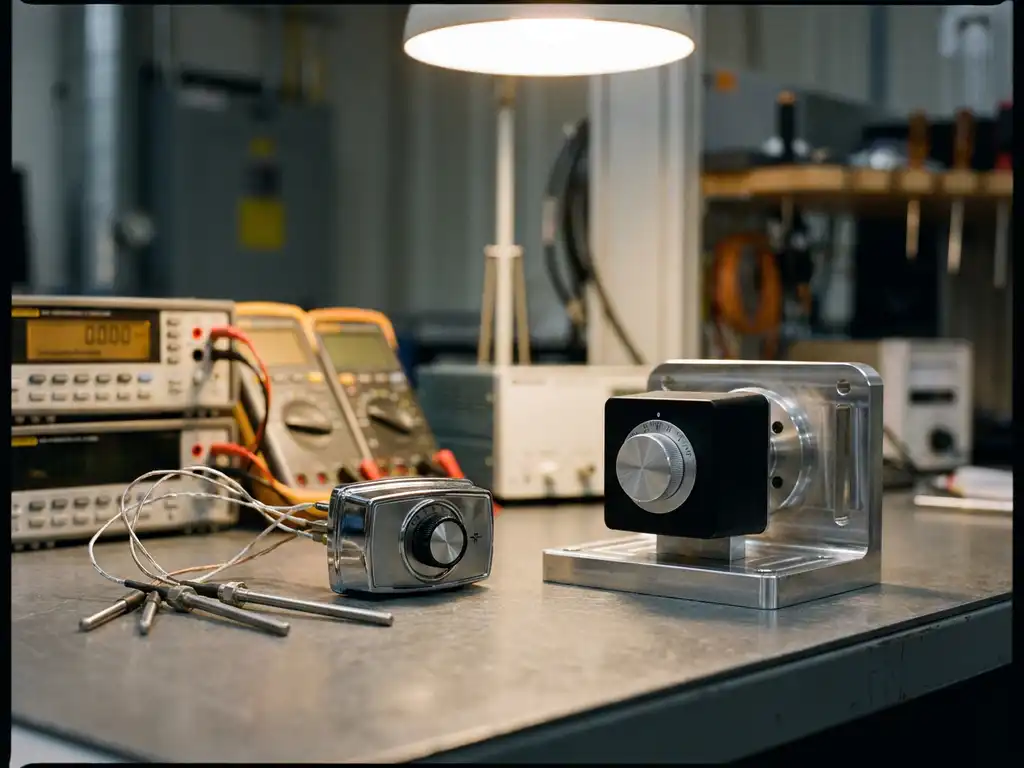
Type testing and routine testing for thermostats serve fundamentally different purposes. Type testing is a one-time qualification process that validates a thermostat design against its full performance specification, while routine testing is a repeated production check that confirms every manufactured unit meets a defined minimum standard. Together, they form the backbone of thermostat quality assurance.
For engineers and procurement teams sourcing thermal management components, understanding the distinction matters because it directly affects how confident you can be in both the design and the delivered product. The sections below walk through how each test works, what standards apply, and when a design change demands a fresh round of type testing.
How does type testing work for thermostat components?
Type testing is a comprehensive validation process applied to a thermostat design before it enters series production. A representative sample of units is subjected to the full range of conditions the component will face in real-world use, including extreme temperatures, pressure cycles, flow rates, and long-term durability loads. The goal is to prove that the design itself is fit for purpose.
During a type test campaign, engineers typically evaluate a broad set of performance parameters. These can include opening and closing temperatures, stroke length at defined temperatures, hysteresis behaviour, leakage under pressure, response time, and mechanical endurance over thousands of cycles. Each parameter is tested against the agreed specification, and the component must pass every criterion to receive approval.
Because type testing is thorough and resource-intensive, it is normally carried out once per design. The results are documented in a type test report that becomes the reference document for all future production. If the design changes, the type test must be revisited, but as long as the approved design remains unchanged, the report stays valid across the full production lifetime of that component.
Type testing is also where edge cases are explored. Engineers look at what happens when a thermostat is exposed to conditions slightly beyond its rated limits, or when it has been aged through thermal cycling. This kind of stress testing gives confidence that the design has a genuine safety margin, not just a nominal pass under ideal conditions.
What does routine testing check in thermostat production?
Routine testing is the systematic inspection applied to every thermostat unit as it comes off the production line. Rather than re-evaluating the full design, routine testing focuses on a defined subset of critical parameters to confirm that each individual unit has been manufactured correctly and matches the approved type.
The parameters checked in routine testing are chosen because they are sensitive to manufacturing variation. For thermostats, these typically include the opening temperature, the stroke at a reference temperature, and a leakage or pressure integrity check. These three checks can be performed quickly on automated test benches and catch the most common production faults, such as wax element inconsistencies, seal failures, or dimensional deviations in the housing.
Speed and repeatability are central to routine testing. A production line manufacturing tens of thousands of thermostat components per year cannot afford the time or cost of a full type test on every unit. Routine testing is designed to be fast enough to run at 100 percent inspection rates without becoming a bottleneck, while still providing meaningful quality assurance at the unit level.
The results of routine testing feed directly into statistical process control. Trends in opening temperature data, for example, can reveal a batch of wax elements drifting out of specification before any units actually fail their limits. This makes routine testing not just a pass/fail gate but a live signal of production health.
What are the key differences between type testing and routine testing?
The core difference between type testing and routine testing lies in scope and frequency. Type testing validates the design comprehensively and happens once. Routine testing validates each individual unit against a shorter parameter list and happens continuously throughout production. One confirms the design is right; the other confirms the manufacturing is right.
Several practical distinctions follow from that fundamental difference:
- Sample size: Type testing uses a defined sample of units, often between five and thirty depending on the standard. Routine testing covers every single unit produced.
- Parameter breadth: Type testing covers the full specification, including durability, environmental resistance, and edge-case behaviour. Routine testing covers a focused subset of critical functional parameters.
- Test duration: Type tests can take days or weeks per sample when endurance cycles are included. Routine tests are completed in seconds or minutes per unit.
- Purpose: Type testing answers the question “Is this design capable of meeting its specification?” Routine testing answers the question “Was this specific unit made correctly?”
- Trigger: Type testing is triggered by a new design, a significant change, or a new application. Routine testing runs continuously as a production control measure.
Understanding this split also helps procurement teams interpret supplier documentation. A type test certificate tells you the design has been validated. Routine test records tell you the shipped batch was inspected. Both documents together give you a complete quality picture for thermostat components.
Which standards govern thermostat type and routine testing?
Thermostat testing for automotive applications is primarily governed by OEM-specific engineering standards and international industry norms, most notably those from the German automotive standards body (VDA) and individual vehicle manufacturer specifications. For industrial and building technology applications, relevant standards come from bodies such as ISO and EN, depending on the region and application.
In automotive thermostat development, OEM test specifications typically define both the type test scope and the routine test requirements as part of the component approval process. These documents specify the exact test conditions, acceptance criteria, sample sizes, and reporting formats. Suppliers are expected to demonstrate compliance with these requirements before a component is approved for series supply.
For thermal management components used in heating systems, radiators, and industrial cooling circuits, standards such as EN 215 (for thermostatic radiator valves) and various ISO fluid system standards provide the relevant framework. These standards distinguish between type approval testing and production conformity testing in a way that closely mirrors the automotive distinction between type and routine tests.
It is worth noting that standards evolve. As emissions regulations tighten and thermal management requirements become more demanding, test specifications are regularly updated to reflect new performance thresholds. Staying current with the applicable standard version is part of maintaining a valid type test approval.
Why do both test types matter for thermostat reliability?
Type testing and routine testing are complementary, not interchangeable. Relying on type testing alone would mean trusting that every production unit perfectly replicates the validated prototype, which is never a safe assumption in volume manufacturing. Relying on routine testing alone would mean catching unit-level defects without ever having proven the underlying design is fundamentally capable.
A thermostat that opens at the wrong temperature, even briefly, can cause real consequences. In an engine cooling circuit, a thermostat that opens too late allows coolant temperatures to spike, increasing wear and emissions. One that opens too early prevents the engine from reaching its optimal operating temperature, reducing fuel efficiency. In a heating system, a faulty thermostatic element can lead to energy waste or comfort problems across an entire building.
The combination of both test types creates a layered defence. Type testing establishes that the design has the right thermal response, the right mechanical durability, and the right tolerance for environmental stress. Routine testing then ensures that the production process consistently delivers units that match that validated design. Neither layer alone is sufficient for the level of reliability that industrial and automotive customers require.
There is also a commercial dimension. Documented type test reports and routine test records are increasingly required as part of supplier qualification processes. Customers conducting supplier audits will expect to see both, and gaps in either area can delay or block component approvals.
When should a thermostat design trigger a new type test?
A new type test is required whenever a change to the thermostat design or its production process could affect the parameters that were originally validated. The threshold for what constitutes a “significant” change is usually defined in the applicable OEM specification or quality agreement, but several categories of change almost universally trigger a re-qualification.
Changes that typically require a new type test include:
- Wax element reformulation: The wax compound determines the thermal response of the thermostat. Any change to its composition or supplier requires re-validation of opening temperature, stroke, and hysteresis.
- Housing or seal material changes: New materials may behave differently under pressure, temperature cycling, or chemical exposure, affecting leakage performance and long-term durability.
- Dimensional design changes: Alterations to stroke length, spring preload, or valve geometry directly affect the flow characteristics and thermal response of the component.
- Manufacturing site or process changes: Moving production to a new facility or changing a key manufacturing step can introduce variation that the original type test did not account for.
- New application conditions: Using an existing thermostat design in a new application with different temperature ranges, pressures, or fluid types requires confirming the design is still appropriate for those conditions.
The practical implication is that type testing is not a one-time administrative hurdle but an ongoing engineering responsibility. Managing the change control process carefully, and knowing when a modification crosses the threshold into re-qualification territory, is a core part of responsible component development. If you are ever unsure whether a planned change requires a new type test, the safest approach is to consult the applicable standard and discuss the change with your customer’s quality engineering team before implementation.
How BTT Solutions supports thermostat testing and component qualification
We know that navigating the requirements for both type testing and routine testing can be demanding, especially when you are managing multiple component families across different applications and customer specifications. That is why we build testing and qualification support directly into how we work with our customers.
When you source thermostat components from us, here is what that looks like in practice:
- Component selection guidance: We help you identify the right thermostat element, whether a wax element, thermostat insert, or engineered housing, matched to your application’s temperature range, flow requirements, and environmental conditions.
- Type test documentation: Our components come with complete type test records so your engineering and quality teams have the validation evidence they need for supplier approval processes.
- Routine test traceability: Every batch we ship is backed by routine test data, giving you confidence that the units you receive match the approved design.
- Change management support: If a design or process change is being considered, we work with you to assess whether a new type test is needed and support the re-qualification process.
- Cross-industry expertise: Our thermal management experience spans automotive, industrial, and building technology applications, so we understand the different standards and customer requirements you may be working against.
Whether you are qualifying a new component for a vehicle platform, specifying thermostatic elements for an industrial cooling circuit, or looking for a reliable supply partner who can keep pace with your quality requirements, we are ready to help. Get in touch with our team to discuss your thermostat component needs and find out how we can support your qualification process from the start.
Related Articles
- Why do cold engines produce more emissions than warm engines?
- What is the relationship between engine temperature and combustion efficiency?
- What certifications should an automotive thermostat manufacturer have?
- What is the difference between a thermostat and a thermometer?
- What are the benefits of thermal management systems?


