
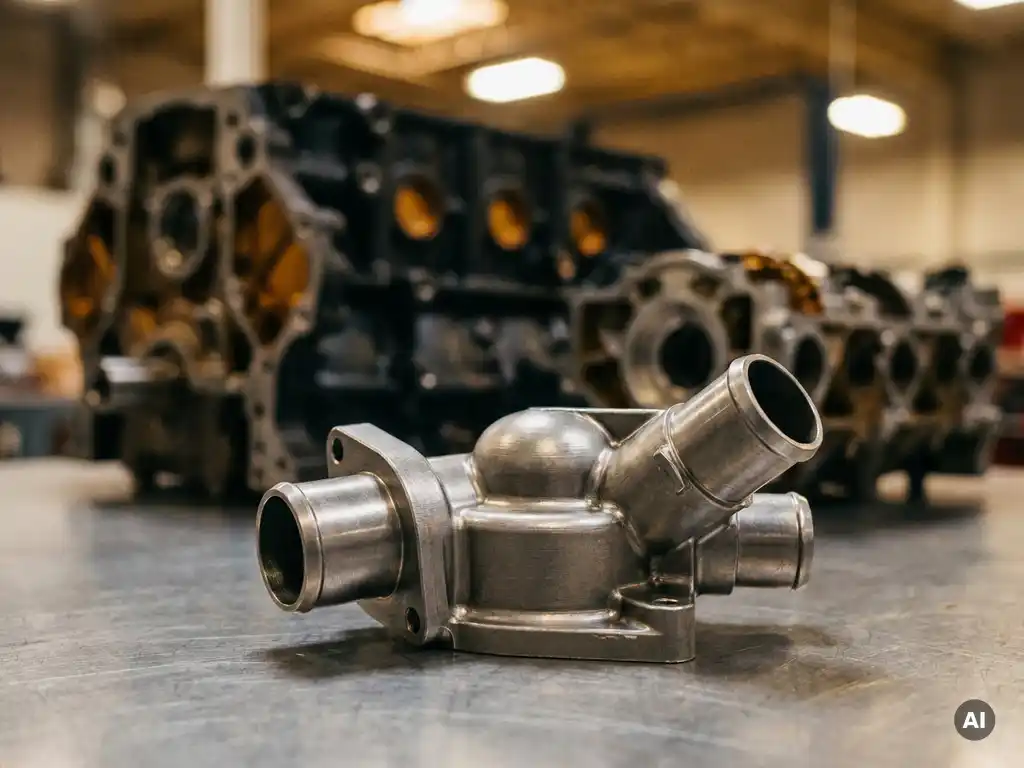
A thermostat housing is a protective casing that holds the thermostat in place within an engine’s cooling system and connects it to the coolant passages. It serves as the mounting point for the thermostat and ensures coolant flows correctly between the engine and the radiator. The sections below unpack how the housing works, what it’s made from, and how to know when something goes wrong.
What does a thermostat housing actually do?
The thermostat housing secures the thermostat in position and channels coolant flow through the engine’s cooling circuit. Without it, the thermostat would have no fixed mounting point, and coolant would have no structured path to follow. It acts as both a mechanical anchor and a flow junction within the system.
When the engine is cold, the thermostat inside the housing stays closed, keeping coolant circulating only within the engine block to help it reach operating temperature faster. Once the engine warms up, the thermostat opens and the housing directs hot coolant out toward the radiator to be cooled before returning. This continuous loop keeps the engine running within its ideal temperature range, protecting it from overheating and improving efficiency.
The housing also typically provides mounting points for coolant temperature sensors, which feed data to the engine management system. That makes it a central hub in the broader thermal management setup, not just a passive bracket.
What parts make up a thermostat housing assembly?
A thermostat housing assembly consists of the main housing body, a sealing gasket or O-ring, the thermostat itself, and often one or more coolant temperature sensor ports. Together, these components form a sealed, functional unit that manages coolant routing.
- Housing body: The structural shell that contains and protects the thermostat, typically cast from aluminum or brass.
- Gasket or O-ring: Creates a leak-proof seal between the housing and the engine block or intake manifold.
- Thermostat: The temperature-sensitive valve housed inside that opens and closes based on coolant temperature.
- Sensor ports: Threaded openings that accept coolant temperature sensors, allowing real-time data to reach the engine control unit.
- Coolant outlets: Pipe connections or flanges that direct coolant to and from the radiator and heater circuit.
In many modern vehicles and industrial systems, the entire assembly is designed as a single integrated unit, making replacement straightforward. You can explore the range of precision thermostat components that go into these assemblies to get a clearer picture of how the parts work together.
What materials are thermostat housings made from?
Thermostat housings are most commonly made from aluminum, brass, or engineering-grade plastics, with the choice depending on the application, operating temperatures, and cost requirements. Each material brings a different combination of strength, thermal conductivity, and corrosion resistance.
Aluminum thermostat housings
An aluminum thermostat housing is the most widely used option in modern automotive and industrial applications. Aluminum is lightweight, dissipates heat effectively, and holds up well against the thermal cycling that cooling systems go through repeatedly. It machines cleanly, which allows for precise tolerances, and it resists corrosion reasonably well when treated or anodized. Most passenger vehicles and commercial engines produced today use aluminum housings for these reasons.
Brass thermostat housings
A brass thermostat housing is the preferred choice in applications where corrosion resistance and longevity are the top priorities, such as marine systems, industrial cooling circuits, and certain heating infrastructure. Brass handles aggressive coolant chemistries and high-humidity environments better than aluminum, and it maintains structural integrity over very long service lives. It is heavier and more expensive than aluminum, but in demanding environments, that trade-off is well worth it.
Plastic housings appear in some lower-temperature or cost-sensitive applications, but they are more prone to cracking under thermal stress and are generally less favored in heavy-duty or high-precision contexts.
How does a thermostat housing differ from the thermostat itself?
The thermostat is the active, temperature-sensitive valve that opens and closes to regulate coolant flow. The thermostat housing is the passive structural component that holds the thermostat in place and connects it to the cooling circuit. They are two separate parts that work together but serve completely different functions.
Think of it this way: the thermostat is the decision-maker, and the housing is the frame that keeps it in position and gives it something to act against. The thermostat contains a wax element that expands when heated, pushing a valve open to allow coolant through. The housing simply provides the sealed cavity and the coolant ports that make that action meaningful within the system.
This distinction matters practically because the two components can fail independently. A cracked housing can cause coolant leaks even when the thermostat inside is working perfectly, and a stuck thermostat can cause overheating even when the housing is in perfect condition. Diagnosing which part has failed saves time and unnecessary replacement costs.
What are the signs of a failing thermostat housing?
The most common signs of a failing thermostat housing are visible coolant leaks around the housing, engine overheating, fluctuating temperature gauge readings, and coolant residue or staining near the housing body. Catching these early prevents more serious engine damage.
- Coolant leaks: Puddles or drips under the vehicle near the front of the engine, often with a sweet smell, point to a cracked housing or a failed gasket.
- Overheating: If the engine temperature climbs higher than normal or the warning light triggers, a compromised housing that disrupts coolant flow could be the cause.
- Temperature gauge instability: A needle that swings unpredictably may indicate that coolant is not flowing consistently through the system.
- White residue or staining: Dried coolant deposits around the housing are a clear sign that a slow leak has been occurring, even if no puddle is visible.
- Low coolant levels: If the reservoir keeps needing to be topped up without an obvious external leak, the housing may have a hairline crack that only weeps under pressure.
In industrial and building systems, similar symptoms appear as inconsistent fluid temperatures, unexpected pressure drops, or visible corrosion around the housing body.
When should a thermostat housing be replaced?
A thermostat housing should be replaced when it shows visible cracks, persistent leaks that cannot be resolved by replacing the gasket alone, or significant corrosion that compromises its structural integrity. It is also good practice to replace the housing when replacing the thermostat in older systems, since both components will have experienced the same wear cycles.
In automotive applications, many technicians recommend inspecting the housing whenever the cooling system is opened for service. A housing that looks intact but has hairline fractures or degraded sealing surfaces will fail again shortly after a gasket replacement, making the repair a short-term fix at best.
For industrial systems, replacement intervals depend on the operating environment. Brass housings in marine or chemical environments may last decades, while housings in systems with poor coolant maintenance or aggressive thermal cycling may need attention sooner. The key trigger is always the condition of the component, not a fixed mileage or hour count.
If the housing is being replaced, it is worth upgrading to a higher-grade material at the same time. Switching from a plastic housing to an aluminum or brass thermostat housing, for example, can significantly extend service life and reduce future maintenance needs.
How BTT Solutions supports your thermostat housing needs
At BTT Solutions, we design and manufacture high-precision thermostat components for automotive, industrial, and building technology applications. Whether you need a robust brass thermostat housing for a marine cooling circuit, a lightweight aluminum thermostat housing for a passenger vehicle platform, or integrated assemblies for industrial temperature management, we build to the exact specifications your application demands.
Here is what working with us looks like in practice:
- End-to-end component expertise: We develop the thermostat, the housing, and the surrounding assembly as a coordinated system, not isolated parts.
- Material flexibility: We work with aluminum, brass, and other precision materials depending on your operating environment and performance targets.
- Patented thermal management technology: Our solutions are engineered to improve energy efficiency, reduce emissions, and extend component service life.
- Dedicated attention: As a focused, mid-sized specialist, we give every client direct access to engineering expertise without layers of bureaucracy.
- Global reach, responsive structure: With eight locations worldwide, we support supply chains across automotive, industrial, and HVAC sectors.
If you want to learn more about who we are and how we operate, visit our company background page. To see the full range of what we offer, browse our product portfolio. And when you are ready to discuss your specific requirements, get in touch with our team directly. We are happy to help you find the right solution.


