
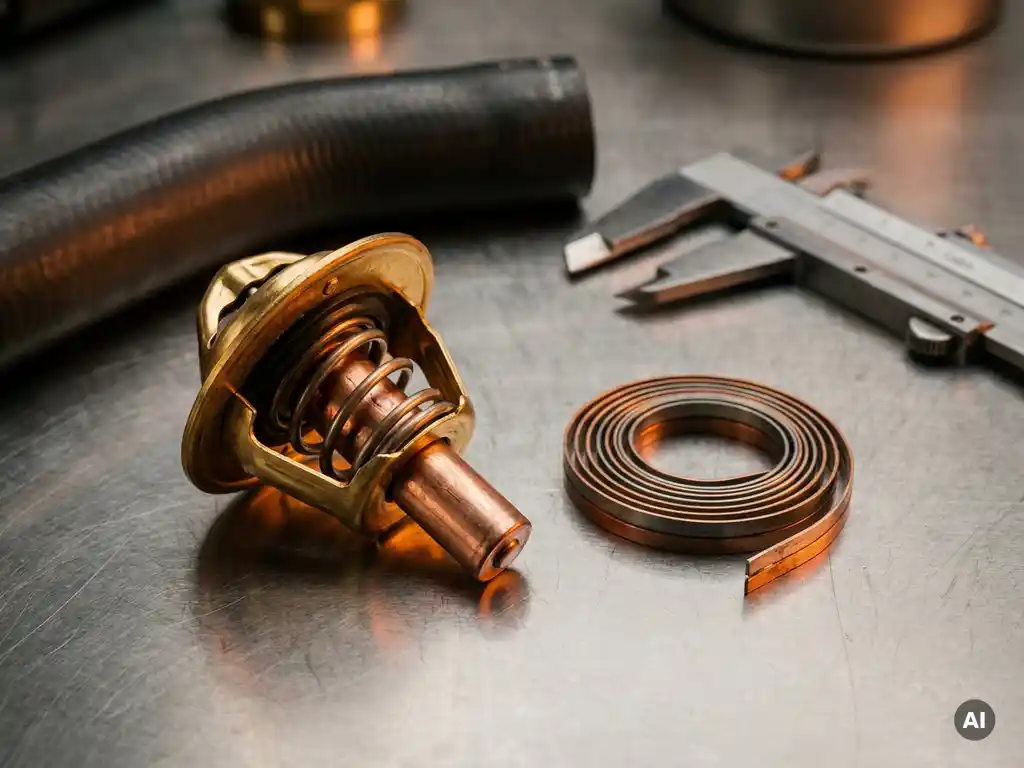
The main difference between a wax pellet thermostat and a bimetallic thermostat lies in the mechanism they use to respond to temperature changes. A wax pellet thermostat relies on the thermal expansion of a wax element material to open and close a valve, while a bimetallic thermostat uses two bonded metals that bend at different rates when heated. Wax pellet designs tend to deliver stronger, more precise actuation forces, making them the dominant choice in automotive and industrial cooling systems. The sections below break down how each type works, where they’re used, and how to choose between them.
How does each thermostat type actually work?
A wax pellet thermostat works by enclosing a specially formulated wax element material inside a sealed chamber. As the surrounding fluid heats up, the wax undergoes thermal expansion, increasing in volume and pushing a piston outward. That mechanical movement opens or closes a valve, regulating the flow of coolant or fluid with considerable force and repeatability. When the temperature drops, the wax contracts and a return spring closes the valve again.
A bimetallic thermostat operates on an entirely different principle. It uses a strip made from two metals bonded together, typically brass and steel, that have different coefficients of thermal expansion. When the temperature rises, the two metals expand at different rates, causing the strip to bend or curl. That bending motion either opens or closes an electrical contact or a mechanical valve, depending on the application.
The key mechanical distinction is force output. Wax thermal expansion generates a much higher actuation force than the bending of a bimetallic strip, which is why wax pellet designs can reliably control valves against significant fluid pressure. Bimetallic strips, by contrast, produce lighter, more gradual movements that suit lower-pressure environments and electrical switching tasks.
Which applications use wax pellet thermostats?
Wax pellet thermostats are the standard choice wherever precise, high-force temperature control is needed in fluid systems. Their ability to generate strong actuation force from wax thermal expansion makes them reliable even under the demanding pressures found in liquid cooling circuits. You will find them in automotive engine cooling systems, industrial machinery, marine engines, and floor-heating distribution manifolds.
In automotive applications specifically, the wax element material is engineered to melt at a very precise temperature, ensuring the engine reaches its optimal operating range quickly and stays there consistently. Beyond vehicles, they are widely used in:
- Industrial coolant regulation systems
- Oil temperature management in hydraulic equipment
- Underfloor heating and radiator circuits in buildings
- Shipboard cooling and thermal management systems
The versatility of wax pellet technology comes from the fact that the wax element material can be tuned to open at almost any target temperature by adjusting its chemical composition, giving engineers a high degree of flexibility across very different industries. If you want to understand the full product range that uses this technology, it spans far beyond the automotive world.
Where are bimetallic thermostats commonly used?
Bimetallic thermostats are most commonly used in applications that require electrical switching rather than fluid flow control. Because the bending strip can open and close electrical contacts directly, they are a natural fit for household appliances, HVAC equipment, and simple safety cutouts. Their simplicity, low cost, and compact size make them practical where high actuation force is not a requirement.
Typical applications include:
- Electric kettles and toasters
- Ovens and dishwashers
- Room thermostats and basic HVAC controls
- Motor overload protection switches
- Simple on/off temperature safety devices
In these environments, the gentle, gradual response of a bimetallic strip is actually an advantage. The device does not need to move heavy valves against fluid pressure; it simply needs to make or break a low-current electrical connection. That said, bimetallic thermostats are rarely found in modern automotive engine cooling circuits, where the demands on precision and force are far beyond what a metal strip can reliably deliver.
What are the key performance differences between the two?
The most important performance differences between wax pellet and bimetallic thermostats come down to actuation force, temperature precision, and response characteristics. Wax pellet designs win on force output and precision, while bimetallic designs are simpler and better suited to electrical switching at lower pressures.
Here is a side-by-side comparison of the key factors:
- Actuation force: Wax thermal expansion produces a significantly higher mechanical force, making wax pellet thermostats capable of operating valves in pressurized fluid systems. Bimetallic strips produce light, gradual force suitable for contact switching only.
- Temperature precision: Wax element material can be formulated to activate within a very narrow temperature band. Bimetallic strips tend to have a wider switching differential and are less precise.
- Response speed: Both types respond relatively slowly compared to electronic sensors, but wax pellet thermostats are designed to follow fluid temperature closely. Bimetallic strips respond to ambient air temperature, which can introduce lag.
- Durability in harsh conditions: Wax pellet thermostats handle vibration, pressure, and fluid exposure well. Bimetallic strips can fatigue over many cycles or corrode if exposed to moisture.
- Cost and complexity: Bimetallic thermostats are simpler and cheaper to manufacture, which is why they remain popular in consumer appliances.
Can a wax pellet thermostat be used instead of a bimetallic one?
In most cases, a wax pellet thermostat cannot simply replace a bimetallic thermostat without design changes, because the two devices perform fundamentally different functions. A wax pellet thermostat controls fluid flow mechanically, while a bimetallic thermostat typically switches electrical contacts. They are not interchangeable in the way that two similar sensors might be.
That said, if an application currently uses a bimetallic device to control a fluid valve and precision or force is proving inadequate, switching to a wax pellet design is often a worthwhile engineering upgrade. The opposite direction, replacing a wax pellet thermostat with a bimetallic one in a pressurized coolant circuit, would generally not work because the bimetallic strip lacks the force to operate the valve reliably.
The practical rule is straightforward: if your application involves regulating liquid flow under pressure and demands repeatable, high-force actuation, a wax pellet thermostat is the right tool. If you need a low-cost electrical switch that responds to air temperature changes, a bimetallic device is the simpler and more appropriate solution.
Which thermostat type is better for automotive applications?
For automotive applications, the wax pellet thermostat is the clear choice and has been the industry standard for decades. The wax thermal expansion mechanism delivers the force needed to open engine coolant valves against system pressure, and the wax element material can be precisely formulated to activate at the exact temperature the engine requires for optimal efficiency and emissions performance.
Modern engines operate within tight thermal windows. Opening the thermostat too early keeps the engine running cold, increasing fuel consumption and emissions. Opening it too late risks overheating. Wax pellet thermostats handle this challenge well because:
- The wax element material can be engineered to open within a very specific temperature range
- The high actuation force ensures the valve opens fully and consistently, even as the coolant system pressurizes
- The design is inherently fail-safe, as a failed wax pellet thermostat typically defaults to the open position, allowing coolant to flow and preventing engine damage
- They perform reliably across wide temperature extremes, from cold winter starts to sustained high-load driving
Bimetallic thermostats simply do not have the mechanical characteristics to meet these demands, which is why you will not find them in engine cooling circuits of passenger cars, commercial vehicles, or marine engines. For automotive thermostat components, wax pellet technology remains the engineering benchmark.
How BTT Solutions supports your thermostat selection
Choosing between a wax pellet thermostat and a bimetallic thermostat is rarely just a theoretical question. In practice, it comes down to your specific application, the pressures and temperatures involved, the fluid or medium being controlled, and the precision your system demands. That is exactly where we come in.
At BTT Solutions, we specialize in high-precision wax pellet thermostat components and thermal management solutions for automotive, industrial, and building technology applications. Here is what working with us looks like in practice:
- Custom wax element formulation: We engineer the wax element material to activate at your exact target temperature, giving you precise control over your thermal system.
- End-to-end product development: From initial design to production-ready components, we support the full development cycle for thermostat and temperature sensor solutions.
- Cross-industry expertise: Whether you are developing an automotive cooling system, an industrial hydraulic circuit, or a building heating manifold, we bring deep application knowledge to every project.
- Flexible, responsive collaboration: As a focused, mid-sized company, we give our B2B partners direct access to our engineering teams and fast turnaround on technical questions, something larger suppliers often cannot offer.
If you are evaluating thermostat technologies for an upcoming project or need a reliable partner for precision thermal components, we would love to hear about your application. Get in touch with our team and let us help you find the right solution.


