
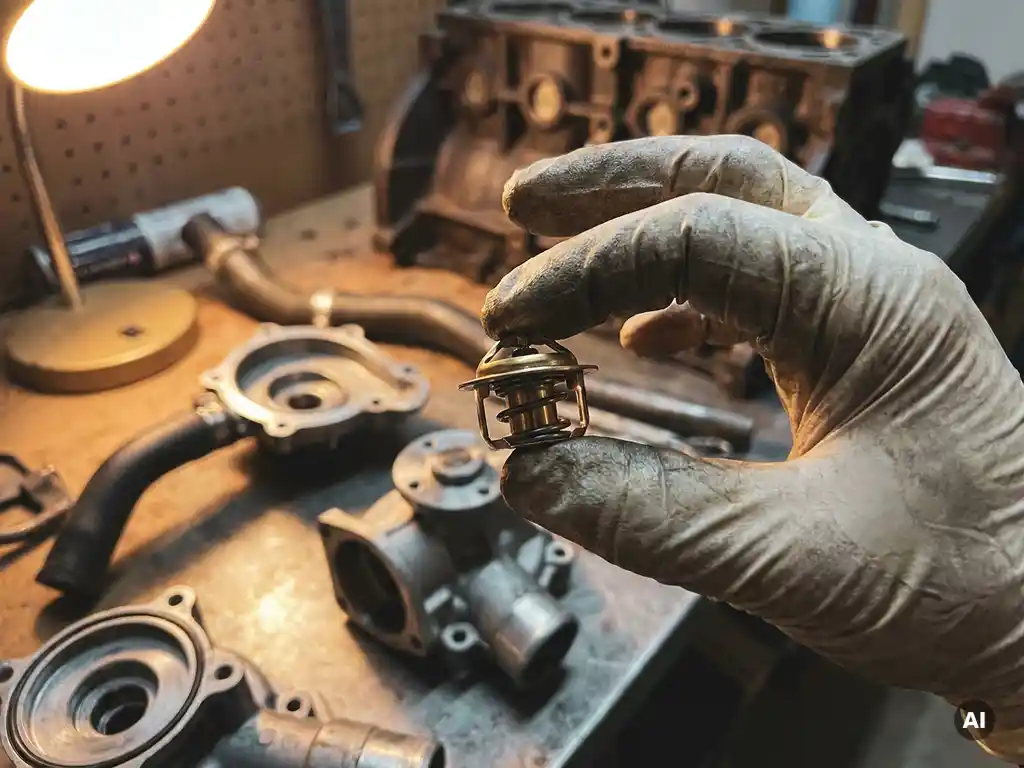
Thermostat insert manufacturing is critical for thermal management because the insert is the active heart of any thermostat assembly. It responds to temperature changes, opens and closes coolant flow paths, and keeps engines or systems running within their optimal temperature range. When manufacturing quality falls short, the entire thermal management system suffers. The sections below walk through the most important questions engineers and OEMs ask about thermostat insert production.
What does a thermostat insert actually do inside an engine?
A thermostat insert is the functional core of the thermostat unit. It contains a wax element that expands when heated and contracts when cooled, physically moving a valve that controls how much coolant flows through the engine. Without this precise mechanical response, an engine cannot maintain the narrow temperature window it needs to run efficiently and cleanly.
When the engine is cold, the insert keeps the valve closed, allowing coolant to circulate only within the engine block so it warms up quickly. Once the coolant reaches the target temperature, typically somewhere between 80 and 105 degrees Celsius depending on the application, the wax inside the insert expands and pushes the valve open. This lets cooler fluid from the radiator enter the circuit and prevents overheating.
The insert must respond consistently, cycle after cycle, across thousands of hours of operation. Even a small delay or inconsistency in opening temperature can push the engine outside its ideal range, leading to increased wear, higher fuel consumption, and elevated emissions. The insert is not a passive component. It is an active, precision-driven part that the entire cooling circuit depends on.
What materials and tolerances define a high-precision thermostat insert?
High-precision thermostat inserts rely on carefully selected thermostat materials and extremely tight manufacturing tolerances. The wax compound inside the element is the most critical material choice, as its expansion characteristics must be predictable across the full operating temperature range. The housing, frame, and valve components are typically made from brass, stainless steel, or engineering-grade polymers, each chosen for corrosion resistance and dimensional stability.
The thermostat frame that holds the insert in position must be manufactured to tolerances measured in hundredths of a millimeter. Any deviation in the frame geometry affects how the valve seats, how the wax element is compressed, and ultimately how accurately the insert responds to temperature changes. Seal materials must also resist coolant chemistry, pressure cycling, and thermal expansion without degrading over time.
What separates a precision insert from a commodity one is not just the materials themselves but the consistency of those materials across every production batch. Wax formulations must be homogeneous, frame dimensions must be repeatable, and assembly processes must introduce no variation that the design did not account for. This level of control requires rigorous process engineering, not just good raw material selection.
How does manufacturing quality affect fuel efficiency and emissions?
Manufacturing quality directly affects fuel efficiency and emissions because a poorly made thermostat insert causes the engine to run at the wrong temperature. If the insert opens too early, the engine stays cooler than intended, which increases fuel consumption and produces more unburned hydrocarbons. If it opens too late or sticks closed, the engine overheats, accelerating wear and increasing nitrogen oxide emissions.
Modern combustion engines and hybrid powertrains are calibrated to operate within a very specific thermal window. Engine management systems, fuel injection timing, and exhaust aftertreatment all assume the coolant temperature is being held within design parameters. When the thermostat insert drifts from its specified opening temperature, even by a few degrees, the entire calibration is disrupted.
For OEMs working to meet increasingly strict emissions standards, this is not a marginal concern. A thermostat insert that performs inconsistently across its production run introduces variability that undermines fleet-level emissions compliance. Consistent thermostat insert manufacturing is therefore not just a quality issue. It is a regulatory and commercial one.
What are the most common thermostat insert manufacturing defects?
The most common thermostat insert manufacturing defects fall into three categories: wax element inconsistencies, dimensional errors in the frame or housing, and seal failures. Each of these can cause the insert to open at the wrong temperature, respond too slowly, or fail to seal the valve properly, all of which compromise thermal management performance.
- Wax element inconsistencies: Non-uniform wax composition leads to unpredictable expansion behavior. This is often caused by poor mixing, contamination, or batch variation in raw materials.
- Frame and housing dimensional errors: If the thermostat frame is out of tolerance, the valve may not seat correctly, allowing coolant bypass even when the insert should be fully closed.
- Seal degradation: Seals that are not compatible with the coolant chemistry or that were assembled under incorrect compression will leak over time, reducing system pressure and cooling effectiveness.
- Incorrect opening temperature: This can result from any of the above or from errors in the wax formulation itself, causing the insert to open earlier or later than its rated temperature.
- Sticking or sluggish response: Caused by friction in the guide sleeve or contamination during assembly, this delays the insert’s response and creates thermal lag in the cooling circuit.
Catching these defects requires end-of-line testing that validates the actual opening temperature and stroke of every insert, not just dimensional checks. Statistical process control throughout production is what separates suppliers who consistently deliver within specification from those who rely on inspection to find problems after they occur.
How is thermostat insert manufacturing different for automotive versus industrial applications?
Thermostat insert manufacturing for automotive applications prioritizes high-volume consistency, compact packaging, and compliance with tightly defined opening temperatures set by vehicle OEMs. Industrial applications, by contrast, often require inserts that operate across wider temperature ranges, withstand more aggressive fluid chemistries, and survive in environments where maintenance cycles are longer and failure consequences are more severe.
In automotive production, the emphasis is on repeatability at scale. A single vehicle platform may require millions of identical inserts over its production life, and any drift in opening temperature across that volume creates warranty exposure. The thermostat materials must also be compatible with modern coolant formulations, which have become more chemically complex as OEMs extend service intervals.
Industrial thermostat inserts, such as those used in hydraulic oil temperature management, marine cooling systems, or large-scale HVAC applications, are often produced in smaller quantities but must handle higher pressures, more extreme temperatures, and fluids that automotive-grade materials were never designed to contact. The design validation process is different, the testing protocols are different, and the definition of acceptable performance is application-specific rather than governed by a universal OEM standard.
Understanding this distinction matters when selecting a supplier. A manufacturer with deep automotive expertise may not have the application engineering capability needed for a demanding industrial use case, and vice versa. The best suppliers have genuine experience across both domains and can adapt their process knowledge to the specific demands of each application.
What should OEMs look for when selecting a thermostat insert supplier?
OEMs selecting a thermostat insert supplier should prioritize proven manufacturing consistency, application-specific engineering capability, and transparent quality systems. A supplier’s ability to hold tight tolerances across high production volumes, validate performance at the insert level rather than just the assembly level, and respond quickly when specifications change are the factors that determine long-term supply reliability.
Key criteria to evaluate include:
- End-of-line functional testing: Every insert should be tested for actual opening temperature and stroke, not just dimensional compliance.
- Wax element development capability: Suppliers who formulate or deeply understand their wax compounds can optimize performance for specific applications rather than offering only standard grades.
- Material traceability: Full traceability from raw thermostat materials to finished insert is essential for warranty investigation and continuous improvement.
- Application engineering support: A supplier who can help define the specification, not just manufacture to it, adds significantly more value across the product development cycle.
- Flexibility and responsiveness: Larger suppliers often struggle to prioritize mid-volume customers. A supplier with a leaner structure can often respond faster to engineering changes and urgent delivery needs.
It is also worth asking how a supplier handles non-conformances. The best indicator of a mature quality system is not the absence of problems but how systematically and transparently a supplier addresses them when they do occur.
How BTT Solutions approaches thermostat insert manufacturing
We have built our entire operation around the precision that thermal management demands. At BTT Solutions, thermostat insert manufacturing is not a commodity process. It is an engineering discipline that we apply across automotive, industrial, and building technology applications. Here is what that looks like in practice:
- We develop and validate wax elements for specific opening temperatures and application environments, rather than relying on off-the-shelf compounds.
- Every insert we produce goes through functional end-of-line testing, verifying actual opening temperature and stroke rather than dimensional checks alone.
- Our thermostat frames and housings are manufactured to tolerances that support consistent valve seating across the full production volume.
- We support OEM and industrial customers through the specification and design phase, not just the supply phase, drawing on decades of thermostat engineering experience carried forward from our origins in the MAHLE thermostat division.
- With eight global locations and a lean organizational structure, we can move quickly when customers need engineering changes, accelerated timelines, or application-specific adaptations.
Whether you are developing a new powertrain platform, upgrading an industrial cooling system, or sourcing inserts for a building technology application, we would welcome the conversation. Get in touch with our team to discuss your specific requirements and find out how we can support your thermal management goals.


