
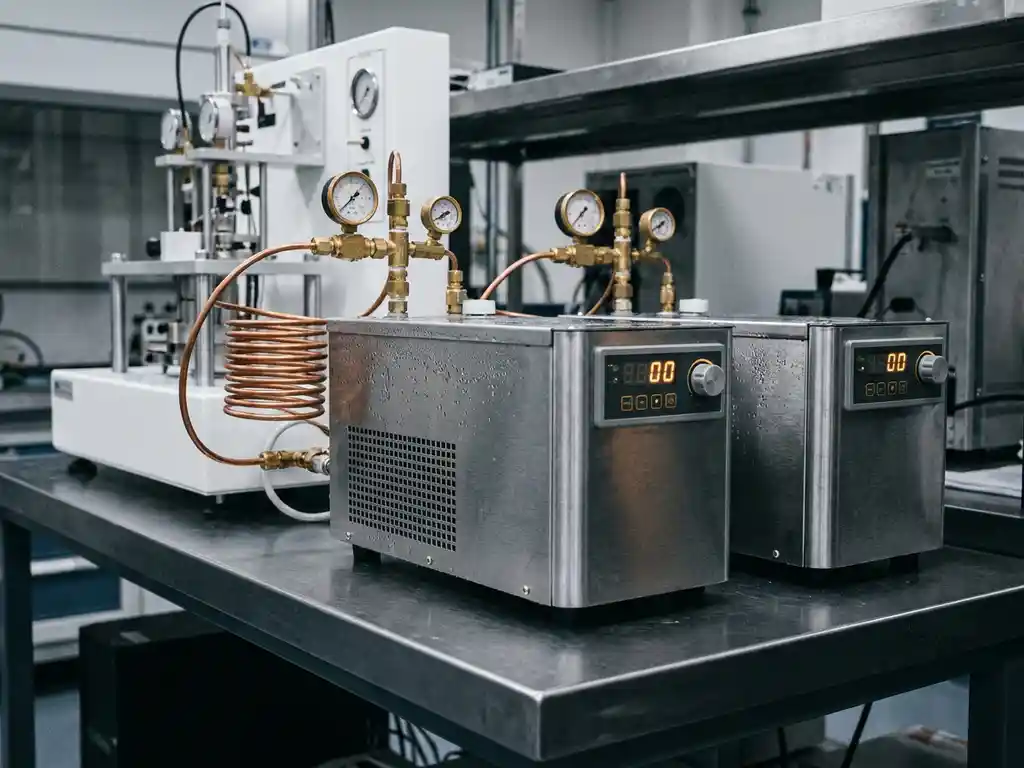
Yes, thermostat test results can vary between laboratories, and these differences are more common than many manufacturers expect. Variations in fluid bath temperature uniformity, equipment calibration, and the interpretation of testing standards all contribute to measurable discrepancies in results. Understanding why these differences occur is the first step toward ensuring your components perform reliably across the supply chain.
What factors cause thermostat test results to differ between labs?
Thermostat test results differ between laboratories primarily because of differences in test fluid properties, bath temperature uniformity, measurement timing, and how individual labs interpret the applicable testing standards. Even small deviations in any one of these variables can shift a measured opening temperature by one or more degrees, which is enough to change a pass or fail outcome.
The most commonly cited sources of variability include:
- Test fluid composition: Water, oil, and glycol-water mixtures transfer heat at different rates. If one lab uses a different fluid than another, the thermostat element experiences a different thermal environment even when the nominal bath temperature is identical.
- Heating rate: How quickly the bath temperature rises directly affects when the wax element begins to expand. A faster ramp rate can cause the thermostat to appear to open at a slightly higher temperature than a slower, more controlled rise.
- Sensor placement: Where the temperature probe sits relative to the thermostat element in the bath influences the recorded opening temperature. Even a few centimetres of distance can introduce a measurable offset.
- Operator technique: Subjective judgments about when “opening” begins, or how stroke is measured, add human variability on top of the equipment variability.
Together, these factors mean that two technically competent laboratories following broadly similar procedures can produce results that diverge by two to three degrees Celsius without either lab making an error.
How does test equipment calibration affect thermostat measurements?
Calibration directly determines the accuracy of every thermostat measurement a laboratory produces. If a temperature probe or bath controller is even slightly out of calibration, every result recorded with that equipment carries a systematic offset, meaning the lab may consistently read high or low relative to the true value.
For thermostat components, where opening temperature tolerances are often defined within a range of just two to four degrees Celsius, a calibration drift of one degree is significant. A probe that reads one degree low could cause a component sitting right at the lower tolerance limit to appear compliant when it is not, or vice versa.
Regular calibration against traceable reference standards is essential, but calibration intervals and reference sources vary between facilities. A lab that calibrates annually using a national metrology standard will produce more consistent results than one using in-house reference equipment with infrequent checks. When comparing thermostat test results across laboratories, always ask for the calibration certificates and traceability chain for the equipment used.
What testing standards are used for thermostat components?
The most widely referenced standards for thermostat component testing in the automotive and industrial sectors include ISO and DIN specifications that define how opening temperature, stroke, and flow characteristics should be measured. Automotive original equipment manufacturers also issue their own internal test specifications, which frequently add requirements on top of the base standards.
Common frameworks include:
- ISO standards: Several ISO documents govern the measurement of thermostatic elements and their performance in fluid circuits, covering parameters such as opening temperature, full-open temperature, and minimum stroke.
- OEM-specific test sheets: Major vehicle manufacturers publish their own test procedures, which may specify particular fluid types, heating rates, and acceptance criteria that differ from the generic ISO baseline.
- DIN standards: Widely used in European industrial and heating applications, DIN specifications address thermostat performance in radiator and heating circuit contexts.
The challenge is that not all of these standards define every test parameter with equal precision. Where a standard leaves a parameter open to interpretation, such as fluid type or heating rate, individual laboratories fill the gap with their own internal procedures. This is one of the primary reasons that thermostat quality testing outcomes can differ even when both labs claim to follow the same standard.
Can the same thermostat pass one lab’s test and fail another’s?
Yes, the same thermostat can pass in one laboratory and fail in another, and this outcome is not necessarily a sign of fraud or incompetence at either facility. It is a predictable consequence of the combined variability described above, and it is most likely to occur when a component’s performance sits close to a specification limit.
A thermostat with a nominal opening temperature of 87 degrees Celsius and a tolerance of plus or minus two degrees is essentially expected to open somewhere between 85 and 89 degrees. If Lab A measures it at 85.5 degrees and Lab B measures it at 88.8 degrees, both readings are plausible given real-world measurement uncertainty, yet the component could be deemed a pass at one and a borderline fail at the other depending on how each lab defines the acceptance window.
This situation is particularly important for manufacturers who qualify components at one facility and then face incoming inspection at a customer’s laboratory. Establishing a shared test protocol before qualification testing begins is the most effective way to prevent conflicting results from becoming a commercial dispute.
How can manufacturers ensure consistent thermostat test results across labs?
Manufacturers can achieve more consistent thermostat test results across laboratories by aligning on a detailed, jointly agreed test protocol before any qualification work begins. The protocol should define not just which standard applies, but every variable the standard leaves open, including fluid type and concentration, heating rate, probe position, and the criteria for determining the opening point.
Practical steps that reduce inter-laboratory variability include:
- Run a round-robin test: Send identical samples to multiple laboratories and compare results before committing to a single qualification source. This surfaces systematic differences between facilities early.
- Request calibration documentation: Ask each lab to provide current calibration certificates with traceability to national or international standards for all measurement equipment used in the test.
- Agree on a reference fluid: Specify the exact fluid composition, including glycol percentage if applicable, to eliminate one of the largest sources of thermal variability.
- Define the heating rate: A controlled, documented ramp rate removes one of the most common sources of discrepancy between facilities.
- Establish measurement uncertainty budgets: Work with your testing partners to document the combined uncertainty of their measurement process, so that acceptance decisions account for the real precision limits of the equipment.
Consistent thermomanagement component testing ultimately comes down to treating the test protocol as a shared contract between the manufacturer and every laboratory involved in the product lifecycle.
How BTT Solutions supports reliable thermostat testing and component selection
At BTT Solutions, we work directly with our customers to reduce the uncertainty that comes with laboratory testing variability. Our team brings deep expertise in thermostat components, including wax elements, thermostat inserts, and engineered housings, and we advise customers on how to specify and qualify these components in a way that holds up across different test environments.
Here is what we offer to support your testing and qualification process:
- Component selection guidance: We help you identify the right thermostat element for your application, including tolerance ranges that give you practical margin against inter-laboratory variability.
- Test protocol alignment: We work with you and your testing partners to align on the specific parameters that matter most for your application, reducing the risk of conflicting results at different stages of qualification.
- Precision manufacturing: Our components are designed and manufactured to tight tolerances, which means the performance window is predictable and consistent, making it easier to validate across laboratories.
- Responsive technical support: As a focused, mid-sized organization, we can respond quickly when testing questions arise, without the delays that come with larger, more layered supplier structures.
If you are dealing with inconsistent thermostat test results or preparing for a qualification program, we would be glad to help. Get in touch with our team to discuss your specific requirements.
Related Articles
- What role do thermostat materials play in floor heating systems?
- What is the relationship between compression ratio and engine efficiency?
- Should you trust manufacturer engine efficiency ratings in real-world conditions?
- How do emission regulations differ between passenger and commercial vehicles?
- What is the relationship between engine temperature and combustion efficiency?


