
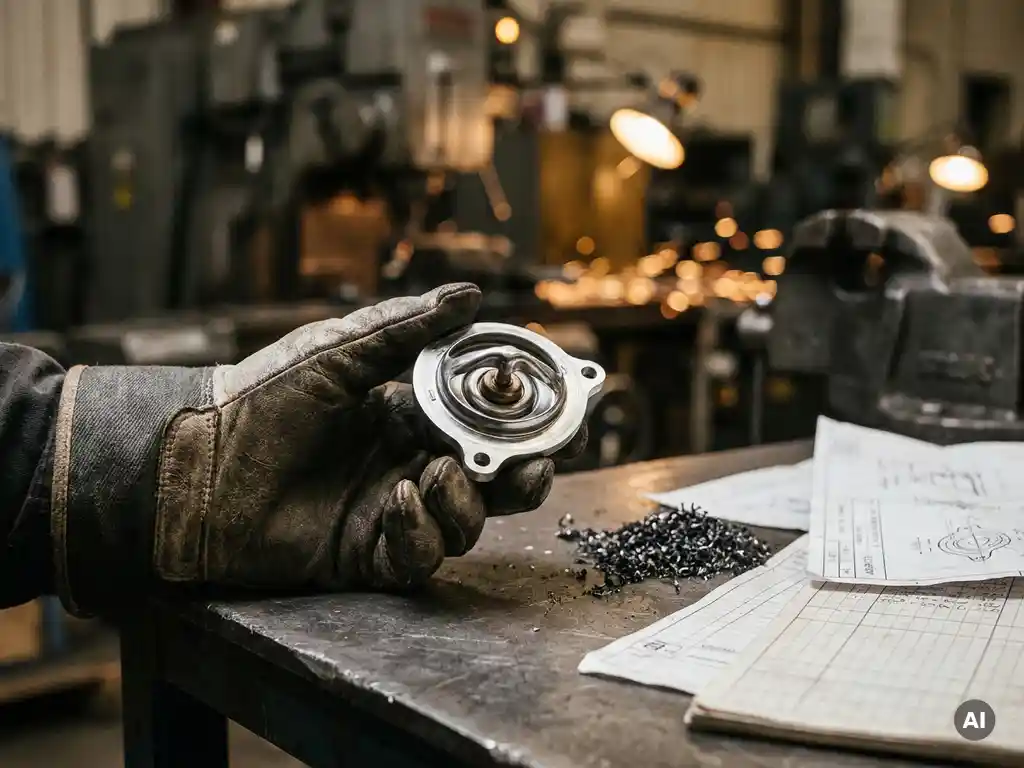
Yes, thermostat frame precision should generally take priority over material cost, especially when the thermostat operates in environments where temperature swings, pressure changes, or vibration are part of daily life. A frame that holds tight tolerances keeps the insert seated correctly, the wax element responding predictably, and the valve sealing cleanly. For engineers and procurement teams evaluating thermostat insert manufacturing, the cost conversation rarely ends at the bill of materials.
The sections below work through the specific questions that tend to surface when this trade-off comes up in real design and sourcing decisions.
What does thermostat frame precision actually affect in real applications?
Thermostat frame precision directly controls how well the internal components, the wax element, valve, and spring, align and move during temperature cycling. When the frame holds tight dimensional tolerances, the insert sits in the correct position, the valve closes fully at the right temperature, and the bypass opens without restriction. Loose tolerances introduce misalignment that compounds over time.
In practical terms, a frame that is even slightly out of spec can cause the valve to seat unevenly. That means coolant or oil leaks past the closed position, reducing the efficiency of the thermal circuit. In an engine cooling system, this translates to longer warm-up times, higher fuel consumption, and elevated emissions. In an industrial process loop, it means the controlled fluid never quite reaches the target temperature range.
Frame geometry also determines how the thermostat behaves under vibration. A loosely toleranced frame allows micro-movement of the insert, which accelerates wear on the sealing surfaces and the wax element housing. What starts as a dimensional shortcut becomes a reliability problem within a relatively short service interval.
How does frame tolerance influence thermostat performance and lifespan?
Frame tolerance sets the boundary conditions for every performance parameter the thermostat is designed to meet. Tighter tolerances mean the opening temperature, stroke length, and closing force all stay within the specified range across the product’s service life. Wider tolerances introduce variability that grows with thermal cycling, mechanical stress, and exposure to fluid contaminants.
The relationship between tolerance and lifespan is cumulative. Each thermal cycle expands and contracts the frame material. If the frame is not dimensionally stable, those cycles gradually shift the position of the insert relative to the valve seat. Over thousands of cycles, which is a routine expectation in automotive and industrial applications, even small shifts produce measurable drift in opening temperature and reduced valve travel.
Lifespan is also affected by how well the frame distributes load. A precisely machined or formed frame transfers forces evenly across the insert and spring assembly. A frame with inconsistent wall thickness or out-of-round geometry concentrates stress at specific points, which is where fatigue cracks and deformation tend to originate. Choosing high-precision thermostat components from the outset is almost always more economical than dealing with premature field failures.
What are the real cost drivers behind high-precision thermostat frames?
The cost of a high-precision thermostat frame is driven primarily by three factors: the thermostat materials selected, the manufacturing process required to hold the specified tolerances, and the quality verification steps needed to confirm conformance. Each of these adds cost, but each also adds value that shows up downstream.
- Material selection: Higher-grade alloys and engineered polymers with tighter dimensional stability cost more per kilogram, but they maintain their geometry across a wider temperature and pressure range. Cheaper materials may meet spec at room temperature but drift under operating conditions.
- Machining and forming precision: Tighter tolerances require slower feed rates, more frequent tool changes, and sometimes additional finishing operations. These process steps add time and cost but are what make the tolerance achievable and repeatable.
- Inspection and validation: Precision frames require more rigorous dimensional inspection, often including coordinate measuring machine checks and functional testing under simulated operating conditions. This overhead is real, but it is the mechanism that keeps non-conforming parts out of the supply chain.
It is worth noting that the cost premium for precision is usually a fraction of the total system cost and an even smaller fraction of the cost of a warranty claim or unplanned downtime event.
When does lower material cost become a false economy in thermostat design?
Lower material cost becomes a false economy when the savings at the component level are smaller than the costs introduced at the system level. This happens most clearly in three situations: when the application involves high thermal cycling frequency, when the thermostat is difficult or expensive to replace, and when downstream failures carry regulatory or safety consequences.
A thermostat frame specified with a cheaper material to reduce unit cost by a few dollars can introduce drift in opening temperature that causes an engine management system to log fault codes, triggers a warranty return, or, in a worst case, leads to thermal damage in the system being controlled. The cost of that outcome almost always exceeds the savings on the original component.
In building systems and radiant heating applications, a similar dynamic applies. A frame that deforms slightly under sustained pressure causes the thermostat insert to respond inconsistently, which means the heating zone never quite reaches setpoint. The energy waste that results over a heating season is a real operational cost that the initial material saving does not offset. Understanding the true cost of thermostat insert manufacturing decisions requires looking beyond the purchase order.
Which applications genuinely require high-precision frames versus standard tolerances?
High-precision thermostat frames are genuinely necessary in applications where temperature control accuracy is critical to system performance, safety, or regulatory compliance. Standard tolerances are appropriate where operating conditions are mild, replacement is easy, and performance variation has no meaningful downstream consequence.
Applications that require tight tolerances
- Automotive engine cooling: Modern engines operate within narrow thermal windows to meet emissions standards. A thermostat that opens a few degrees early or late affects combustion efficiency and tailpipe output.
- Transmission and differential oil thermostats: These control viscosity in precision-clearance components. Temperature drift translates directly to wear rate.
- Industrial process cooling: Where product quality depends on fluid temperature, such as in chemical processing or precision machining coolant circuits, thermostat accuracy is part of the process specification.
- Marine and off-highway equipment: These environments combine high vibration, wide ambient temperature ranges, and long service intervals, all of which amplify the consequences of loose tolerances.
Applications where standard tolerances are sufficient
- Domestic hot water systems with wide acceptable temperature bands
- Low-pressure radiator circuits where flow variation has minimal impact
- Non-critical industrial fluid loops with frequent maintenance schedules
The line between these categories is not always obvious. If you are working with an experienced thermomanagement partner, mapping your operating conditions against tolerance requirements early in the design process prevents costly corrections later.
How should engineers and buyers evaluate the precision-cost trade-off?
Engineers and buyers should evaluate the precision-cost trade-off by anchoring the analysis to total cost of ownership rather than unit price. The right starting point is defining what a thermostat failure or performance drift actually costs in your specific application, in downtime, warranty exposure, energy waste, or regulatory risk, and then working backward to the frame specification that keeps that risk within acceptable limits.
A practical evaluation process looks like this:
- Define the operating envelope: Temperature range, pressure, vibration, fluid type, and expected service interval. These parameters determine what the frame material and tolerance need to handle.
- Quantify the cost of failure: What happens if the thermostat opens at the wrong temperature, fails to seal, or degrades ahead of schedule? Assign a realistic cost to that scenario.
- Compare options on total cost: Unit price plus installation cost plus expected service life plus failure probability weighted by failure cost. This gives a more honest comparison than price per piece.
- Validate with supplier data: Ask for dimensional conformance data, material certifications, and test results under simulated operating conditions. A supplier who cannot provide these is implicitly asking you to absorb the validation risk.
Buyers who engage their thermostat supplier early in the design phase, rather than at the point of sourcing a finished specification, typically end up with better outcomes. The thermostat materials and frame geometry can often be optimized together in ways that improve performance without proportionally increasing cost.
How BTT Solutions approaches the precision-cost balance in thermostat frames
We work with engineers and procurement teams across automotive, industrial, and building technology sectors to get this balance right from the start. Rather than offering a catalog of standard parts and leaving the specification decision to the buyer, we engage directly with the application requirements to determine where precision adds genuine value and where it does not.
Here is what that looks like in practice:
- Application-specific tolerance analysis: We map your operating conditions against frame geometry requirements so the specification reflects real-world demands, not worst-case assumptions.
- Material selection support: We help identify the right thermostat materials for your thermal and mechanical environment, balancing performance with cost in a way that holds up over the product’s service life.
- End-to-end manufacturing control: Our thermostat insert manufacturing process covers the full production chain, which means dimensional conformance is verified at multiple stages rather than only at final inspection.
- Flexible production for mid-size volumes: As a focused, independent company, we can respond quickly to design iterations and volume changes without the lead times that larger suppliers typically require.
If you are working through a thermostat frame specification and want a direct conversation about where the precision-cost trade-off sits for your application, get in touch with our team, we are straightforward about what makes sense and what does not.
Related Articles
- What are the benefits of using a wax pellet thermostat?
- How do you test whether a wax pellet thermostat is working correctly?
- How do miniaturized thermostat components differ from standard ones?
- What thermal management components are required for oil temperature control?
- Why is thermal management important in automotive design?


